Bangladeshi artist Soma Surovi Jannat’s exhibition at the Ashmoleon helps viewers learn to see the invisible realities of climate change.
Article by Carmen Vintro
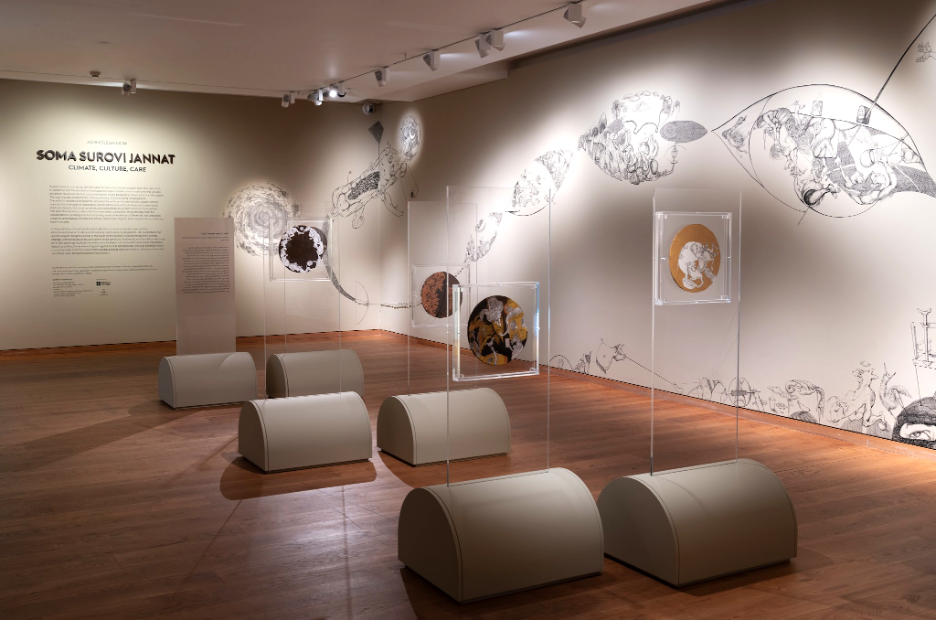
In a talk this May at the University of Oxford, eco-philosopher David Abram summed up humanity’s greatest barrier to overcoming climate change: “Out of sight, out of mind.” We cannot see the pollution we pump into the atmosphere, the atrocities buried at the other end of complex global supply chains, the long-term environmental impacts that play out over centuries, or the truth of our bodily interconnectedness with nature. For Abram, who believes that seeing with our embodied – or “animal” – eyes is essential to human understanding of the world, these invisibilities pose a profound problem.
I left Abram’s lecture with a burning question: How can we begin to see the invisible realities of our climate? It wasn’t until a few days later when I walked through Soma Surovi Jannat’s exhibition in the Ashmolean in Oxford, UK that I could begin to respond.
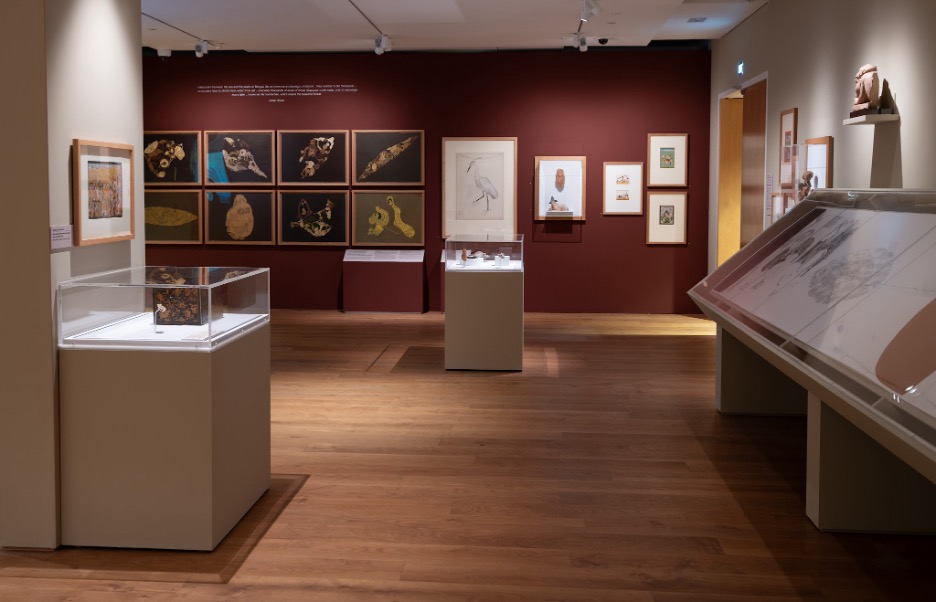
Surovi (the artist’s preferred name) met me at the entrance of her exhibition, titled Climate Culture Care, which marks the first-ever solo exhibition of a Bangladesh-based artist in a museum in the UK, and is the culmination of her residency at the museum. Surovi told me that the works on display arose out of her research on the Sundarbans in Bengal and India, the largest mangrove forest in the world, which has inspired other notable artists like writer Amitav Ghosh. His description of the forest in the 2004 novel The Hungry Tide can be read on the gallery walls:
“Interposed between the sea and the plains of Bengal, lies an immense archipelago of islands … no borders here to divide fresh water from salt … everyday thousands of acres of forest disappear underwater, only to reemerge hours later … known as the Sundarban, which means the beautiful forest.”
Climate change is not out of sight in the Sundarbans. Floods, monsoons, and cyclones are becoming more frequent and extreme. The sea is rising at twice the global rate, causing land mass to shrink and water to get saltier. As the climate heats up, life in the Sundarbans is becoming increasingly untenable for the people, tigers, trees, and other life forms that rely on the forest to survive. Surovi told me that the Sundarbans ecosystem was first destabilized when colonial British powers “interrupted nature” in the eighteenth century by exploiting the forest and the people. Inspired by her study of the Ashmolean’s colonial period collection in tandem with her research trips into the forest, Climate Culture Care is a reckoning with the intertwined histories of colonialism and climate change in the region.
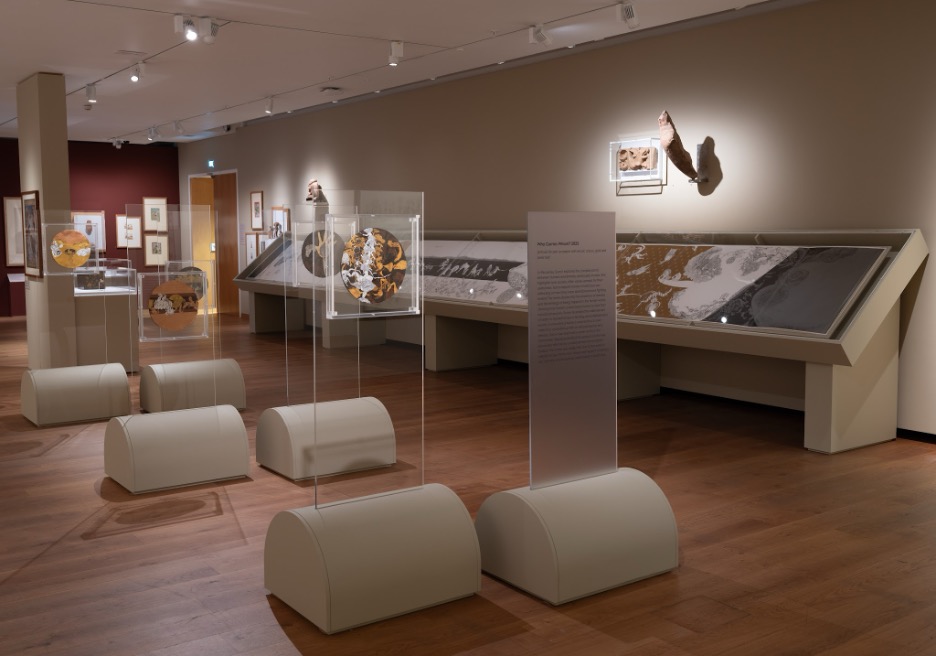
Figural drawings of interlinking women, tigers, elephants, trees, birds, ants, bananas, cups, chairs, microphones, and many other creatures and miscellaneous objects populate the forty-or-so pieces on display in the gallery, which include a 30-foot-long scroll, a series of paper discs displayed in glass panels, and a floor-to-ceiling work drawn directly onto the galley wall. Across these diverse pieces, Surovi’s primary tool is a black pen. At first, her uniform black lines appear to reify and reinforce the boundaries that Ghosh’s Sundarbans render fluid. But looking closer, just as land becomes sea and fresh water becomes salt in the Sundarbans, in Surovi’s drawings, hands and legs morph into tree trunks and branches, tiger tails grow into fruit stems, snails become human heads, and bananas transform into airplanes.
Nowhere is this morphing more apparent than in She Carries the River in Her Skin, the piece drawn directly on the gallery wall that represents the increasingly strained relationships between the forest, Bengal tigers, and women and children. During colonial rule one thousand two hundred tigers were killed and the forest was destroyed, Surovi explained when I asked her about the interconnected bodies represented in the piece. Tigers started to attack people more frequently as their habitat shrunk and their food supply dwindled. Women whose husbands were killed by tigers were outcast and to some extent held responsible for their husbands’ deaths. “In some representations of animals, only the people are highlighted,” Surovi said. In such works, “there are humans, and then all nature is moving around them. But it’s not like that. We all move together … I feel that it’sour duty, or responsibility, as artists to give a visual representation so that people can find that connection which is invisible.”
Surovi’s work also invites a particular way of looking that helps viewers notice hidden connections that are not always obvious to the untrained eye. “I believe that whenever people sit quietly in nature and look around, they’ll find that every minute thing is important, and everything is connected,” Surovi told me when we stopped in front of She Carries the River in Her Skin to examine a line of ants she had drawn scurrying across the wall and climbing up onto the chain of five boats. “I went to draw in a village and I just followed an ant walking, and followed his line,” she said. “I see that where he goes, another ant follows the same line, but in my eyes, I couldn’t see any lines or anything. But if he moves like this,” she explained, motioning the curved shape of the ant’s deviation with her hand, “the other ant will move exactly on the same path.”
Two points are notable about the way Surovi looks at the world. First, by following an ant, she humbly surrenders her attention to a non-human guide. This act recognizes the ant as worthy of devoting time and care to – a recognition which is also apparent in the way she refers to the ant using subject pronouns, or what Robin Wall Kimmerer calls a “grammar of animacy.” By following the ant’s path, Surovi is able to see through the eyes of the ant, and lines that were previously invisible become indirectly discernable.
Surovi’s work provokes a parallel form of attentional surrender in the viewer. Looking at any one figure in Surovi’s drawings necessitates looking at the next, with which the first is inevitably enmeshed. The viewer is led onto one figure after another, until, having followed a successive chain of interlinking birds, people, horses, fish, elephants, chairs, clouds, and so forth, they find themself standing in front of a completely different part of the wall than where they started. In this way, Surovi invites her viewers to become enthralled by the creatures in the scene and let them, like the ant, guide their attention.
Second, Surovi moves her body to follow the ant’s path. To observe and understand the ant, Surovi created a physical, embodied connection with the ant by visiting him in his ecological context and following his path with her body. This embodied viewership is critical to how Surovi conceptualises her art and her viewers’ experience. “We interact with the artwork with our eyes,” she said, “but also with our physical body, how it moves, and that actually stores the memory of the work. Whenever we interact physically with something, it will stay in our body as well.”
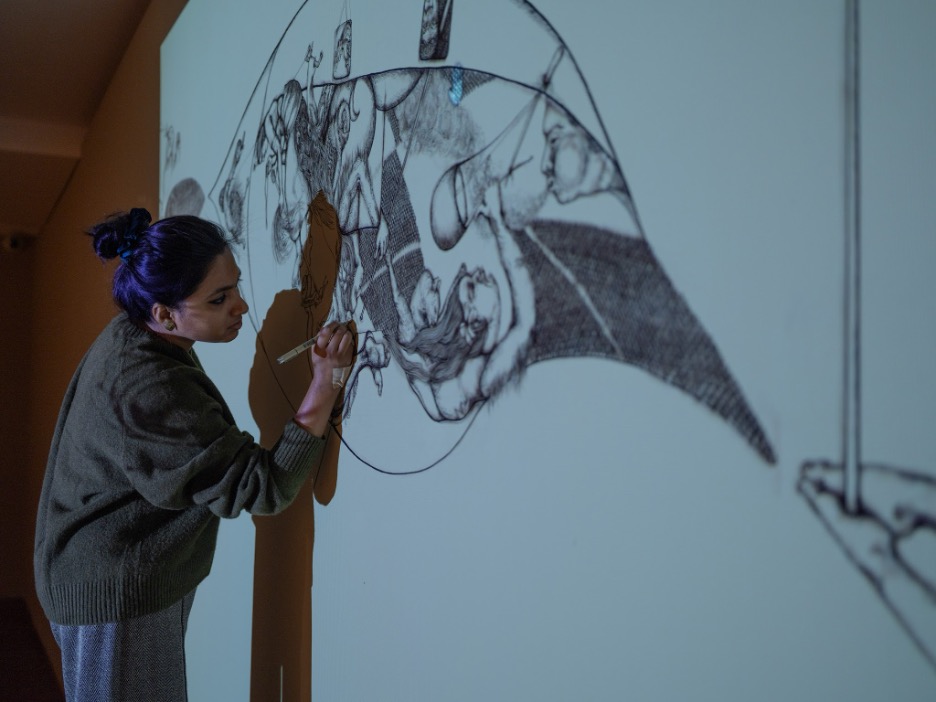
Walking through Climate Culture Care requires embodied engagement. Encouraged to share in the physical context of the creatures depicted in the drawings, viewers must crouch down on the floor to find crawling ants, crane their necks and push up on their tippy-toes to see the clouds and boats floating near the ceiling, walk along the 30-foot scroll, and navigate through the array of free-standing staggered glass panels that have work displayed on both sides. “When I draw something, like this wall piece,” Surovi gestured, “I lie down sometimes, I go up on the ladder. I go very close to the wall, and sometimes I step back. So that kind of experience makes the work possible, and I really want people to have a similar experience while seeing the work. So, you see that every work – how it is displayed – will move one’s body to interact.” The fact that She Carries the River in Her Skin will be erased at the end of the exhibition this coming November further draws attention to the embodied, and therefore ephemeral, reality of the work itself.
By dynamically moving through the gallery and around the artworks, Surovi hopes that viewers will “go close” and “step back” to encounter the pieces from multiple perspectives. Such a method perhaps goes some way to addressing the difficulty of engaging with the complex ecological systems that are the central subject of Surovi’s work. In Timothy Morton’s view, these systems – which he terms “hyperobjects” for the way they are distributed across space and time – are beyond humanity’s capacity for comprehension. So too, the myriad, interlinking figures that mesh together in Surovi’s scenes can be overwhelming. But by encouraging the viewer to let go of their attention and witness from their body, Surovi suggests a way forward.
In his book Becoming Animal, David Abram argues that experiencing the world through our bodily, animal senses, rather than just through our disembodied mind, is imperative to rekindling our connection with the Earth. The incomprehensibly large, complex ecological systems that structure the Earth often obscure the consequences of our actions within it, threatening to disconnect us and leave us blind to climate change. A walk through Climate Culture Care might begin to help us see.
Soma Surovi Jannat’s Climate Culture Care is on view at the Ashmolean Museum until 1 November 2026.
Discover more from Modron Magazine
Subscribe to get the latest posts sent to your email.


