Interview by Zoë Brigley
Welcome back to our series on writing the “More Than Human”. We offer a set of interviews with poets and writers on how they approach writing about the environment. The more-than-human is a phrase that seeks to side-step traditional nature-culture dualisms and draw attention to the unity of all life as a kind of shared commonwealth existing on a fragile planet. It also reminds us humans that there is more to life, that there is more world, than the human. It relocates us in relation to the mystery.
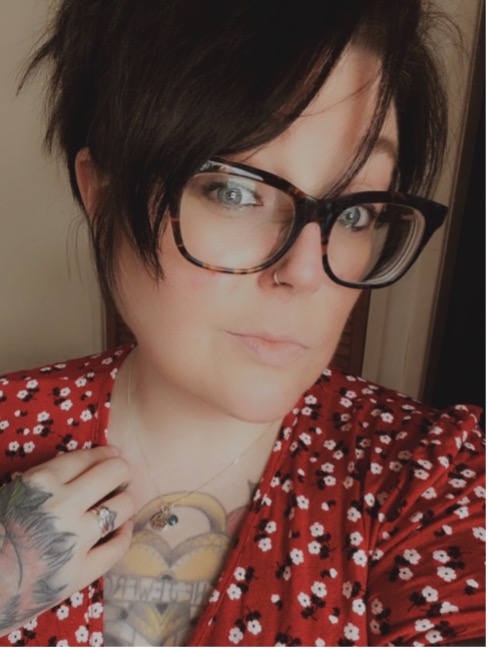
This week we meet Rochelle Hanslow a Scottish, neurodivergent, chronically-ill poet & writer published in (Un)Common Magazine, Propel Magazine, and Black Cat Poetry. She studies ornithology, zoology, and botany, developing her engagement with the natural world that informs her creative work. Her debut ‘Wolf in the Nursery’ is forthcoming in 2027 with Black Cat.
What’s Inside a Caterpillar?
Zoë Brigley: So to begin at the beginning, why a caterpillar?
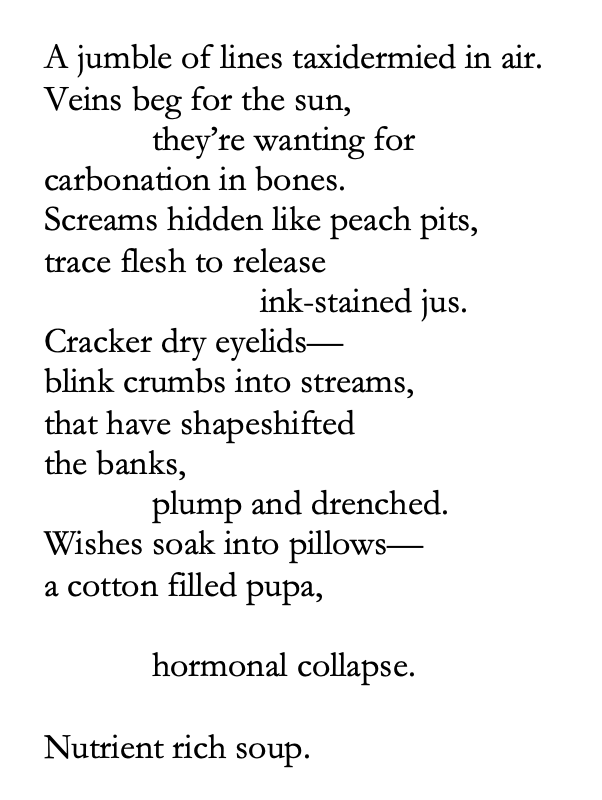
Rochelle Hanslow: Without sounding cliché, the caterpillar emerged without any kind of intention around it. It wasn’t until around half-way through the poem that I’d realised themes of transformation were beginning to emerge and how central the caterpillar imagery had become.
Zoë: You have some wonderful unique and wild imagery here. Could it be the poet’s job to renew the kind of joy and awe that we may have felt about nature as children?
Rochelle: I do think poetry has the capacity to renew our sense of wonder, however as neurodivergent person, it also allows me to show my experience of the world. I think as children we are naturally curious and we tend to allow the strange and miraculous to be there without question, whereas adults often overlook it. The process of metamorphosis is prime example—when you really see what happens inside a chrysalis, it’s extraordinary, even a little unsettling. It’s also something so common but can recapture some of our natural curiosity. I think poetry allows us to slow down, pay attention, and see things with different eyes.
Zoë: The form itself feels like a caterpillar type lozenge. How does form emerge for you?
Rochelle: In full transparency, form is something I’m still trying to master in poetry. I’ve experimented with a range of approaches over the years, from more traditional forms such as the sestina, sonnet, and ghazal to prose poetry. Most of my poems begin as free-form drafts, and I prefer to begin with a pen and a notebook, so the shape often comes later in the process. With this poem, I became aware that the narrowing and widening of the lines echoed the caterpillar and chrysalis imagery, and I leaned into that. I tend to focus first on finding strong opening and closing lines, then work on the structure and line breaks. Lineation is something I’m still constantly learning from and experimenting with.
Zoë: Is there anything else you want to tell us about this poem?
Rochelle: I started writing this poem on a day when I was having difficulty sitting in my own body. As someone living with chronic illness and neurodivergence, this is unfortunately something that remains a constant learning curve for me. I have always found writing myself as an animal, or using the natural world to describe my predicament, easier than staying in human form. Nature and creatures allow me to go deeper and become more vulnerable; paradoxically, they help me embody myself more fully.
The caterpillar felt like a particularly fitting vessel for those feelings. Metamorphosis is often spoken about as something beautiful, but there is also discomfort, uncertainty, and dissolution within that process. I find that some of my deepest insights come from exploring the shadow-self. I was interested in the liminal space between no longer feeling like what you were but have not yet become something new. In many ways, the poem became a way of exploring that tension and finding meaning within it.
Discover more from Modron Magazine
Subscribe to get the latest posts sent to your email.


