Interview by Zoë Brigley
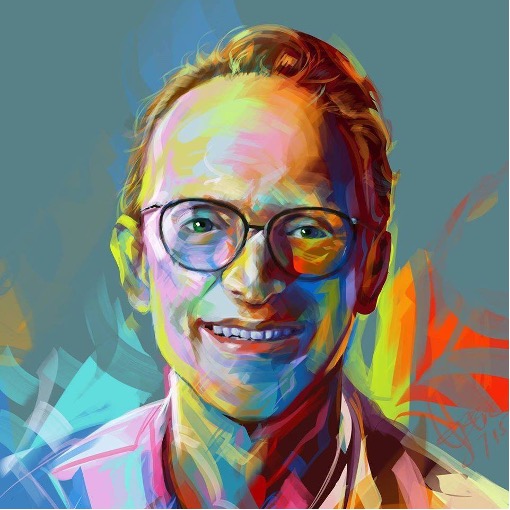
Welcome back to our series on writing the “More Than Human”. We offer a set of interviews with poets and writers on how they approach writing about the environment. The more-than-human is a phrase that seeks to side-step traditional nature-culture dualisms and draw attention to the unity of all life as a kind of shared commonwealth existing on a fragile planet. It also reminds us humans that there is more to life, that there is more world, than the human. It relocates us in relation to the mystery.
Here, we meet Peter Julian Taylor, who lives in Cheshire and works as an editor. His poems have appeared in PN Review, The Rialto, Cambridge Poetry, and Lucent Dreaming, plus anthologies from the 1-2-3, Candlestick, and Wee Sparrow presses. He has been shortlisted for the Ginkgo/AONB ‘Best Poem of UK Landscape’, longlisted for The Rialto/RSPB ‘Nature and Place’ Prize, and twice highly commended in the Wales Poetry Award. IG: @petetaylorpoetry
There are no trees on the island
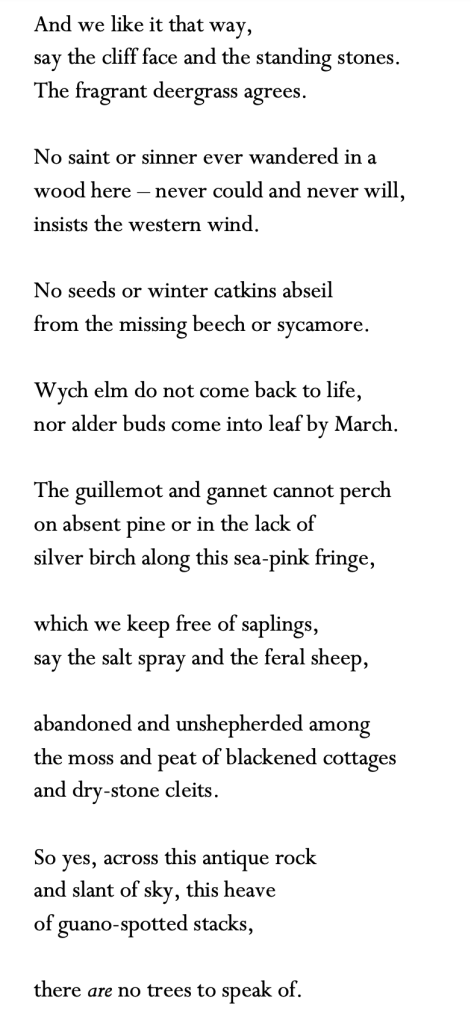
Zoë Brigley: I enjoy the mystery of this poem and how an intriguing landscape unfolds here. Is this based on a real place?
Peter Julian Taylor: Thanks. Yes, Hirta – the main island in the remote archipelago of St. Kilda, off the Scottish Outer Hebrides. I’d been researching remote islands like Lundy, or Skomer and Skokholm off the coast of Wales, for another piece which turned out to be a love poem to the puffin! But we took a trip up to the Isle of Lewis in Scotland, where there are very few trees – the (probably untrue) story being that they were cut down by the Vikings to prevent the local clan from building boats. Then I discovered that St. Kilda has no trees at all – and the idea for this poem grew out of that sense of absence, of a landscape where elements of nature are missing.
Zoë: I like how the poem opens with the more than human speaking. Your poem seems to set up the idea that a cliff, a standing stone or a blade of grass might be a person?
Peter: In the back of my mind were some promotional films made over a decade ago for Conservation International. Finding them again on YouTube, it was a series called ‘Nature Is Speaking’, in which famous actors ‘voiced’ parts of nature – Harrison Ford as the ocean, Liam Neeson as the ice caps, Robert Redford as a redwood tree. Inspired by that, I thought of partly letting the St. Kilda islands themselves describe the lack of trees, instead of me describing it solely from a human perspective. So yes, we hear the opinions of the cliff, the circle of standing stones, the grass, the wind, the salty sea-spray, and the wild sheep.
Zoë: There’s an interesting jolt when you mention the concept of the saint or sinner which seems out of place in this more than human space. They cannot wander in a wood as there are no trees, but are they also framed in a way as intruders regardless of whether the trees exist or not?
Peter: Learning more about St. Kilda, I found that there never was a saint called Kilda – and that the islands’ name is probably a corruption of their 16th century name, Skildar. So then the lack of a saint (or indeed a sinner) was a nice parallel for the total absence of trees. The main island of Hirta was in fact inhabited by a small population until 1930 when the last residents departed, leaving a village street of abandoned stone cottages. The ‘cleits’ mentioned in the poem, with hundreds still standing, are the remains of small igloo-like storage huts and shelters dotted around the island – built with local stone, given the lack of wood. Two breeds of wild sheep do survive there, together with up to a million visiting seabirds – those, obviously, which nest in burrows or cliff crevices, rather than trees.
Zoë: In a way, this poem feels like absence is at the heart of it, the absent trees only being present through imagining the life they would have supported?
Peter: Yes, it was the whole notion of a treeless, uninhabited island that led me to the challenge of writing about what’s not there – evoking something out of nothing. Eventually, when the landscape itself has had its say, as we’ve moved around the island, the final line circles back to confirm the truth of the poem’s title.
Zoë: Is there anything else you want to tell us about this poem?
Peter: In terms of the language, I guess this poem reflects my overall approach to writing. I always aim to craft the rhythm and internal rhyme of a piece. It was A. E. Housman who said that poetry lies “not in what is said, but in a way of saying”, that the words – and their sound – are as important as the meaning. This builds on an earlier idea from Gerard Manley Hopkins that we should read more with our ears than with our eyes, “to hear the sound of words and learn to love their music”. Seamus Heaney added: “When you’ve listened long enough, strike your note”. So I imagine the note I strike is a bit traditionalist – but, for me, the sound and rhythm are what differentiates poetry from chopped-up prose.
Discover more from Modron Magazine
Subscribe to get the latest posts sent to your email.


