Interview by Zoë Brigley
Welcome back to our series on writing the “More Than Human”. We offer a set of interviews with poets and writers on how they approach writing about the environment. The more-than-human is a phrase that seeks to side-step traditional nature-culture dualisms and draw attention to the unity of all life as a kind of shared commonwealth existing on a fragile planet. It also reminds us humans that there is more to life, that there is more world, than the human. It relocates us in relation to the mystery.
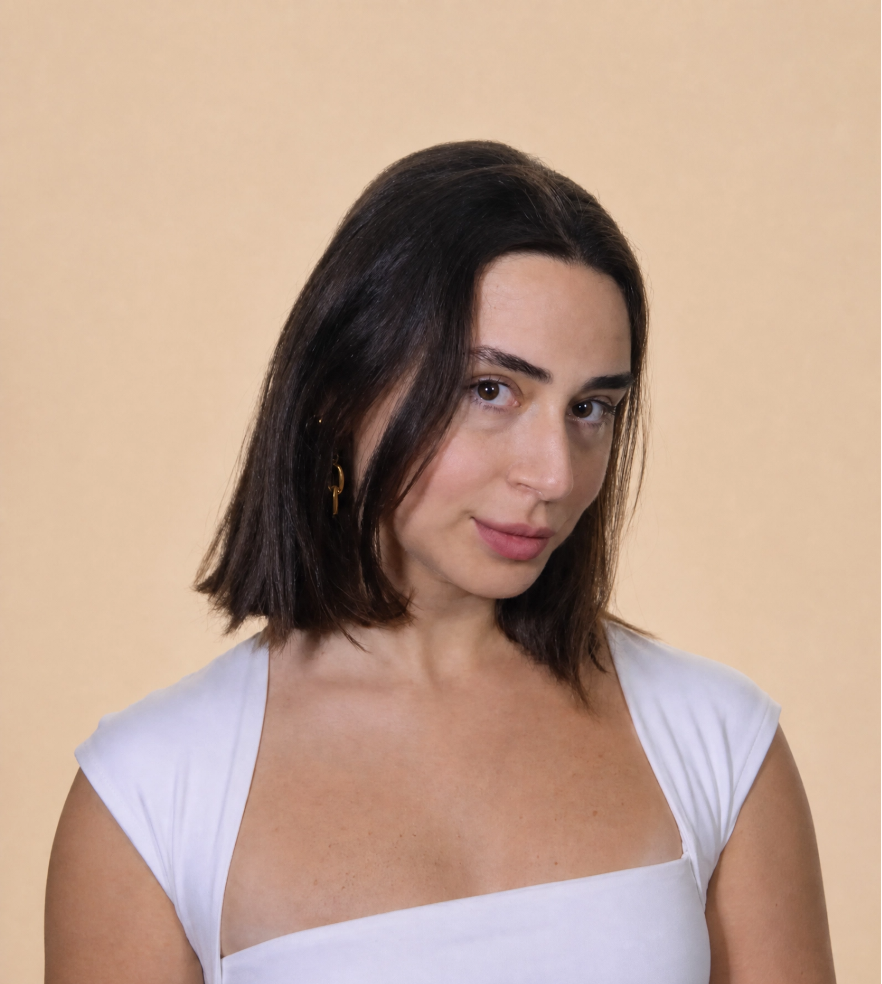
This week we meet Perla Kantarjian, a Lebanese-Armenian writer from Beirut. A Pushcart-nominated poet and Sonny Mehta Scholar at UEA, her work appears in Wasafiri, Electric Literature, The Rumpus, and aboard NASA’s Lunar Codex missions. Her debut collection, You Must Become Field, is forthcoming from Bad Betty Press in September 2026.
Zoë Brigley: So perhaps we could start by talking about Mona Khalil, her conservation work and how you knew her?
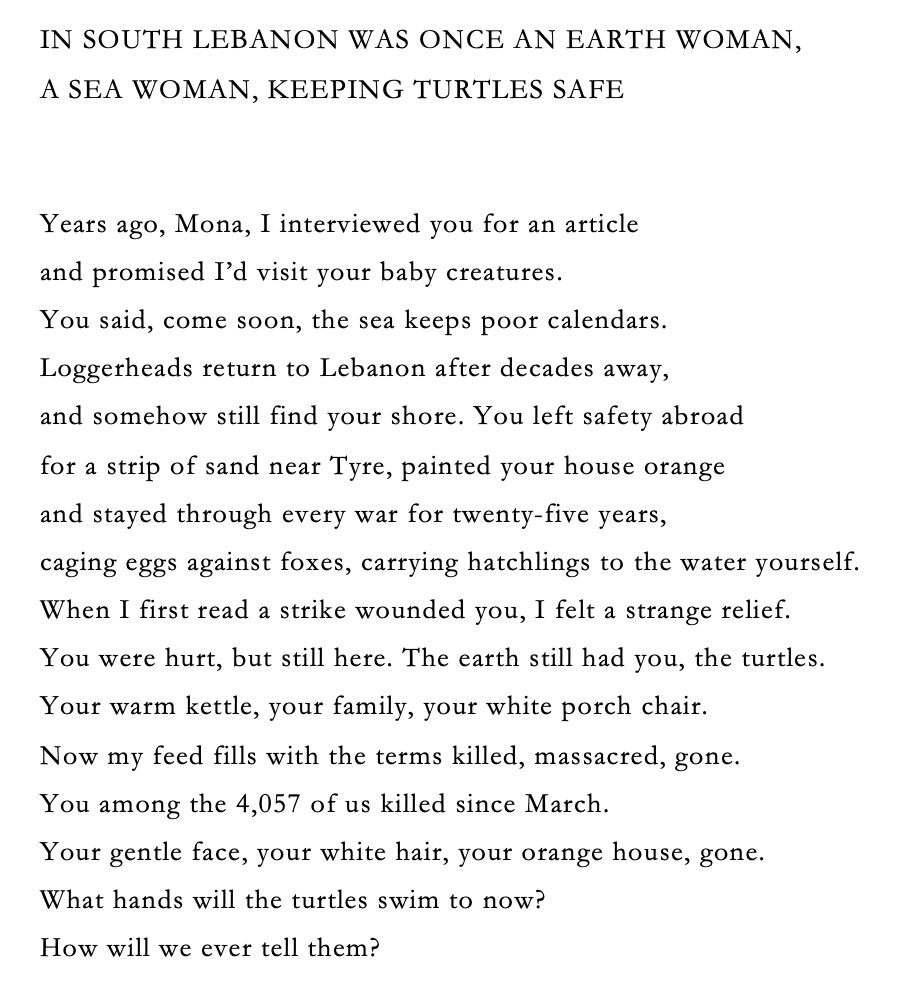
Perla Kantarjian: As a journalist, you interview many people, and very few stay with you. Mona stayed. She represented something so rare in Lebanon: a life organised around care rather than survival. Lebanon has always had extraordinary environmentalists, but they’re often working against impossible odds. So when someone quietly dedicates decades to protecting loggerhead turtles, refusing to leave because the turtles still return, it feels almost mythic. Mona left a life in the Netherlands and returned in 1999, after a green turtle laying her eggs on Mansouri beach one night threw sand over her. The next year she founded the Orange House Project: she painted her family’s house orange, turned it into a guesthouse whose income protected a 1.4-kilometre stretch of coast, one of the most important nesting shores for endangered loggerhead and green sea turtles in the eastern Mediterranean. For 25 years she cared for those creatures, fought dynamite fishing and beach privatisation, raised a generation of volunteers, and refused every reason to leave, including two wars.
I interviewed her when I was nineteen or twenty, in my first months as a journalist at Annahar English. It was a phone interview, and I no longer remember the article’s angle. What I remember is her calm voice, so ripe with knowingness. She invited me to visit the Orange House, to see the turtles for myself and conduct the interview there. I promised I would, but I was battling an article deadline at the time. Like so many promises we make to people who seem eternal, I assumed there would always be another summer. The poem is, among other things, an apology for that.
Zoë: At MODRON, we believe that war and conflict is embedded in environmental concerns and issues around ecojustice. Do you have a take on that?
Perla: War doesn’t stop at people. It reaches the groves, the shore, the nests, everything that can’t run and can’t be warned. We count our human dead, and rightly. Barely anybody counts the rest. I don’t see ecojustice as a separate cause from justice. A grove takes decades to bear; burning it takes an afternoon. The bond between a farmer and her land is a sacred thing, and severing it is the point. It isn’t a loss beside the human loss, it’s the same wound made twice. You take the life, and then you take what the life was for.
Zoë: How important is poetry of witness? I notice that you have been building an archive of poems online highlighting the suffering of people in Lebanon and Palestine. What are your hopes for that archive?
Perla: I’m a descendant of Armenian Genocide survivors, so witness is my inheritance before it is my practice. I come from two countries the world knows by their suffering, so I grew up knowing exactly what happens when a people’s dead are reduced to a disputed number.
When war reescalated here in 2025, Lebanon almost became a footnote to a larger catastrophe, as if people had grown numb after months of witnessing unimaginable violence in Gaza. I wanted to write against that numbness. As I write this, the Ministry of Public Health counts 4,304 Lebanese killed since the second of March 2026. I wish I had the hands, or the gut, to dedicate a poem to each of them. I don’t.
My hope for the archive is small and enormous at once: that no one inside it stays a statistic. To bring as many of them to life as I can. To carry them to strangers. To say this person existed once, in this place where they were loved. This is how they were taken from the world. And because they are remembered, perhaps they are not entirely lost.
Zoë: Is there anything else you would like to tell us about this poem?
Perla: Only about the line I’m most ashamed of, which is the one about relief. When I first read that Mona had been wounded, I felt relieved because wounded meant alive. War does this to the grammar of hope; it shrinks it until she was only hurt becomes good news. I kept the line because the poem would be a lie without it
Discover more from Modron Magazine
Subscribe to get the latest posts sent to your email.


