Interview by Zoë Brigley

Welcome back to our series on writing the #MoreThanHuman. We offer a set of interviews with poets and writers on how they approach writing about the environment. The more-than-human is a phrase that seeks to side-step traditional nature-culture dualisms and draw attention to the unity of all life as a kind of shared commonwealth existing on a fragile planet. It also reminds us humans that there is more to life, that there is more world, than the human. It relocates us in relation to the mystery.
This week we meet Mark Fiddes. His third full collection ‘Hotel Petroleum’ is launched at the end of June by Broken Sleep Books. Winner of last year’s Ledbury Prize, he was just Commended in the National Poetry Competition and awarded runner-up in the Keats-Shelley Prize. His libretto ‘Threadlands’ written with composer Joanna Marsh was premiered in May at Berlin’s Pierre Boulez Saal.
Cinderland
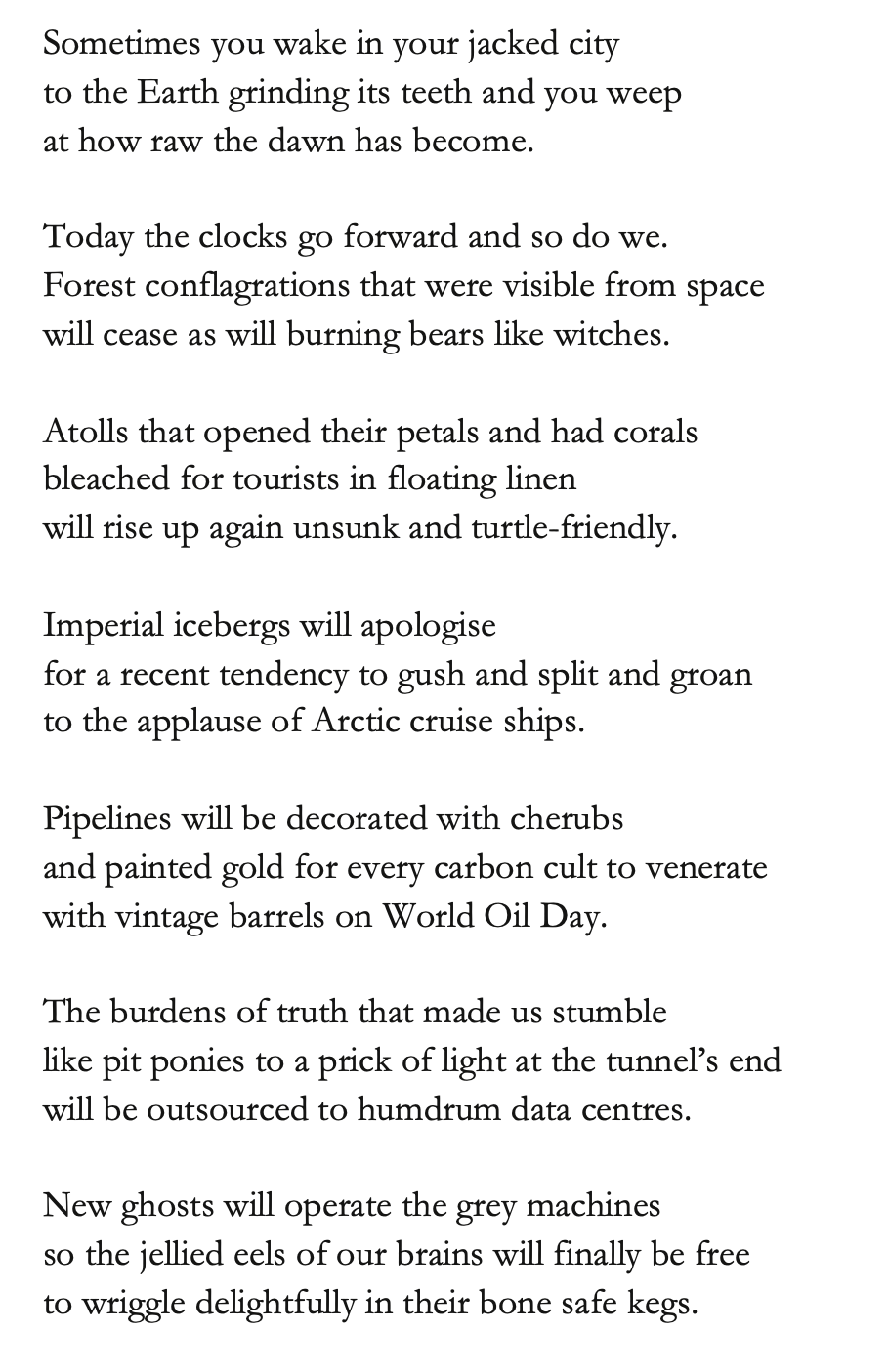
Zoë Brigley: There is so much that is intriguing about this poem, but perhaps let’s begin with how it is told. I can still, even after years of writing, see the appeal of the tercet as a vessel for poetry. What do you think is special about this form and how does it help you write the poem you want to write?
Mark Fiddes: For this poem, I wanted to be able to fly over the planet and scoop up each scene in a capsule, almost like a documentary in film. A tercet allows you to do this economically, by setting the scene, creating action and then drawing a conclusion. Each lives by itself but allows for the progression of an argument over the arc of the poem. I am able to go from being trapped in a grinding cityscape, to Maldivian atolls in one bound before ending up in a Huxleyan dystopia.
Zoë: You have currently been keeping a ‘Spring Journal’ to document the upheaval of our times in the same manner as Louis MacNeice did in 1938 in his ‘Autumn Journal’. How important is it for poets to document our times?
Mark: It’s hard to hold back. I started off as a journalist in Washington in less manipulated times. When the US started the war, I wanted to tell the story from the point of view of the people living here in the Gulf, many of whom are already part of other diasporas. I’ve always admired the way MacNeice contrasted the banality of our everyday struggles with a much darker force shifting in the background – in his case Nazism. Eight decades later, the combination of technology and populism is no less lethal.
Zoë: This feels to me less like a poem about nature than a record of all that is lost when we allow the human-made, the man-made, the AI-made, technological, post-industrial world take over our planet. Is it a warning?
Mark: That’s a great note. It’s hard to unravel what has happened to our natural world from our own desire for more of everything. I am complicit, having worked in branding and advertising. Maybe this is a mea culpa as much as a warning.
Zoë: The clocks going forward in the poem feels sinister and strange in the context of imagery around that line. It also puts me in mind of Orwell’s clocks striking thirteen in 1984. Do you think there is something Orwellian about your writing? Is Orwell an influence at all?
Mark: Absolutely. Orwell at the beginning and Huxley at the close: “so the jellied eels of our brains will finally be free/to wriggle delightfully in their bone safe kegs” – a reference to the alphas’ societal control through the ‘soma’ of artificial intelligence, as the glow of The Enlightenment’s finally dulls. Who would have thought that 1984 and Brave New World could both be true at the same time?
Zoë: Is there anything else you want to tell us about this poem?
Mark: Yes, the title came after the California forest fires, hence the image of bears burning like witches. (The grizzly is featured on the State flag.) I also wanted to point out that the tercet on oil was written in reaction to the expression ‘Drill Baby, Drill” which sounds more like a 60s Sexploitation movie than the environmental policy for the world’s largest economy. How can we even start to have a proper debate on oil and its role beyond energy when this is the rhetoric?
Thank you for the questions, Zoë.
Discover more from Modron Magazine
Subscribe to get the latest posts sent to your email.


