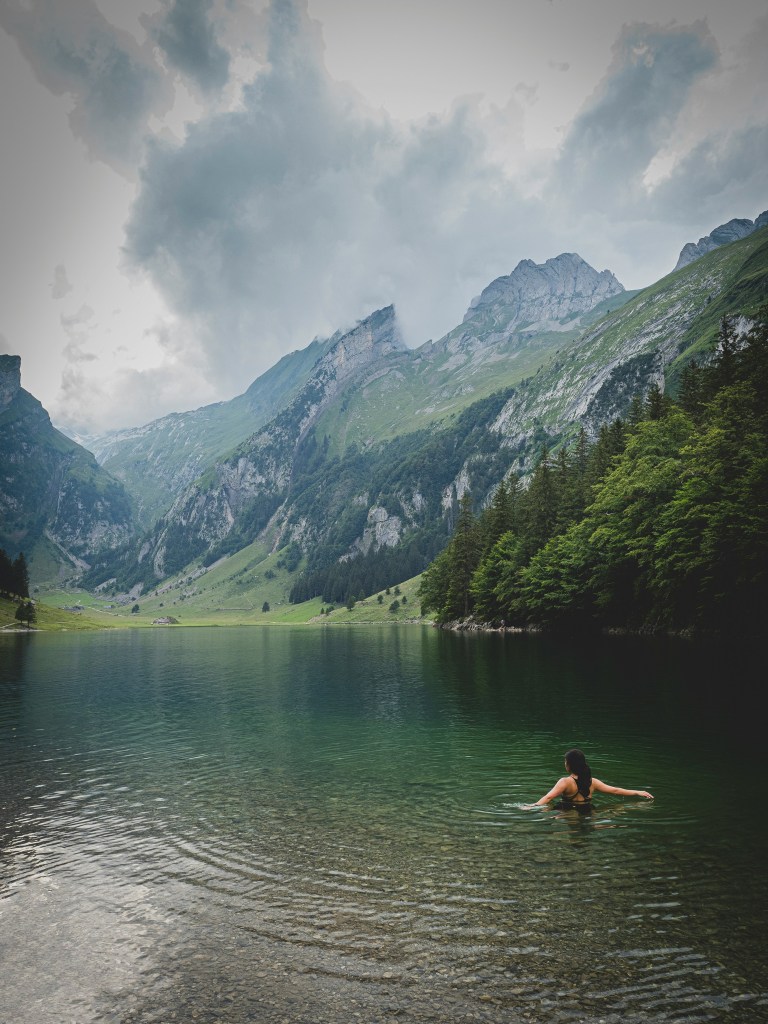
An image flashes across the screen; a young white woman wearing a dark blue swimming costume wades through clear green water, her dark blonde hair cascades down her shoulders. On either side huge boulders rise as high as cliffs dripping with green moss. She turns to look behind her where a waterfall crashes down between granite walls. Trees grow out of cracks and meet overhead shading the dark pool she is emerging from. Sunlight filters through lime green leaves making the water sparkle around her. Young and lithe, her skin clear and firm. She walks through the water with ease, confidently tracing her way over a rocky waterbed. A creature made of myth and wild places, of ancient longing and the call of the more-than-human. Born of cold water and time-worn tales, from the oldest forests we glimpse her. She stirs the old stories in us and we remember the Aes Sideh, Sith or Tylwyth Teg, the Celtic Fair folk. She walks the liminal space between the human and non-human world, between safety and danger. From magic and folklore she comes, from social media she is born. A pure spirit who can flit from one hidden pool to the next with freedom and ease, who has more in common with the Fae than with her human kin.
Looking at that image it is easy to imagine her continuing her walk out of the water onto a sunny river bank where she will wrap herself in an organic cotton towel, changing into her practical, yet earthy clothes topped with a snug sheepskin gilt and bobble hat before making a fire to boil water for fresh coffee in her hand carved Quaich cup which she will sip in quiet reverence of her surroundings. Alone in the wilderness she is confident and unhurried, absorbing the peace of the woodland, she luxuriates in the afterglow of her cold swim, refreshed, reborn, healed of all troubles. The fire burns low before she decides it is time to move on in search of her next pool. She leaves without a trace, just like a Sith, and we wonder if she was in fact ever really there.
A variation of this image will be found on almost every wild swimming website and in many guidebooks that have exploded into shops in recent years yet is at complete odds with how swimming really feels. Modern western culture has romanticised and simplified the ideas of freedom and healing that can be found in natural bodies of water. We have successfully packaged and sold something which humans have been doing since the dawn of time; going to water. We have spread the story that the ‘cure’ for many of our modern ailments is simply to get outside into cold water. We talk about how in bygone times people knew this and that we must reclaim it. Portrayed as simple, ancient and easy, we take the photos at face value and chase creating our own versions.
There is a particular kind of grief, well known in the disabled community, of knowing the environments that help you feel better, regulate, function and not being able to get to them. There is an anger which lives between your love of adventure and the tiring reality. A frustration that your body is so very far away from the ones in those pictures, not only aesthetically but, physically and mentally too. So when people tell you that nature heals, you stay quiet, smile and nod and think to yourself, But how when I can’t even get there?
There is no doubt that it is possible to find places and recreate these images, but in this pressurised simplification we are ignoring the exhausting reality for many marginalised folk, especially disabled people and people from the global majority face. In over-romanticising the realities of what swimming in remote places actually entails and desperately trying to re-connect with the natural world we are actually moving even further away from it, forgetting what the Fae folk tales were often truly trying to tell us and the guidance and caution they once offered.
The truth of swimming outside begins long before any photos are taken. Often it starts with a longing born of lonely hours managing medications and balancing energy, of scrolling travel sites and dreaming of being anywhere but here, of escape, of freedom, of clean air, birdsong and health.
After that, there are the practical logistics; do you need childcare? What transport do you need to get there? Can you walk? If so, how far? If not, is there public transport or can you drive? How much might it cost? Do you feel safe outside your home? What are you going to wear? Can you change by yourself? How does your culture view swimming? Will your family support you doing this? This, in itself, is exhausting and overwhelming for many, particularly for neurodivergent people this can be the hardest stage, the number of small decisions needed to be made to even get out of the door is an invisible labour that glossy pictures rarely show.
Once this logistical mountain is summited, often we see that it was in fact a false summit. And now we have to actually arrive at the shore and then get in. Are there accessible paths to the waters edge? Not only for wheelchairs but for others with fluctuating mobility too? How long is the journey from car to water? How much time do you have? What other demands are on you that day, what have you squeezed this in between and who else might need you in this time? Frequently a long-awaited swim is achieved and it is harder and more complex than we remembered. Paths are not maintained, the weather is not welcoming, friends cancel, the bus runs late and we find that the swim has not cured all our ills. Sometimes it may even have brought new ones and our recovery time is much longer than we hoped. And yet, we keep coming back, dreaming of it, yearning for it.
The myth of the wild swimmer is strong: we do not need to throw her out entirely, but we must begin to see her less as a figure of memoir and more one of legend. We can use her to give us inspiration, as like all great works of fiction she offers escapism and wonder, but it is important that we also know she is not real.
Adventure to water needs to be redefined. What is an adventure for one may be mundane for another, there is no such thing as a perfect wild swimming trip. Social media is taking away our ability to spot nuance, to enjoy our lives in all their imperfect perfection and we must hold onto that because it is in our differences and complexities, the wonder and pain of all our individual challenges that true joy has a chance to exist. If it was as simple as that photo appears you would miss the rollercoaster of emotions we ride to get to swim: the ridiculousness of early starts, the reliance on friends for support, the tears over lost kit, the slips and trips, the lost knickers, mud splattered bags, the community effort it takes to get into water and the immensity of the high from the eventual achievement.
So next time, your swim kit is damp, your body is in pain, you can’t face the bus, the children are sick, you’re in a mad rush, you forget your old thermos or you can’t even do the swim you dreamt of, remember; the swimmer in that picture? The one you dream of being? She doesn’t really exist, but you, in all your painful human mess, you do and your adventures to watery spaces are just as wild and beautiful as the ones in those perfect pictures.
Lucy Baena is a writer, mother, swimmer and birthkeeper from Brighton UK. Finally diagnosed autistic aged 38 after a lifetime of chronic illness, Lucy writes at the intersection of motherhood, neurodivergence, disability and the natural world. A writer of fiction, YA, and nonfiction prose, most recently Lucy published a piece in the Womancraft Publishing Compendium Weaving Our Way Beyond Patriarchy.
Discover more from Modron Magazine
Subscribe to get the latest posts sent to your email.


