Review by Zoë Brigley
Poems on Nature, compiled by Gaby Morgan and introduced by Helen Macdonald. Macmillan, 2025. US Macmillan website. UK Macmillan wesbite.
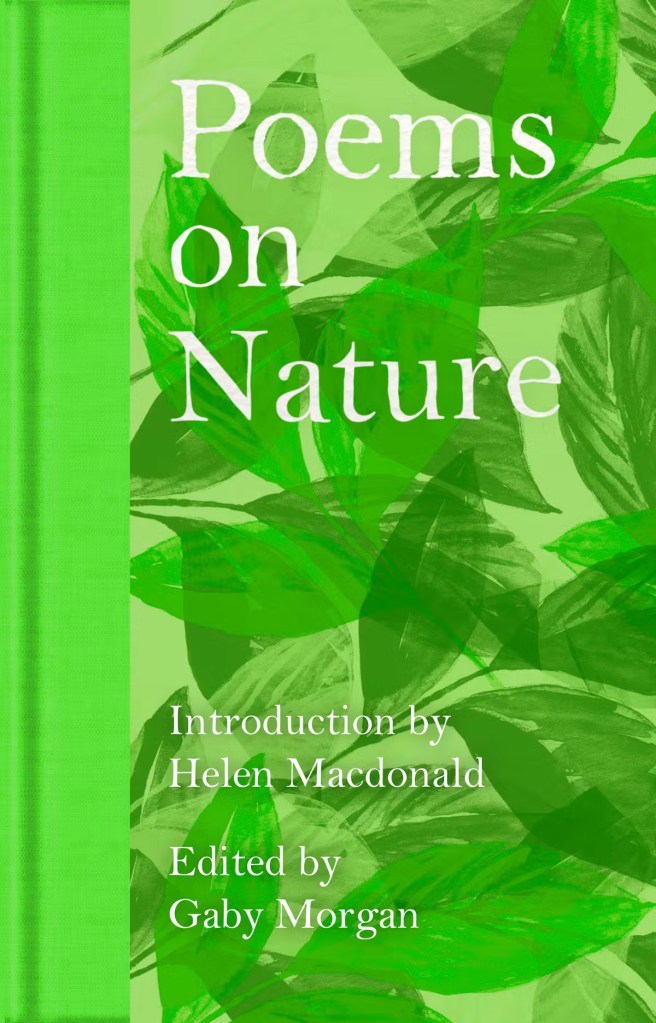
Poems on Nature is an anthology compiled by Gaby Morgan and introduced by Helen Macdonald, author of H is for Hawk. The anthology is reminiscent of collections of nineteenth-century poetry common in the 1980s: traditional in tone, pastoral in emphasis, and designed to introduce younger readers to well-loved poetic depictions of the natural world. In that respect, it functions effectively as an accessible introduction to poetry for children. At the same time, the anthology can occasionally feel detached from contemporary ecological realities, offering a vision of nature shaped more by older literary traditions than by the environmental urgencies of the present moment.
It is mainly dominated by white, male poets, though there are some women poets included, around eight by our count including Emily Brontë, Emily Dickinson, Rachel Field, Jean Ingelow, Amy Levy, Charlotte Mew, Christina Rossetti, and Sara Teasdale. The anthology is also mainly populated by English poets, though there are a few poets from elsewhere such as the Anglo-Welsh Edward Thomas, Scot RL Stevenson, and the Irish W.B. Yeats. A clutch of Americans appear such as Emily Dickinson, Walt Whitman, Henry Wadsworth Longfellow, Sara Teasdale, and Ford Maddox Ford.
Thinking about these choices, the omission of poets of the global majority feels like a missed opportunity to create a different sort of selection. If including Whitman, why not Rabindranath Tagore? If including W.B. Yeats, why not include Langston Hughes? If including Amy Levy, why not include Phyllis Wheatley or Toru Dutt?
The term “nature poetry” itself can feel somewhat old-fashioned, because it risks implying a separation between the human and the natural world, whereas contemporary ecological thought increasingly emphasises human embeddedness within ecological systems. In the introduction, Macdonald writes that “very often, nature is presented in these poems as a corrective to the mores and trials of modern life, a green refuge when the world is too much with us.” From a contemporary eco-critical perspective, however, this framing may raise questions about the tendency to position nature primarily in relation to human need or restoration, particularly in the context of the current ecological crisis.
The anthology foregrounds the pastoral – it is central to many of the poems selected. Macdonald also suggests that “The poems of Wordsworth and Coleridge show us a nature that is a benevolent, comforting power,” though Romantic poetry also frequently engages with the more unsettling and awe-inspiring dimensions of the sublime. At times, the anthology’s approach consequently may feel somewhat shaped by earlier traditions of nature writing rather than more recent ecological thinking.
Macdonald argues that it can be acceptable to “write generic creatures rather than individual ones” because “They can offer the poet a vision of eternity.” Yet contemporary environmental criticism might question whether this abstraction risks overlooking the specificity and vulnerability of actual creatures and ecosystems in an era of accelerating ecological loss. Macdonald does acknowledge that ideas of home become complicated in “the age of Empire,” but it is notable that the anthology includes little direct engagement from poets situated within those colonised contexts themselves.
The poems themselves are divided into seasons, and the idea of creating a commonplace book, perhaps read every day through the year, has potential. The collection opens however with Robert Browning’s poem ‘The year’s at the spring’:
The year’s at the spring
And day’s at the morn;
Morning’s at seven;
The hillside’s dew-pearled;
The lark’s on the wing;
The snail’s on the thorn:
God’s in His heaven—
All’s right with the world!
Read in a moment of contemporary ecological crisis, the poem can feel strikingly distant from present environmental realities. Does this reflect one of the anthology’s underlying impulses: to offer moments of reassurance through familiar representations of the natural world? There is, of course, genuine value in literary comfort, particularly in difficult times. At the same time, the collection raises interesting questions about the balance between consolation and ecological realism, and about whether contemporary nature anthologies might also make space for more unsettled or urgent environmental perspectives.
It is possible however that to judge this anthology for not engaging with contemporary ecological perspectives, is to misunderstand its purpose. It is not fundamentally a modern ecological-minded anthology. How can it be when the earliest poems included are from around 100 years ago? It is poignant to revisit these poems and a time when eco-anxiety did not exist in the form it does now.
Discover more from Modron Magazine
Subscribe to get the latest posts sent to your email.


