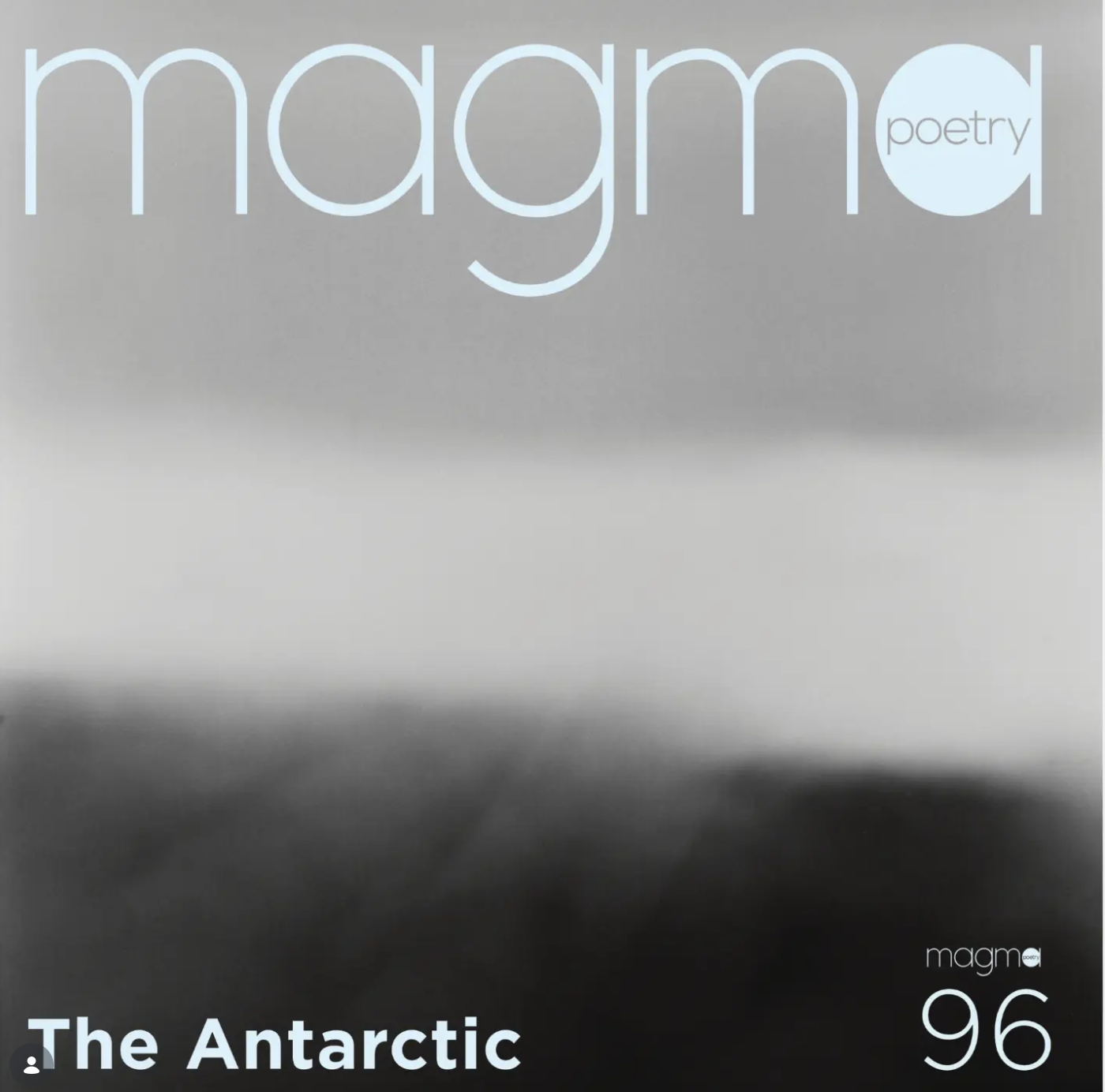
“can a continent be kept within the confines of Garamond font?” asks Jane Burn in ‘A more-than-human conversation’, published in Magma 96: The Antarctic.
MODRON’s founding editors, Zoë Brigley and Kristian Evans, were delighted to take part in this conversation. We were all in different parts of the world, so we met on Zoom. One of the pleasures of the conversation was discovering how much our questions had in common. We talked about elephant seals diving beneath icy water, imagined an archive shaped by glaciers and winds as well as animals and people, and wondered how poetry might help us pay closer attention to lives and processes we only partly understand.
It was lovely to be in conversation with Jane Burn, whose work we’ve published in MODRON and whose poetry is deeply engaged with finding ways to express our encounters with the more-than-human world. That question is at the heart of our ongoing More-than-Human interview series, where we ask poets and writers how they approach writing about the environment. We were also joined by Dr Katherine Collins, who leads the More-than-Human Stories of Antarctica project. Her research asks what happens when ice, water, rock and animal lives help shape the stories we tell about Antarctica.
Each of the issue’s editors brought a different perspective. Cheryl Moskowitz is a poet, writer and educator who spoke with us for the series about her poem ‘Degenerate’ and the hierarchies we impose when we compare human and animal lives. Branwell Roberts is a poet based in nipaluna/Hobart whose work explores Antarctic history. Their piece for the issue, ‘Antarctic History: The Queer Herbarium’, brings together five writers and researchers to imagine a queer Antarctic past, present and future. Elizabeth Lewis Williams is the author of two books of Antarctic poetry, Deception Island and Erebus, and draws on both polar science and family history in her writing about the continent.
We were also delighted to see a poem by fellow MODRON editor Glyn Edwards in the issue: ‘In Observing the Vanishing Point of the D28 Iceberg for 60 years’.
Thank you to Cheryl, Branwell and Elizabeth for including us. We warmly recommend buying a copy of Magma 96: The Antarctic. It’s full of marvellous writing about a continent under threat. At a time of ecological crisis, it matters that writers are asking us to spend time with Antarctica and think about our responsibilities to it.
Featured photo by Conservation Commons on Unsplash.
Discover more from Modron Magazine
Subscribe to get the latest posts sent to your email.


