Interview by Zoë Brigley
Welcome back to our series on writing the “More Than Human”. We offer a set of interviews with poets and writers on how they approach writing about the environment. The more-than-human is a phrase that seeks to side-step traditional nature-culture dualisms and draw attention to the unity of all life as a kind of shared commonwealth existing on a fragile planet. It also reminds us humans that there is more to life, that there is more world, than the human. It relocates us in relation to the mystery.
This week we meet Nathaniel Calhoun, who works on biodiversity and board governance. His projects focus mostly on the Amazon basin or Aotearoa New Zealand. His poems have featured in the London Magazine, the Iowa Review, Oxford Poetry, Landfall and many others. He sometimes tweets @calhounpoems
desiccating
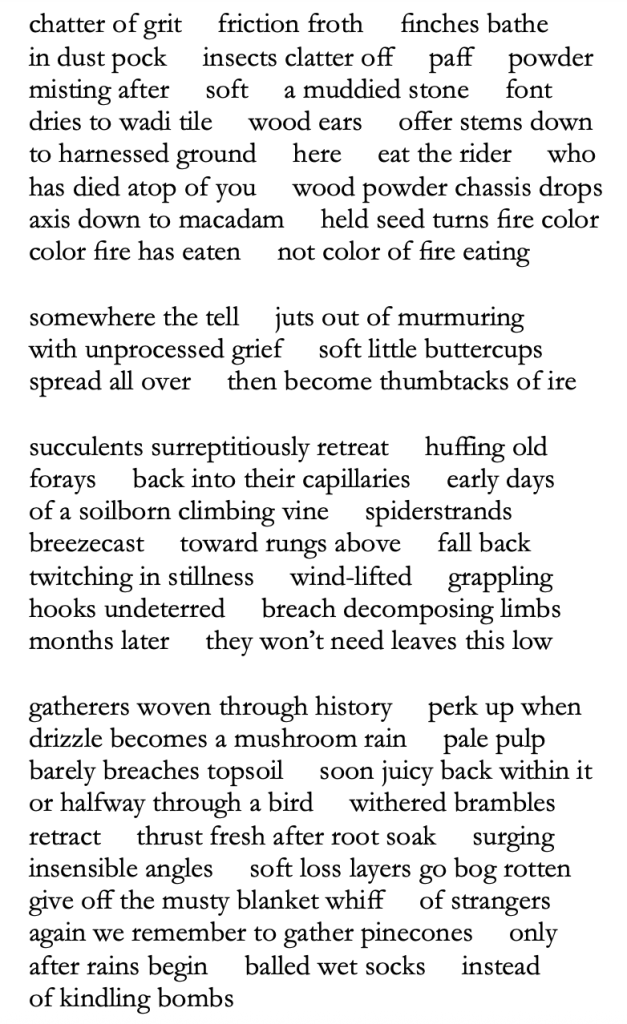
Zoë Brigley: I love the rush of this poem with the influx of images that seems so well observed. Was this poem remembered, based on observations or imagined?
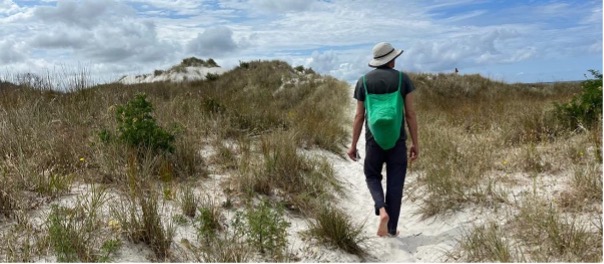
Nathaniel Calhoun: It comes from observations made on a narrow, sub-tropical tombolo just below the northernmost point of Aotearoa New Zealand, where I lived for eight years on a regenerating, coastal plot. This turned out to be more isolating than my small family foresaw, though it was wonderful for my writing. Working with that land brought a multi-decade, world-spanning semi-frenzy to a stop, changing how I write and what I read. While I try not to make obscure references in my work (such as culturally or temporally coded ones), I give myself permission to name any mineral, plant or animal.
Zoë: I enjoy the spacing within the lines. How do you go about choosing a form for a poem and how did this poem come to settle in the form it did?
Nathaniel: Paramount for me is giving a reader enough indication of where to pause when reading my work. The simple visual logic of five space gaps and line breaks are usually enough for that purpose. In this case I also needed stanzas.
I realized recently that most of my poems go through a multi-year phase of being churned into a sort of soil or compressed into a kind of sediment. The component parts of poems in this phase of composition frequently seem interchangeable. Sometimes these soil pieces cough up a rock or give rise to a growing thing—something more conventionally poem-like or plotted. By accreting within a persistent thematic register, “desiccating” is in that camp.
Zoë: That final line is so striking because the world of militarisation, conflict and destruction suddenly enters a poem that had been existing in a very different space. How did that ending come about and does it relate to your thoughts about human and more than human worlds?
Nathaniel: Often it is a near-literal truth in my poems that outweighs its metaphor. For years, as soon as the dry season of our summer would yield to the rains, I would think: shit, I haven’t started gathering pinecones yet for the wood burner—which was our only free source of heat. Those pinecones were large, fully-bloomed, satisfying to throw, heat dense and more explosive than anything else allowed in the stove.
At the same time, the military, bureaucratic, technical, therapeutic, corporate, legalistic and industrial lexicons frequently present themselves as layers within my work. Metaphors from within these registers are allowed to be intrusive, with visible seams along their strange, outsider belonging. The poem’s job is to embrace and appreciate them for their utility and then to keep building a nest around them with pre-human things strands from the inner world. I am not one for handling useful things with irony.
Zoë: Do you have anything else you would like to tell us about this poem?
Nathaniel: I’m glad it’s ending up in Wales. The mouth feel where the poem’s recurring sounds pull themselves into the foreground is particularly influenced by UK and Irish writing traditions. Whenever I’m feeling hesitant about musicality or internal rhymes, it’s your islands I look to for reassurance.
Discover more from Modron Magazine
Subscribe to get the latest posts sent to your email.


