Interview by Zoë Brigley
Welcome back to our series on writing the “More Than Human”. We offer a set of interviews with poets and writers on how they approach writing about the environment. The more-than-human is a phrase that seeks to side-step traditional nature-culture dualisms and draw attention to the unity of all life as a kind of shared commonwealth existing on a fragile planet. It also reminds us humans that there is more to life, that there is more world, than the human. It relocates us in relation to the mystery.
This week we meet Jane Spray who lives in the Forest of Dean, where she writes, pots, prints, gardens, plants trees and supports environmental causes. Her poems, some prize winning, have appeared in Poetry News, Mslexia, Pennine Platform, Acropolis Journal, Blithe Spirit, The Haibun Journal, and elsewhere. First collection, Cave Whale (Alba Publishing, 2026).
Meta menardi, European Cave Spider
First visit
Second visit
Third visit
Zoë Brigley: I like the idea of writing a poem about a creature across time and many visits. Was this based on a real occurrence, or was it imagined?
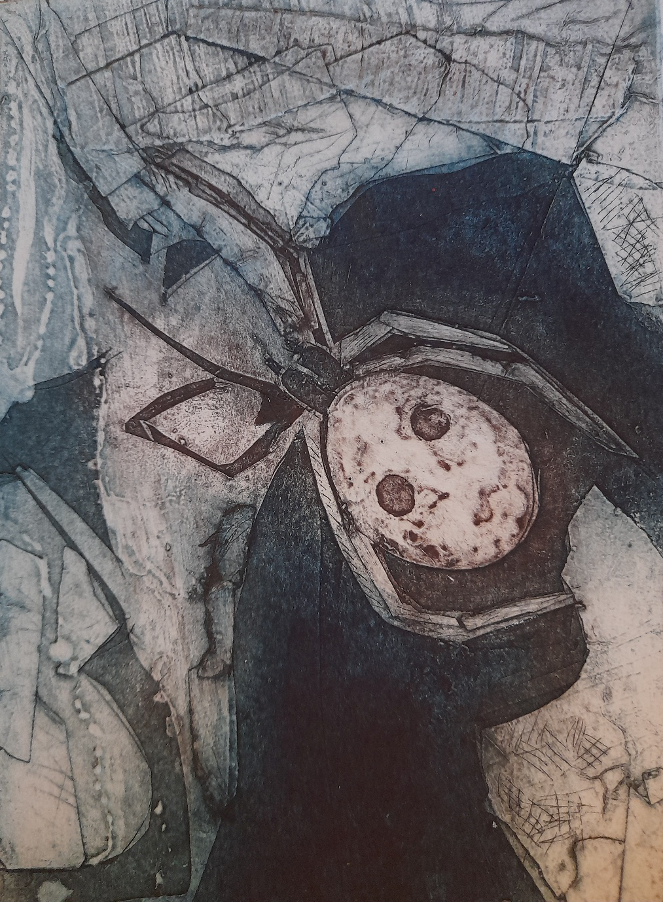
Jane Spray: This was a real occurrence. I was curious to learn more about cave spiders, since I’d never come across them before, never seen one. The visiting times spread across the year were important to me, to learn about the spider’s life cycle – I knew very little. The second visit was in early summer, when the cocoons had hatched, but the baby spiderlings were so smallI could barely see them. The collagraph print used an online photo for inspiration, and the third visit was definitely the climax, seeing a fully grown cave spider hanging there, after all the anticipation.
When I asked the owners of Clearwell Caves, Jonathan and Heather Wright, whether they’d be open to me being a poet in residence there, I was struck how Jonathan seemed to test my resolve by making a point of mentioning the cave spiders, giving them their Latin name. This intrigued me, but when I looked out for them, down the caves, I could never see any. I had to go back and ask him exactly where to find them. It turned out they lived back stage, in the dark, behind a hidden away back door, which is behind an exhibit, over a safety fence – this increased the intrigue in searching for them.
Zoë: I enjoy the way that this poem gives itself over to observing the spider closely and it is simply about the creature rather than using it to discuss human problems. Was this by conscious design or did it happen instinctively?
Jane: I’d say both instinctively, and consciously. Again, learning about the spider in its habitat. To observe as a naturalist might, to make notes and observations in situ. Yet, more, to meet the spider and have a conversation with it, seek to understand it. As much as this is possible. Communication across some species – human and spider, say – is quite a jump. The wished for conversation didn’t happen, but I ended up with a greater admiration of and appreciation for the cave spiders: their elegant beauty; how well suited they are to their particular ecological niche.
They are the inhabitants and true guardians of the caves, never mind the humans who claim ownership, the poet who claims residence.
Zoë: Spiders tend to have negative connotations for humans, but you avoid that here. How important is it to see beyond myths created about animals, insects and creatures?
Jane: The sudden scuttle of spiders can unsettle, but I count myself lucky not to be afraid of them. Some spiders have spectacular markings. I remember admiring these from childhood, especially when I’d come across one sat in the middle of its web, with the light shining through.
Inaccurate and negative urban legends about spiders, such as that they are out to bite you, are unhelpful in that they ramp up unnecessary fear. A more accurate approach, including curiosity and wonder, is more likely to lead to conservation efforts – this is true of other species too.
Myths, though, are great for story-telling, metaphor, symbolism. We are definitely a story telling species. Spider myths abound all over the world, showing a certain fascination. Many of the associations are positive – patience, hope, perseverance, saving people from being discovered hiding in caves, saving people from drowning, skill in weaving, intelligence, for instance. Webs and nets, like Indra’s Net in Vedic and Buddhist philosophy, may also offer us a profound reflection on ecological interbeing and interdependence.
At the end of the poem, in thinking of the cave spiders as the true guardians of the threshold perhaps I start to create my own myth around them? Some stories may be more helpful and of their time than others. So, yes, the stories that we tell have consequences. As I say in the preface to Cave Whale, we are not separate from nature, we are nature. The more than human story-truth.
Zoë: Is there anything else you want to tell us about this poem?
Jane: I admire poetswho manage to write in situ, embodied, and in the moment. I attempt this sometimes, too. For instance in haiku, haibun, and in parts of this poem. Sean Borodale terms his poems documentary poems. I found his book Asylum inspirational for my first collection, Cave Whale (Alba Publishing, 2026), which contains this spider poem.
I also like how Eleanor Rees once put it in Poetry Wales[1], on how she writes a poem – “Poetry is … thinking understood as ethical, embodied action.” This, I feel, is something to aspire to.
[1] https://poetrywales.co.uk/eleanor-rees-on-how-she-writes-a-poem/
Discover more from Modron Magazine
Subscribe to get the latest posts sent to your email.


