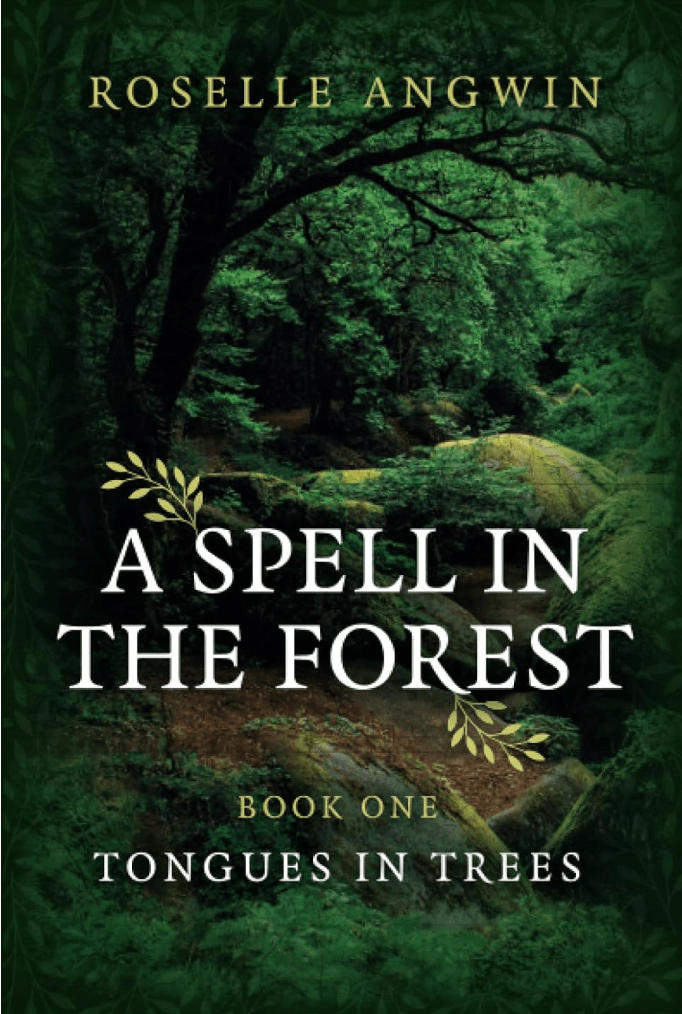
Rosie Angwin. A Spell in the Forest, Moon Books (John Hunt Publishing): 2021, 262 pp, Pbk. £18.99.
One summer afternoon, un-forecasted thunder boomed as a friend and I were crossing a bare ridge 12,000 feet up in New Mexico’s Sangre de Christo Mountains. Hail and wind chased us, gasping and terrified, down towards the relative safety of diminutive Krumholtz trees. A warm glade of ancient pines opened around us, barely taller than our heads: we were guests saved from a storm. In a moment, we experienced the forest as a living, respiring, collective that, thankfully, included us.
I recalled that experience often as I read Roselle Angwin’s A Spell in the Forest. Spell’s hybrid of essay, mythology, speculation, spirituality, poetry, and experiential tasks is intended to inspire readers towards a closer relationship with trees. Angwin’s book suggests that mythology and spiritual experiences can inform our responses to and understanding of trees, and it points towards mythology and spirituality’s value in facing the ecological crisis.
Spell arose from the author’s course “Tongues in Trees,” during which students studied each species on Angwin’s version of a Tree Calendar and then responded creatively. Drawing on a variety of ancient and recent sources, Angwin’s interdisciplinary work sits largely outside of academic disciplines, including Celtic and Folklore studies, and outside any formal religion, although Druidism’s desire to promote honorable relationships with the natural world informs this work. In addition to science, mythology, and history about each tree species, Angwin’s Tree Calendar offers her “own sense of an archetypal system that works…at an imaginative level.”
Angwin’s system didn’t entirely work for me (as someone else’s system for anything rarely does), and I didn’t find every page of the book satisfying, but I did find Spell a productive book to think and feel with. I share with Angwin a deep interest in the non-human world and how humans relate to and with it. As I am writing, I look out onto a forest on Galiano Island, one of the Canadian Gulf Islands, a narrow, forested outcropping between the mainland of British Columbia and Vancouver Island. It’s home to 1500 people and Biodiversity Galiano, an attempt by citizens (including visitors like me) and scientists to name every species of the island: animal, plant, fungal, and protozoan, including marine life to a kilometer offshore. But Angwin’s work reminded me that naming isn’t all there is to knowing, and scientific study isn’t the only way to understand nature.
Angwin’s book encourages readers to look back towards something our cultures once considered sacred, trees, as a means to bond with ourselves and the natural world. Her tree calendar connects the natural cycle of a year to our lives. As we face ecological crisis, mythology and spirituality, reminding us of how trees have been sacred, may allow us to again find reverence for the natural world.
This summer the coastal Pacific Northwest has been temperate, so although I have grown used to finding my favorites trees and forests burned or ailing, this year, mostly, the trees look good. Sometimes too good. English Holly, which I learned from Spell is beloved in Great Britain for its association with Christmas and the Winter Solstice, as well as the Holly King in Celtic folklore, is an invasive pest in my home state of Washington. Astonishingly, it seems to have been first planted—we have no native holly—in an attempt to protect the East Coast’s native holly, ilex opaca, which was being overharvested for Christmas greens, a fact which points us back towards the sacred that humans seem to innately find in trees.
Over the course of this summer, as I found the species in Angwin’s calendar, I considered the botanical, ecological, and mythological information about each tree, alongside the creative work (her own and that of others) collected about each species. I felt the Birch’s “branches of owl-call and distance,” saw the “green aura” of the young Ash, and I am now watching Apples gleam “like small suns,” on trees standing heavy with fruit, at the threshold of the autumn season. Passing through fog between the narrow trunks of my young Hawthorn and Service Berry, I have the feeling, so often evoked in Angwin’s work, of crossing a doorway into another realm. I sense the trees around me oscillating between familiar and powerfully strange.
I didn’t love this book; although many of its stories and poems open up new ways of thinking and feeling about trees, some of the poetry felt obvious—personal without resonance—and some of the prose discursive to the point of rambling. Although Angwin provides plentiful material to inspire our understanding of each species, she doesn’t provide any visuals, which seems a lack in book that encourages sensory experience. Similarly, Angwin has a deep knowledge of Celtic myth and literature that she assumes readers share. Both of these choices effectively narrow her audience for what’s ostensibly an interdisciplinary exploration. There also were times when I felt she was hacking at material for her own purposes. Regarding lines from the “Song of Amergin” she describes “mixing, matching, merging, and sometimes departing all together from the traditional translations…when I have good reason to.” That is well enough, but because she never quotes the whole poem, readers like me without prior knowledge of the work/ cannot know the context she is recalling and miss out on encountering a great and important poem.
Ultimately, despite its shortcomings, Angwin’s project is important; in the face of the ecological crisis, A Spell in the Forest provides a means, different from the naming and studying of science, for humans to know the species with whom we share our world, a necessary first step towards improving our relationships within and with extra-human lives and systems. Perhaps readers, especially those interested in Celtic mythology, can use this book to nurture understanding of and relationships with trees, as well as to generate creative work. Spell... should also stimulate academic and creative consideration of how mythology and spirituality can and do influence human relationships with the natural world.
Sarah Bitter is a writer from Seattle, Washington. Her poetry has been published in Denver Quarterly‘s FIVES, River Mouth Review, The Seventh Wave, and other publications, and has accompanied art at the Page Gallery and the Goldfinch Gallery, while her prose has been featured in Poetry Northwest and EcoTheo Review. Sarah has an MFA from the University of Washington.
Discover more from Modron Magazine
Subscribe to get the latest posts sent to your email.

 Modron Magazine