Interview by Glyn F. Edwards

Welcome back to our series on writing the #MoreThanHuman, a set of interviews with poets and writers on how they approach writing about the environment. The more-than-human is a phrase that seeks to side-step traditional nature-culture dualisms, and draw attention to the unity of all life as a kind of shared commonwealth existing on a fragile planet. It also reminds us humans that there is more to life, that there is more world, than the human; it relocates us in relation to the mystery.
This week’s interview features Lydia Harris, who has made her home in the Orkney island of Westray. Her first full collection, Objects for Private Devotion (Pindrop 2022) was long listed for the Highland Book Prize. Her second collection’ Henrietta’s Library of the Whole Wide World is out with Blue Diode now.
Ear Moss
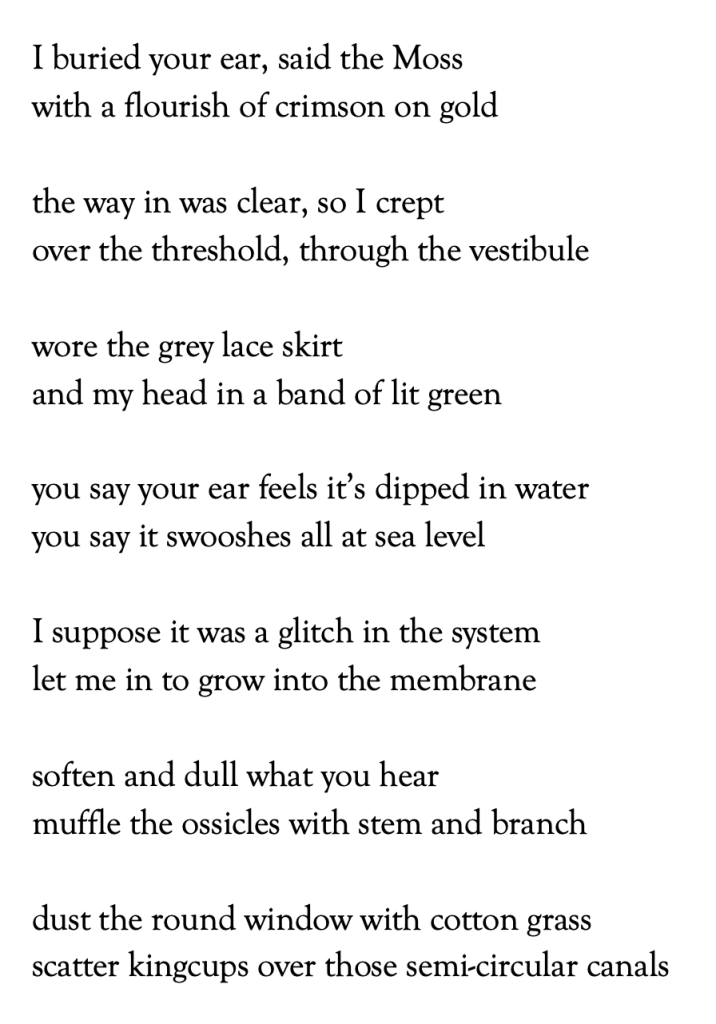
Glyn F. Edwards: A quick web search shows ‘Ear Moss’ as the pair of fungi ‘Moss Ear’ and ‘Jelly Ear’. Is your ‘Ear Moss’ a variation on one such fungus or a more literal moss growing on a human ear? Is such fungus growing on a corpse, or is it a ‘glitch in the system’ causing decay in a live ear?
Lydia Harris: I wrote ‘Ear Moss’ when I was exploring and getting to know the island’s only remaining peat moss which is called White Moss. I think in Scotland generally moss refers to boggy ground. Once, Westray would have been covered with extensive mosses but drainage and modern farming means most of it has gone.
I love the moss for its depth. Who knows how many fathoms of peat there are and what has found its way in, maybe antler tines, worked stones, lengths of heather rope. I love it for the variety of sphagnum mosses which grow into tumps and tussocks and feel almost animal when you touch them. The place is full of flowers and sedges and grasses. And it is unfenced land.
Anyway it is such rich inspiration for writing. And when I wrote Ear Moss earlier this year I was deaf in my left ear and it is such a peculiar sensation!
Glyn: The poem seems to explore the human body through the growth of a further organism, in some ways it is like natural first person endoscope. Is the repositioning of humans consider the more than human a theme in your work?
Lydia: I find myself humanising places and plants these days. I do think of the moss as a creaturely being. When I first visited the moss I felt it absorbed me and my rather chaotic thoughts. I think mosses have often been regarded as places of otherness.
Glyn: If ‘Ear Moss’ was considered a contemporary sonnet how would you identify the unconventional ‘love’ that appears to exist in the exchange? In what ways do you feel ‘Ear Moss’ and your poetry in general enable a reader to creep ‘over the threshold’ to recognise the more than human?
Lydia:I am rather wedded to couplets. I am also a bit thoughtless to my reader. Because I have written so many moss poems I rather carelessly think the moss is present in a way which is more complete than it actually is.
Discover more from Modron Magazine
Subscribe to get the latest posts sent to your email.

 Modron Magazine
What a delightful poem—and poet— to reintroduce your more-than-human series. Lydia Harris interweaves the human and other-than so intricately here, into a new kind of organism, through the medium of our language. Thank you.
LikeLike
Thanks for writing! We love this poem too!
LikeLike
This one really affected me, as I’m both deaf and entranced by mosses and lichens. It was strong, clear and powerfully tactile-really memorable-thanks!
LikeLiked by 1 person
We appreciate the feedback! This is good to know!
LikeLike