Noreen Masud, A Flat Place: A Memoir, Penguin: 2024. Hbk £16.99. Pbk £10.99. Ebook £6.99.
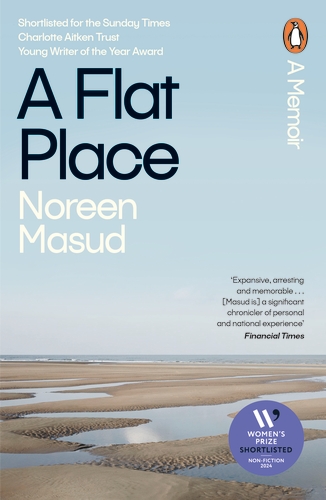
As flatness offers respite to Noreen Masud, A Flat Place offers an antidote to the tropes and constructs that threaten to make some nature writing a slightly contrived product of a flourishing commercial market; a central aspect to its success is the originality of its form: part environmental writing, part memoir, part socio-political essay, part polemic. And somehow, using the starkest landscapes as her lens, Masud is able to write about place and race, and fauna and trauma simultaneously.
In her introduction, she questions, ‘Why do I love flat landscapes so much? Why do they quieten the thing in me that’s always crying? Flatness is a puzzling thing to love’ and throughout the memoir, the reader seems to ponder similar quandaries: what is it about this writer’s voice that is so engaging – is it her abruptness, her honesty, her humour? One endearing feature is that Masud does not profess to be an ecologist, or a nature-writer. She loses her way, arrives unprepared, acknowledges when she is underwhelmed, or finds a person or situation overbearing; when she picks through the bones of a bird skeleton, she doesn’t seek to intimidate or impress with esoteric knowledge; she archives, she processes, she shares.
In the UK edition, on the front page, below the title A Flat Place, are the words ‘a memoir’, but on the US version the subtitle is extended to read, moving through empty landscapes, moving through complex trauma. The epilogue explains how the book began ‘solely’ as ‘a study of encounters with flat landscapes’, but the aspect of psychogeography was so intrinsic that the narrative needed to adapt: ‘I came to understand that the complex trauma I sustained in my early life was an element which could not be omitted.’ And so the ‘first flat place’ is the emotional and geographical juxtaposition between the ‘green misted fields…glimpsed from far away’ and ‘the flat stone floors’ of her house in Pakistan. Masud reflects on a youth where memory is elusive, where her ‘father put his two big hands on the ground around us, and we crawled around inside’. It is distinctly clear that both she loved and loathed this controlling father; less clear is how she existed so long in the hiatus between fear and fascination that a sense of loss, perhaps grief, became intrinsic long before she emigrated to the UK with her mother and sister. Akin to any prolonged study of a surface, Masud frequently discusses depth in the memoir: depth of vision, volume of history. After the first chapter, the reader begins to understand that below these liminal spaces, ‘very gently and deeply, like a whale passing beneath a boat, a long animal just under the surface’, is the presence of her father.

A Flat Place is divided into separate journeys across the UK. Geographically, Masud travels from Ely to Welney, to Orford Ness and Morecambe Bay, to Newcastle Moor and Orkney. In Ely she investigates a landscape shaped by human intervention, where after the Scientific Revolution, nature was seen being distinctly different to culture and the fens were drained and dredged as testament to the power of engineering. In Morecambe, the tides and sands of the bay are so precarious ‘the path had to be renegotiated, made afresh, the safe places moving with the tides and seasons. No old way could be relied upon’. But these are personal journeys too, and she begins to navigate her own condition alongside her counsellor, as she travels with friends and with her mother, while she chronicles often overlooked places. By Welney, she transposes the abstract binary oppositions over a ‘natural self’ and resolves that ‘nature and culture intertwine indissolubly in the fenlands, as in every person’. In Morecambe, she is ‘connected to a bigger network’ and finds comfort in other walkers, all ‘doing their best to break whatever cycle they found themselves in, on this day out with their family, to find something good.’
Masud’s extended exploration one the country’s largest common spaces, Newcastle Moor, takes places during the COVID pandemic, where the rhythms of her complex PTSD seemed well-suited to the isolation and hyper-regulation that caused others to experience loneliness:
Incredibly I was adapted for the situation I found myself in. Growing up behind chicken wire in a house of crisis meant I knew how to deal with what was happening. This was the worst, or a version of it. All my muscles relaxed. The new normal was my normal.
Because ‘we don’t know how to look at places which don’t do anything’, Newcastle Moor’s urban wide expanses have been coveted for centuries. While the capitalist mindset seeks to unlock potential for private gain, the socialist wants to situate philanthropic endeavours there; Masud, refreshingly, is content to practice looking at the same place from different perspectives, which leads her to take particular interest in idiosyncratic structures from aerial photographs, and to make a unique discovery.
When organising her trip to Orkney, Masud poses an interesting anthropological question whether ‘stone circles were even monuments at all’. She cites the archaeologist Colin Richards who suggests ‘rather than being built solely as ritual or ceremonial centres it may have been the actual acts of construction that provided the main sole focus’. Perhaps, incongruously, it is because we ‘use such poor, narrow, clumsy categories to try and grasp the unknown’ the writer invites her mother to accompany her on the book’s final journey to Orkney. And, because Masud is as tender to the reader as she is to the sites they visit on the remote islands, somehow, writer, mother and reader all encounter catharsis at Skara Brae and, ultimately on a beach on Stromness.
A Flat Place is always topical, and the final chapter considers again the problematic social and historical ties of empire, of imposing a religion and rules of division on foreign people, of inherent aspects of racism made prominent by the Black Lives movement. Ultimately, this is Noreen Masud’s study of her singular trauma in our common flat places, but it invites us to reflect on the very notions of land, and space, and of belonging.
How, and what, do we know? A flat landscape tells me that we never really know ourselves, let alone anyone or anything other. And so it gives me an ethics to live by.
Glyn F. Edwards’ In Orbit, by Seren, was voted People’s Choice at the Wales’ Book of the Year. His first collection, Vertebrae, was published by the Lonely Press. Glyn is the Writer-in-Residence at the North Wales Wildlife Trust and edits the feature Wild Words for the trust’s quarterly magazine. He is a PhD researcher in Ecopoetry at Bangor University, and has an MA in Creative Writing (Poetry) from MMU. Glyn works as a teacher in North Wales.
Discover more from Modron Magazine
Subscribe to get the latest posts sent to your email.

 Modron Magazine
I read A Flat Place recently with enormous interest. This is a really perceptive and lucidly expressed review that does full justice to the book. Ros 🙂
LikeLike
Thanks for commenting! We agree about the book, and we are glad that you enjoyed the review.
LikeLike