WRITING PROMPTS TO BENEFIT CHILDREN IN GAZA
UNICEF reports that in Gaza, “hundreds of thousands of children and families are caught in a catastrophic situation” and that, as of November 14th 2023, over 4200 children have been killed and more than 7000 have been injured “due to unrelenting attacks”, while over 1300 others are missing. According to the World Health Organization, one child is killed in Gaza every 10 minutes. Outlining the charity’s Appeal for Children in Gaza, UNICEF spokesman James Elder explains: “Gaza has become a graveyard for thousands of children. It’s a living hell for everyone else.” Elder has also called for “children held hostage in Gaza [to] be immediately reunited with their families and loved ones”. Recent updates state that “hundreds of thousands of children … remain trapped in a war zone with little or no access to food, water, electricity, medicine or medical care”.
For the duration of NaNoWriMo, we will be posting a writing prompt every day and in doing so, we are hoping to encourage our community to donate to charities providing medical aid to children in desperate need in this unprecedented crisis.
These prompts have been created by writers from Wales or with a connection to Wales and its magazines and presses. The prompts are on all kinds of subjects, but many are related to anti-violence and the work of empathy, and they are offered with the simple hope that they might encourage people to donate in support of medical aid in Gaza. We include a list of suggested charities to donate to below, highlighting the Appeal to Children in Gaza.
UNICEF “continues to call for an immediate ceasefire as 1.1 million people — nearly half of them children — in northern Gaza have been warned to move out of the way of a widescale military assault, but with nowhere safe for them to go”. Elder concludes: “The humanitarian situation has reached lethal lows, and yet all reports point to further attacks. Compassion – and international law – must prevail.”
DAY 20: PHILIP GROSS
Macaronic Verse
… is poetry in which two languages co-exist, often in alternating form, so that one seems to comment on the other. Historically, this has been used for irony or protest; this poem from 14th century England alternates lines of Middle English with medieval Latin – roughly, the language of the common people set against the language of power in that time. (The translation on the right is very rough!)
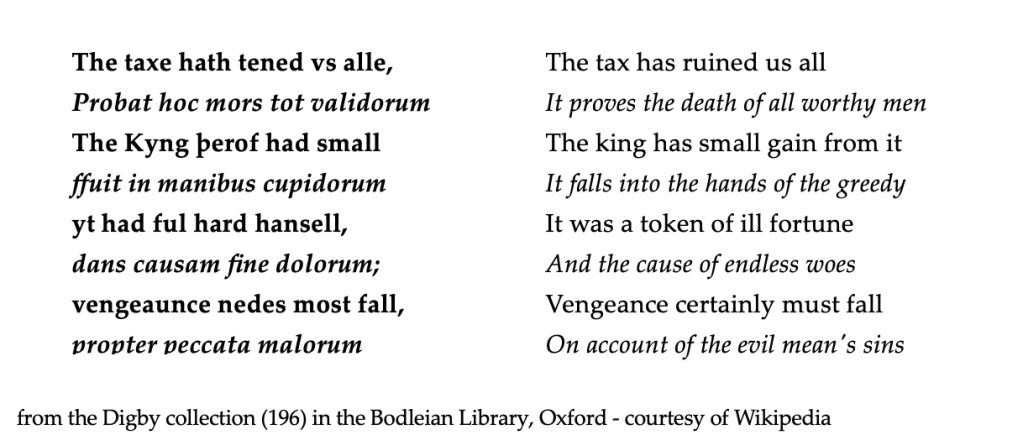
This can be a great discipline for the ear: asking one language to rhyme with another makes us aware of the different, never quite compatible, sound qualities of each.
Macaronic verse can be used to explore more sensitive emotions too – the poem below may make a real French speaker wince, but the distance, the sound-slippage, even the mistakes, between the languages is meant to be part of the point:

You don’t need to know two languages to write macaronically. There are so many branches to the worldwide family of English – traditions, dialects and accents – and so many registers: the legal, or the bureaucratic, the languages of medicine or politics, any sub-culture; each has its own tone and vocabulary, its own references and clichés.
Try a macaronic poem in two registers of English. How you define those registers, and whether you use rhyme or not, is up to you. The main thing is to hear the difference between them and make creative use of it.
Please find a WORD accessible version of this prompt at this link.
Please consider donating to a charity providing medical aid in Gaza. We recommend UNICEF’s Appeal for Children in Gaza, but other charities include:
Palestine Children’s Relief Fund
Discover more from Modron Magazine
Subscribe to get the latest posts sent to your email.

 Modron Magazine