
Welcome back to our nonfiction series titled “Plots & Plants”, inspired by intimate connections with place and the natural world. Plots & Plants is a space for nonfiction from writers and environmentalists to talk about places special to them. This series will be an archive and record of places for us to reflect on as time passes, and as we continue to experience environmental emergency and loss. This week we visit Cathays Cemetery with Rachel Carney.
Rachel Carney is a Cardiff based poet, visual artist, creative writing tutor and academic. Her debut collection Octopus Mind was selected as one of The Guardian’s Best Poetry Books of 2023. She worked in museum learning, research and community engagement for several years, and recently completed a PhD, examining how ekphrastic poetry can enrich our engagement with art in museums. She currently teaches at Cardiff University and Swansea University. Her poems, articles and reviews have been published in numerous magazines including Poetry Wales, Envoi, Under the Radar, New Welsh Review, Ink Sweat and Tears, Poetry Saltzburg Review and Acumen.
A sanctuary can be defined as ‘a place of refuge and protection’, or ‘a refuge for wildlife where predators are controlled and hunting is illegal’. In a spiritual sense, a sanctuary is often understood to be a ‘consecrated place’, a place that has been set aside as holy, for a specific purpose. And I have found, by accident, a sanctuary that fulfils all of these criteria, and more.
In 2020 I was struggling with my health (post viral fatigue, and a rather traumatic tooth extraction). As so many of us sought out local parks and gardens, these spaces became crowded and noisy. I needed to be outside. But the social distancing laws meant that I could not go for walks with friends. And when you are struggling with mental and physical health, there is nothing more lonesome than being surrounded by a crowd of cheerful strangers.
There were tentative smiles, and greetings with neighbors. But what I needed (as someone with no garden of my own) was a quiet, private outdoor space.
Eventually, I found such a space in Cathays Cemetery, not far from where I live. More specifically, I discovered a small patch of mown grass, among the gravestones. I could sit down, on this particular patch of grass, approximately five metres from the edge of the path, and be completely hidden from view, surrounded by brambles and dandelions, and long grass and foxgloves, by butterflies and solitary bees, going about their business.
It was what I needed: to be immersed in nature in such a way that I could let my mind and body heal.
Time seemed to slow down in that place.
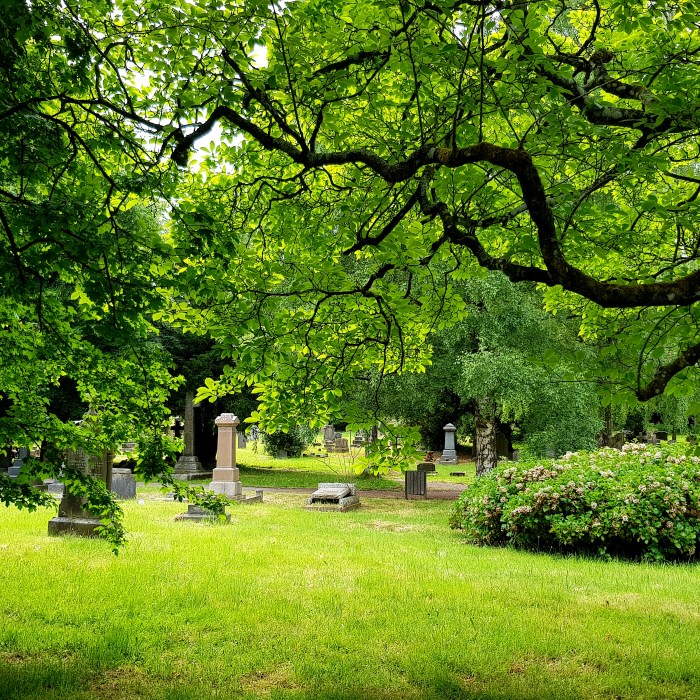
But this was not just a sanctuary for my body, or for the small creatures and hidden eco-systems that thrive in that place. It was also a sanctuary for the soul.
I often find that an old church building contains a sense of immensity and peace that builds up over the years from generations of prayer and longing. The weight of prayer and grief and hope that has filled that cemetery over the years felt almost tangible, in the silence.
I sat there, surrounded by bees, and privacy and birdsong. And also, by something deeper, and more difficult to explain. It felt like freedom: a sense of faith in God, made solid and touchable in the form of stone statues and crosses. There was a sense that, while so much sadness and pain has soaked into the soil of that place, hope, too, was woven into the earth. And hope was what I needed.
That piece of ground which was set aside more than a hundred years ago to accept the pain and heartbreak of the citizens of Cardiff was not just a burial ground, or a protected habitat for birds and insects. It became, for me, a ‘place of refuge and protection’, and of healing.
Discover more from Modron Magazine
Subscribe to get the latest posts sent to your email.

 Modron Magazine