Welcome back to our nonfiction series titled “Plots & Plants”. We have a busy week this week as Earth Day is coming up on Tuesday 22nd April, featuring work by Rebecca Goss, Maggie Harris, Joshua Jones, Özge Lena, Jonaki Ray, and CJ Wagstaff, as well as a review of Hanan Issa’s recent ecological film, and a feature from a new collective, Thrutopia Poets. Please take this essay as a starter before the main course, celebrating and highlight Earth Day on this important week.
The Plots & Plants series is inspired by intimate connections with place and the natural world. Plots & Plants is a space for nonfiction from writers and environmentalists to talk about places special to them. This series will be an archive and record of places for us to reflect on as time passes, and as we continue to experience environmental emergency and loss. This week we visit the Vale of Glamorgan with John Freeman.
John Freeman’s latest collection is Plato’s Peach (Worple Press). His What Possessed Me
(Worple) won the poetry section of the Wales Book of the Year Awards in 2017. Other
books include Strata Smith and the Anthropocene (Knives, Forks and Spoons Press), and
Visions of Llandaff (The Lonely Crowd Press).
Letter to a Grandson
I thought you might like to know about a favourite walk of mine near our village, and an incident that happened recently.
Where we live there are animals in the fields. Pigs in one place, cattle in another, sheep and lambs everywhere. And horses. Sometimes people riding horses pass us as we walk along the lanes, and up the paths out of the village. There are two of these paths, called bridle paths, which means they’re suitable for riders with their horses and their bridles, the leather straps and reins by which the riders guide them to go left or right, stop or walk on.
These paths have been there for so long they’ve sunk below the level of the fields around them. The bridle path where I most like to walk is overhung by trees on either side, and you can see some of the trees’ roots exposed in the earth of the banks, sometimes at head height.
At times when we’ve had a lot of rain, the ground underfoot is muddy, with pools in hollows left by the hooves of horses. Climbing up them, it can be quite difficult in places not to lose a shoe where you’ve pressed down in the mud. Trying to lift your foot for the next step it’s as if the mud wants to hold onto it. I’m not comfortable in wellingtons walking any distance, I wear trainers. Many’s the time I’ve come home with mud spattered halfway up my trouser legs. Other times, the bridle path is so muddy and uneven I don’t even try to walk there, and instead stick to the tarmac of the lanes, standing back every so often against the hedge or bank to let a car or van drive slowly past me.
Recently we’ve had a long spell of dry weather. Where the bridle path was mud you could sink into, the same mud became firm enough to walk on. More and more of it dried out completely, became a lighter colour, not black but brown, pale yellowish brown, some of it dry as dust. It’s been a pleasure to rediscover, after the wet months of winter, what it’s like to walk up under these trees, catch glimpses of fields beyond them with woolly sheep and lambs. Sometimes just enjoying being down here, with the banks, held in place by the trees’ roots, blocking my view of anything beyond them.
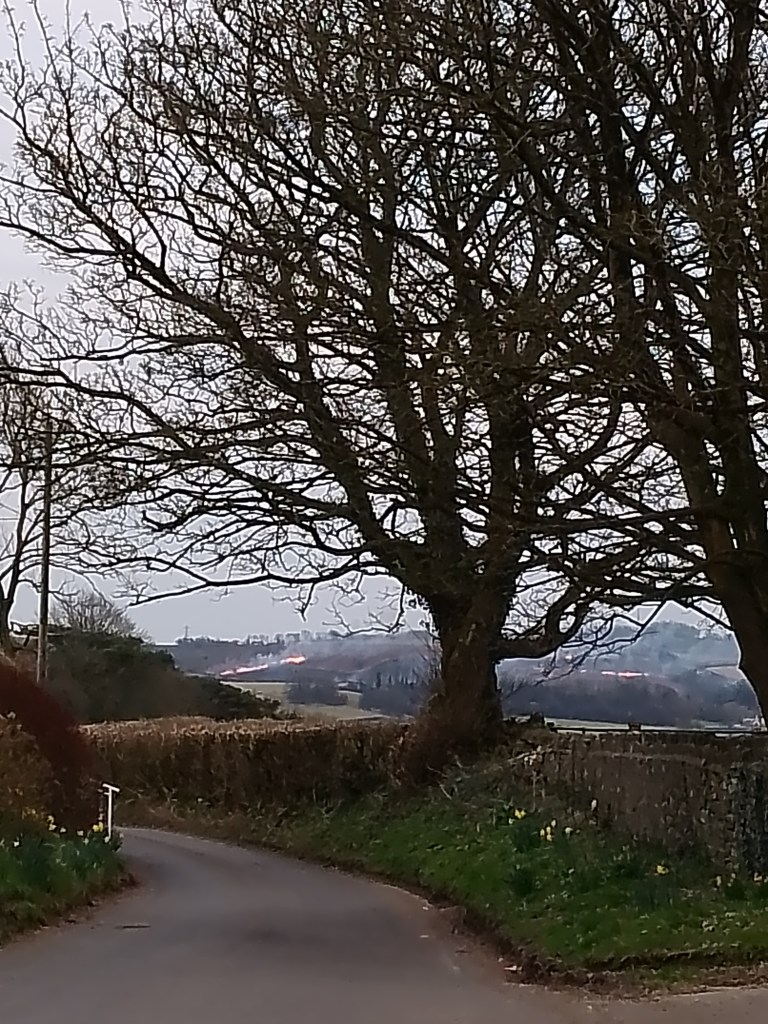
At last the path rises to the level, and leaves the trees behind, so there are views across the fields and hills. It turns left, westwards, and as I walked there last Monday evening I looked down towards the Bristol Channel, the glint of water visible between the cliffs along the coast here in South Wales, and, on the further shore, a range of hills in Somerset in the southwest of England. The countryside that stretched out before me is all part of the county called the Vale of Glamorgan.
It’s a vale, or valley, compared to the hills northwest of where we live, the Black Mountains and Bannau Brycheiniog, but the land rises and falls even here, so I can see a road climbing a hill, which I recognise as Stalling Down, so steep the road zigzags up it. When we drive there we go very slowly, because the hairpin bends mean you can’t see if there is someone coming the other way until you’re nearly on them. The road is narrow, with steep banks, so cars can pass each other, but only carefully. At the top of the hill is an area of open grassland where some people like to walk.
As I looked towards this hilltop, I could see black smoke rising from somewhere close to it, and then a flame. I thought perhaps a house, or a barn, or some other farm building was on fire. I went on walking along the bridle path, past the riding centre, with horses in the fields, and out onto the road that leads downhill back to our village. I could still see flames, and now they spread rapidly in a line of red along the top of Stalling Down, and on crests to left and right of it.
I wondered if the trees as well as grass were burning in the distance. Had the same lack of rain, that has dried the mud on the bridle path, left the winter trees, still without the green leaves that will cover them as spring progresses and turns into summer, as easy to catch fire as all that grass?
At last I saw, among the lines of red, a flashing blue light. It might have been a police car, for all I could see from where I looked across the intervening country, but I expect it was a fire engine.
When I got home I looked on local news websites, but found no mention of what seemed to me an incident worth telling people about. Next evening, though, on Tuesday, bigger grass fires in parts of south Wales further west, were reported on, with video pictures of flames, like the ones I’d seen myself. That morning I had driven with my friend Peter up Stalling Down on our way to walk in a place called Dyffryn Gardens, and we had seen an expanse of what had been pale grass, partly green, partly bleached with the drought, and was now an unbroken stretch of blackened stubble.
On Friday when we met our neighbour, Julia, she told Nana and me that she and her friend Jane had driven with their dogs to Stalling Down on Monday, and had just begun to walk with them, when Julia suddenly saw flames racing towards them, some of the same flames I’d seen from across the valley. They had hurried back to their cars and driven home, not the way they’d come, that zigzag lane, but a longer way round, to avoid the fire.
So this was news in our quiet village. It’s unusual to have wildfires so early in the year in this country, in March, but climate change has made things more unpredictable. Nobody knows what started this fire, the first one so close to our home in all the years we have lived here, or those bigger fires next day, but when there’s been no rain for weeks it doesn’t take much at all. Perhaps the smouldering end of a cigarette, thrown down among the undergrowth, apparently put out, slowly working away among the brambles, warming some light leaflitter till it catches, still hidden, where nobody nearby can see it – and, likely as not, there would be no one there anyway. But slowly the fire spreads, and gains momentum, until people far and wide have noticed it.
Discover more from Modron Magazine
Subscribe to get the latest posts sent to your email.

 Modron Magazine