Interview by Zoë Brigley
Welcome back to our series on writing the #MoreThanHuman. We offer a set of interviews with poets and writers on how they approach writing about the environment. The more-than-human is a phrase that seeks to side-step traditional nature-culture dualisms and draw attention to the unity of all life as a kind of shared commonwealth existing on a fragile planet. It also reminds us humans that there is more to life, that there is more world, than the human. It relocates us in relation to the mystery.
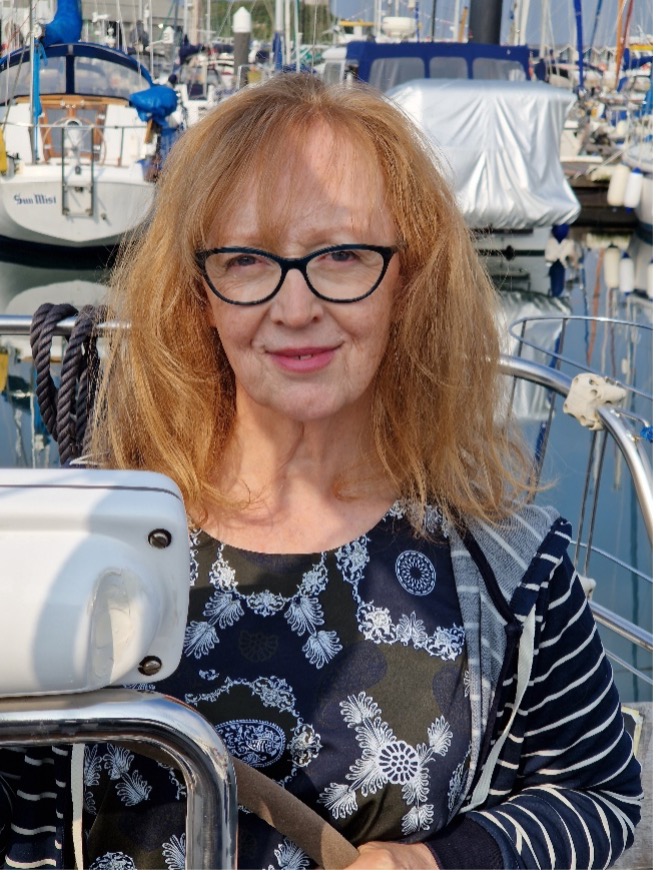
This week we meet Lesley Curwen, a poet, ex-BBC reporter and sailor from Plymouth. She often writes about ocean pollution and the effects of consumerism. Her pamphlet ‘Rescue Lines’ is published by Hedgehog Press and an eco-chapbook, ‘Sticky with Miles’ is from Dreich. She won the Molecules Unlimited Prize in 2024 and her poems have been nominated for Forward and Pushcart Prizes and Best of the Net.
Night on the Yealm

Zoë Brigley: How did this poem come about? Was it a remembered or imagined scenario?
Lesley Curwen: It was written as it happened, after I woke up on our little sailing boat while we were moored overnight on the river Yealm in Devon. I wrote it on my phone at about 4am. It is intensely quiet there, in a deep creek between tree-lined cliffs. Even though there are houses nearby and boats on the river, it feels very far from the everyday world. It seemed to me that the noises of nature were all I could hear, that everything human and mechanical had been silenced. The slight rocking of the boat as she drifted around the buoy was calming. It felt as if we were at the mercy of the tides (and therefore the moon) but were also safe, and I saw our tiny orbit around the buoy as an echo of the earth moving around the sun. It seemed like a sensory manifestation of the forces that act on us, the birds, the trees and the water, all the time, without us noticing.
Zoë: Something I enjoy about this poem is the extent to which it devotes itself to the moment: to the moon, the cliffs, the skies, the detail of everything. It puts me in mind of slow movements based on taking time to appreciate the world around us. The human doesn’t necessarily come into the poem until the line “I wake” and the use of the bird app on the phone. There’s a sense of loss in the “loom[ing]” dawn. How important is that immersion in nature to you as a writer? Does it mean giving up something of the self and its concerns to create effective writing about nature?
Lesley: Immersion in the moment can be really hard to achieve, and I think it’s tough to convey that through writing. I do find those moments when I’m sailing, and also sea-swimming. I often have images, or lines of words that come to me in the water. You ask if it means giving up something of the self? I don’t agree. We can suspend concerns in the foreground of our minds while absorbing fully what there is to see and feel. I think it’s about allowing the senses to take over from the nit-picky logic we usually deploy.
Zoë: This poem is highly imagistic. Is Imagism a movement that you admire, and who are your favourite poets in terms of creating highly moving or effective imagery?
Lesley: I do admire aspects of Imagism, and some of my poems have appeared with Black Bough Poetry, a publisher which is largely devoted to imagist and imagistic poetry. But many of my poems are not imagist, including those that deal with sensitive issues such as coercive control and forced adoption, issues which have affected me and my family.
You ask who are my favourite poets who deliver heart-stopping imagery? I would have to choose Pascale Petit and Fiona Benson.
Zoë: Is there anything else you want to tell us about this poem?
Lesley: Of all my sea poems, this is very untypical as it says nothing about marine pollution. I have written a lot about microplastics and other damage to our oceans. This is simply a poem of gratitude, and of contemplation.
As a sailor, I have often felt the fierce power of tides. So the key moment in the poem is – slack water, when the boat lies still, when all the forces, gravitational and tidal are held in balance. It is a moment of reflection between the push and pull. Living things (birds, trees, humans) and the inanimate (cliffs, water, stars) experience a strange togetherness, waiting for the inevitable rush of normality to resume.
Discover more from Modron Magazine
Subscribe to get the latest posts sent to your email.

 Modron Magazine
Wonderful ♥️
LikeLike