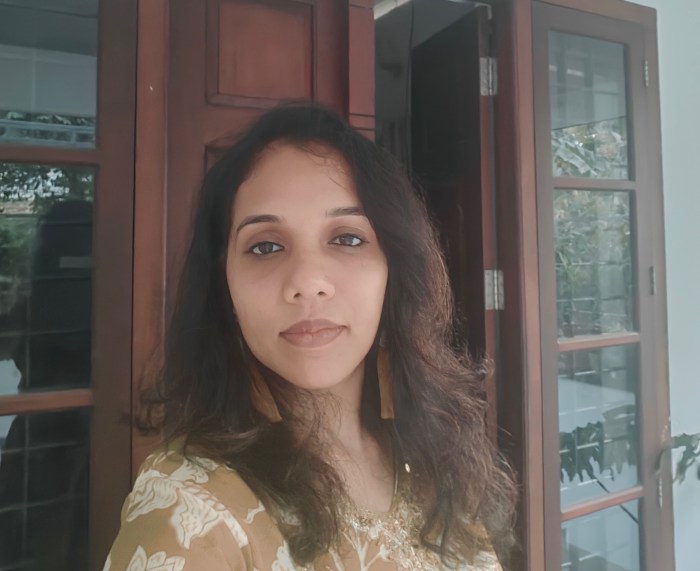
Interview by Glyn F. Edwards
Welcome back to our series on writing the #MoreThanHuman. We offer a set of interviews with poets and writers on how they approach writing about the environment. The more-than-human is a phrase that seeks to side-step traditional nature-culture dualisms and draw attention to the unity of all life as a kind of shared commonwealth existing on a fragile planet. It also reminds us humans that there is more to life, that there is more world, than the human. It relocates us in relation to the mystery.
This week we meet Rahana K. Ismail, the author of Newtness (Yavanika Press, 2022). Her poems have been featured in The Yearbook of Indian Poetry in English (2021, 2022), Penn Review, Alchemy Spoon, among others. Rahana is a poet and doctor from Kerala, India.
Bottle
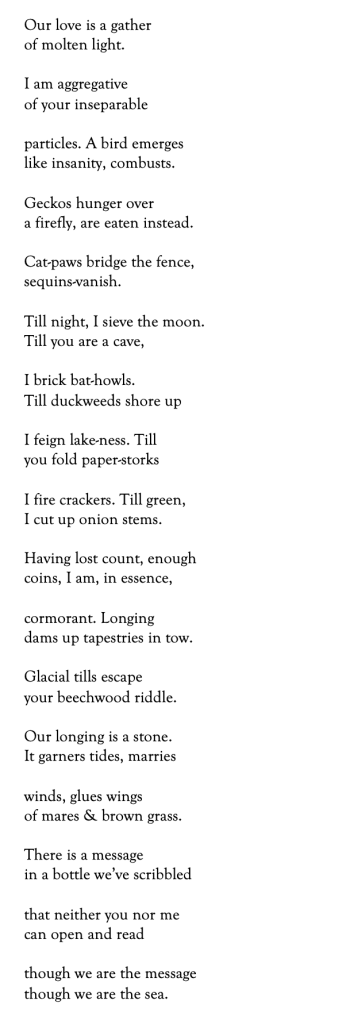
Glyn Edwards: The first question is the one any reader will ache to ask: what is the ‘scribbled’ message that lies in the bottle?
Rahana K. Ismail: The poem, and all that it stands for, begins with the conception of the bottle, an-early-star-birthing-in-infant-galaxies like event and invests itself in this bottle-ness all through and concludes with the gaze going into the interiority of this universe and abruptly zooming out into what floats it.
The bottle, conventionally just a vessel and vehicle for the message inside, becomes the message, the very existence of which dims the significance of what’s contained within it. Still the message is very much present—scribbled by the mammalian prowl of time, the reptilian stealth of life’s insidious-ness, the avian flashes of the first wings of a poem, the recalcitrance of fern-prints and our fossilized memories though the bottle itself predates all of them.
It’s up to the reader to come upon this jungle-ness and pick it up: whether the existence of love is the overarching message in and of itself or the infinite intricacies of its expression in us—the silence and sadness of love, the anger and agony, the possessiveness and pessimism, the desperation and drunkenness, the insanity and isolation, the caverns and craving, everything ephemeral and simultaneously eternal. Love that nests inside of us which in turn nests us—like the sea floating the bottle that encases the scrolled hieroglyph—‘though we are the message/ though we are the sea’. It’s up to the reader to read the poem in a way that’s conducive to the landscape they live on—be it mundane, mystical, or metapoetic—‘reader, we are carbon, and more’, to quote from Erica Hunt’s poem ‘Reader We Were Meant to Meet‘.
Glyn: The poem is fascinating in how it uses conversion – when a word class is used beyond its regular function. Is this permeable play a feature in how you conventionally explore the more-than-human as a theme? Which aspects of the liquid language in ‘Bottle’ gave you the most joy as you wrote it?
Rahana: Over the years, I have forsaken the habit of silo-ing words into classes (this was not a conscious decision, but an eventuality in the evolutionary process). If I linger long enough on a noun, I sense movement—the river rivering—though this preoccupation happens subliminally. I believe it cracks open an unprecedented path rendering a closer look at a clearer imagery. The jungle—the northern sun on a twirl of vines, an impending pounce, the permanence of the foraging deer moments before it’s clawed into, the dried moss on the beechwood trunk shining in tomorrow’s rain—defies the rigid construct of time.
So my poems feature verbs like uncobble, soft-stitch, slug, mold, stencil, planet, and so forth. A similar event happens with a verb—it solidifies and becomes denotative of things (‘our love is a gather/ of molten light’) lending us a freeze, a capture of what’s transitory, all that’s melting.
You ask about the instance in ‘Bottle’ that gave me the most joy when I wrote it: it’s the first line—the whole poem started gathering around the word ‘gather’ for me—like the even-spaced stitches of crochet around the central hole. My poems make room for a jungle of clearings, a jumble of days, the nod of sunset, the simmer of anger, the snail of his ear, the shell of his shrill fever, the sieve of her fingers, the sky of shadow, the sprawl of air, a glug of unconcern. They tend to describe things with adjectives like scalpelled (rocks), misted (mirrors), stone-seared (names), ill-geared (wince), unpaved (stones), engorged (evenings), veiled (morning-fog), soundless (time), rust-ribbed (cage), citrous (homeliness), soured (sweetness), yellowed (afterthought).
In the poem ‘Newtness’, children become newts floundering in seas of bewilderment, scampering/ to grow out of gulfs, gasps/ caught in the seaweed-jungle of growing up. In my ‘The Sculpture of Pathumma’s Goat, Kozhikode’, the poem reads “I can see your face in it”, the way you see the skies of your futures in it—your children morphing into the steel of the milk and the moon with your house and the town. I immensely enjoy the play of linguistic fluidity (both as a reader and a writer)—the fluctuating viscosity, the surprise of sublimation and an instant dry ice-like freeze—and I hope the readers sense the joy in these lines.
Glyn: ‘Our love is a gather’ … ’Our longing is a stone’. It could be said that one of the virtues of first person narrative voice is how it invites the reader to engage the poem a sense of volition. By writing in first person plural, how much of the reader do you seek to include the ‘love’ and ‘longing’ of the ‘bottle’, ‘the message’, ‘the sea’?
Rahana: The shift from first person singular to first person plural was abrupt, an unintentional one at that. Perhaps it was in line with my shifting perspective towards life, a switch from a solitary creature to include in my interiority, someone else, more often than not, multiple subjectivities. This collected identity that I assume rather organically, which I only realized I did after a while, lent me more grounded-ness, which is essential for a poet who trails behind a fading kite-thread or a falling hawk-feather or a shredded poem on its gravity-driven descent. It establishes itself very early on in ‘Bottle’ (I am aggregative/ of your inseparable/ particles) and carries it forward through to the end. I find myself liberated from having to stand in my alone-ness, having to proclaim truths that neither I knew nor the world around me. In my poems, my ‘we’ differs as much as my reader’s ‘we’—it’s up to them to decide how much of ‘we’ includes the immediacy of the speaker—it’s as expandable as the universe is, minuscule and microbe-scaled if wished so, and essentially subjective to the reader and varies potentially from one instance of reading to the next.
Glyn: There is so much to cherish in this poem: from the lyrical couplets, to the unique grammar, to the range of otherness celebrated. The paged poem sometimes does disservice to a soundscape. Could you use ‘Bottle’ to demonstrate how much of your writing is written with phonology in mind?
Rahana: Every poet has a process that they evolve into. Early on, I had taken to reading my drafts over and over again especially the next day morning. With every read, as and when words or sections that don’t fit into the rhythm of things pop up, they are erased, reworked, re-envisioned or in rare cases let so if there are other considerations.
It’s critical for me to get the first line of every poem right (as would be the case with every poet). By ‘right’, I want it to have the right rhythm, sprawl on the page, and imagery and until I get it working, I search. Sometimes, a poem doesn’t have a first line for a long time and when ‘along the lines’, I write something that qualifies to be the first line, I discard the rest and begin a new poem with the newly-found line. ‘I Can’t Keep Stones in my Mouth Anymore’ is an example.
Since a poem is essentially informed by its form, certain poems are rhythmic while others are dissonant, staccato, phonologically non-linear—I can only say that this happens along the way, very rarely, immediately. I wanted ‘Bottle’ to mimic the slow back-and-forth wash of wavelets upon the calm beach (where shells could still be discerned from the rather bigger grains of sand)—so the lines are similar in length when you read them, the only exception being the last line where the breath has to be stretched to read it to the end. I also loved that I could give the rather grand proclamation ‘Our longing is a stone’ a pause at the end to sink it in by virtue of its shorter length. I also wanted to preserve the metapoetic reading of the poem—hence the shorter line lengths giving rise to a spine poem.
Discover more from Modron Magazine
Subscribe to get the latest posts sent to your email.

 Modron Magazine

Thank you for this wonderful interview with a wise poet. Rivering. Yes. Rahana is a shinng star on a dark night, a gift to us all, the readers.
LikeLike