Interview by Glyn F. Edwards
Welcome back to our series on writing the #MoreThanHuman. We offer a set of interviews with poets and writers on how they approach writing about the environment. The more-than-human is a phrase that seeks to side-step traditional nature-culture dualisms and draw attention to the unity of all life as a kind of shared commonwealth existing on a fragile planet. It also reminds us humans that there is more to life, that there is more world, than the human. It relocates us in relation to the mystery.
This week we meet Mike Jenkins who hails from Merthyr Tudful (Tydfil) and is a former editor of Poetry Wales. Mike has co-edited Red Poets magazine for 30 years, and is winner of many prizes, including Wales Book of the Year for short story collection Wanting to Belong (Seren). His latest books include – as editor – Yer Ower Voices (Culture Matters), the first ever anthology of dialect poetry from throughout Cymru, and Igh Sheriff o Merthyr (Carreg Gwalch), poems in Merthyr dialect.
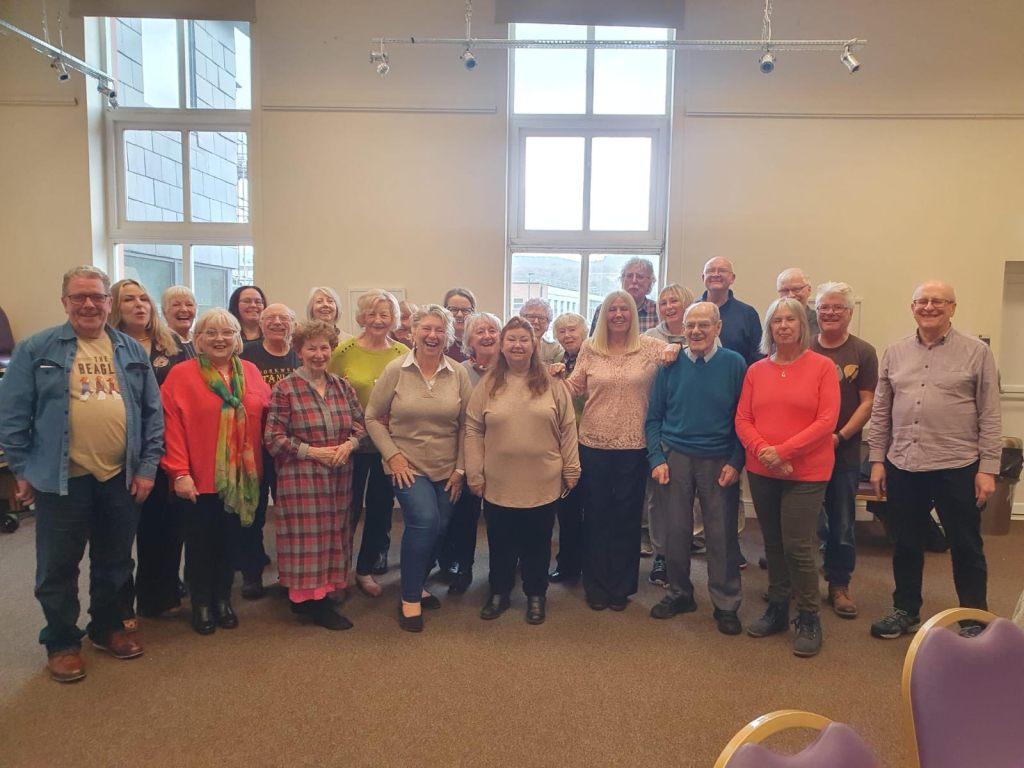
THE SHAPE OF OUR CÔR
This our crescent
our crab claw catch of sound
but also our curve of Bae Ceredigion
from penrhyn to penrhyn,
our horizon’s moon-song
calling across waves –
our finding and our timing
our turning of the tide –
our cormorant diving through surf
gwylanod balancing on up-currents,
our swimming and our landing –
our spread load of light.
Notes – côr – choir, penrhyn – headland, gwylanod – seagulls.
Glyn F. Edwards: ‘The Shape of our Côr’ employs the collective first person throughout. In the twelve line poem, the pronoun ‘our’ is repeated eleven times, which suggests that this ‘shape’ goes beyond a single geography into a place of national identity or significance. Can you explore some of the imagery, and particularly the temporal ‘our finding and our timing’?
Mike Jenkins: The collective is definitely the choir itself and the identity we create together, yet our côr belongs very much to Merthyr and the imagery of the poem is that of the place where I spent my early years, above Aberystwyth and, of course , Bae Ceredigion.
I don’t consciously make these associations when I write : the imagery carries me where it will and I’ve no idea where that destination is.
However, it seems to me , retrospectively, that I’ve rediscovered a vital connection with song (and maybe, a belonging) through being part of this choir. It returns me to childhood joy, so the shape we always make, as singers , suggests the “crescent “ of that Bay.
I was always fascinated by maps as a kid, from the moment a teacher in Penparcau Infants pointed out where we were and where I was going: Cambridge (with my father’s new job).
So, the ‘c’ of our choir and the map of the Bae, with its two peninsulas, connect to childhood discovery.
The temporal imagery is all about people finding themselves rejuvenated by our côr ; literally finding our voices. Timing is everything in music; learning how to respond to each other.
Yet, through time/beat we go beyond time; just like a poem .
Glyn: The sickle-shaped ‘crescent’ seems to amplify the alliterative consonance in the first lines. The bay is richly cacophonic in ‘c sounds’ – ‘cresent’, ‘crab claw catch’, ‘Ceridigion’, ‘calling’,’cormorant’ – does this particular ‘cor’ (choir) have greater significance to you than an orchestra of the more-than-human?
Mike: Once again, I’m looking back at what arrived subconsciously.
Our choir creates togetherness and joy: simple emotions I did feel back in Aber when I was wandering the area, or singing in school.
“Crab claw catch “ for example evokes the times we spent looking for crabs in Aber harbour and the rockpools. The stillness of cormorants conjures a later time in Aber, when I was a student there.
The alliteration of language can transport you, just as songs can take you back to past explorations.
I grew up in a highly dysfunctional family, so my times outside the house were amplified in their wonder.
Having said that, my mother did give me early experiences of both poetry and music, both of which she loved (especially the word-music of Dylan Thomas).
Glyn: In English, ‘cormorant’ comes from ‘sea raven’, and in Welsh, ‘mulfran’ translates to ‘donkey crow’ – both, presumably, because of the bird’s raucous call. However, in Cymraeg, there appear to be four separate names for the same seabird. This ‘cormorant’ is the only species named in English in the poem, and seems acutely linked to the title. Can you elaborate on your method?
Mike: I have no method. Perhaps because, as a student, I shunned Cymraeg, that word from those times had to be in English. Perhaps it is more basic and the sound of côr suggests “cormorant “.
Singing is all about being lost in sound and, in this poem, I was certainly lost in words: just as , when a young boy on Pen Dinas, I would totally forget time and my brother (some years older) would be sent to find me in twilight.
It’s quite frightening now (but also inspiring) to think of the freedom we had. I never looked forward to returning home, mind.
Glyn: Your poems translanguage between English and Welsh. Here, there is the geographical ‘penrhyn’, familiar to many in Wales through nomenclature, and ‘gwylanod’ (seagulls). You have written previously in a South Wales dialect, do you feel your identity, or ‘poetic identity’, traverses English and Welsh in a similar way to the speaker in this poem, or do you retain a distinctly different balance between the languages in your writing?
Mike: This is something which has happened, quite naturally, in recent years, as I have written more in Cymraeg, spoken the language more regularly and attended classes every week.
It’s almost like I’m reclaiming an identity I never had , but I’m highly conscious that my grandparents on my father’s side did.
Both my grandparents were from Welsh-speaking families (from Wenvoe & Cilfynydd). They lost it because English was the language of trade and the future. Even my parents (who had no love of Cymraeg) used a few phrases and they stay with me.
Our choir, Merthyr Aloud, do sing in Welsh and that’s all part of this reclamation.
Discover more from Modron Magazine
Subscribe to get the latest posts sent to your email.

 Modron Magazine