Interview by Glyn F. Edwards

Welcome back to our series on writing the #MoreThanHuman. We offer a set of interviews with poets and writers on how they approach writing about the environment. The more-than-human is a phrase that seeks to side-step traditional nature-culture dualisms and draw attention to the unity of all life as a kind of shared commonwealth existing on a fragile planet. It also reminds us humans that there is more to life, that there is more world, than the human. It relocates us in relation to the mystery.
This week we meet Cheryl Moskowitz, a poet, novelist and creative translator trained in psychodynamic counselling and dramatherapy. She writes for children and adults. She has authored two poetry collections, one novel and two poetry books for children. Formerly an actor and playwright, she facilitates creative projects in a wide variety of health and community settings including schools, prisons, refugee centres, and with the homeless. She was a co-founder of Lapidus, the national organisation for writing for wellbeing and taught on the ground-breaking Creative Writing & Personal Development MA from 1996–2010 at Sussex University. She is an editor at Magma and together with Alastair Gavin forms the poetry and electronic series, All Saints Sessions.
Degenerate
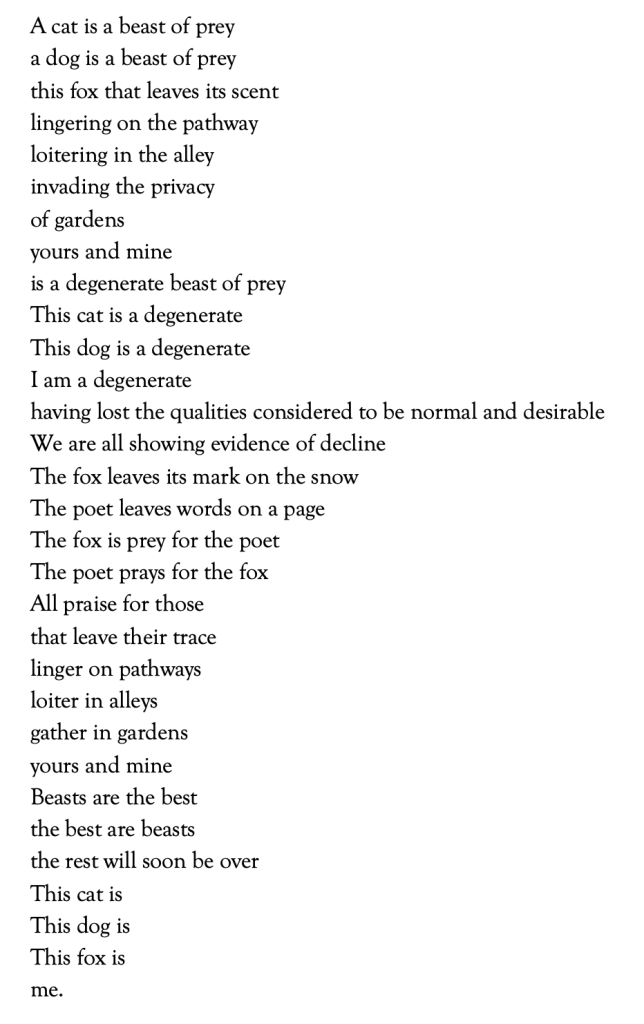
Glyn F. Edwards: ‘Degenerate’ as a title works as both verb and noun in the context of the poem. Can you elaborate on whether you intended it to be one rather than other, or if you favoured the ambiguity of the wordplay?
Cheryl Moskowitz: Yes, I favour the ambiguity of the wordplay in this poem and the title is intended to call the term into question. As a verb, ‘to degenerate’ means to pass from a higher to a lower type or condition, but this, I would argue, need not necessarily imply lesser in terms of value. In biological terms the meaning of degeneration could be described as an organism’s change from a more complex to a simpler less differentiated form. I’m most interested in the difference here, as to what criteria is being applied in deciding what counts as higher and lower, particularly when it comes to comparing humans with their more than human counterparts.
To refer to someone or something as ‘a degenerate’ has negative connotations and has come to be used almost exclusively as a derogatory term to condemn people or animals whose behaviour, beliefs, appearance or even their mode of survival are judged as wrong or unacceptable, offensive to the powers that be and therefore deemed to be reprehensible.
Historically, degeneration concepts have often been associated with authoritarian political attitudes where the tagging of an individual, a group or a work of art for example, with the label ‘degenerate’ is used as a weapon of annihilation alongside other forms of othering and employed to justify extreme and punitive measures like exclusion and extermination resulting in the complete obliteration of irretrievable life and culture. What a loss.
The other side of othering is identification and commonality, in which there can be huge power and strength. In the poem I am wanting to reexamine what it means to wear the label ‘degenerate’, what might be positive and even necessary about the degenerative process in terms of evolution and survival, and how it might feel to practise at identifying as a degenerate myself.
In his 2010 paper published online by the National Library of Medicine, James Whitacre from Birmingham University offers a new perspective on the mechanics of evolution and the origins of complexity, robustness, and evolvability. He explores the hypothesis that degeneracy plays a central role in the evolution and robustness of complex forms (eg humans). In support of his hypothesis, he presents evidence to show that degeneracy is a fundamental source of robustness and that its presence establishes conditions that are necessary for system evolvability.
Glyn: The poem appears to reappropriate terms with negative semantics in order to identify, even sympathise, with ‘beasts’ and ‘degenerates’. Have you always considered ‘beasts are best’, or is it a recent development in your thinking and work?
Cheryl: My poem makes use of and is also challenging the kind of recursive thinking that perpetuates disgust, cruelty and disregard in society and in nature. Recursion is the process whereby one representation or idea becomes embedded within a similar one, a subset of maths and computer science that deals with the idea of self-reference as a form of problem solving. It is a basic characteristic of human language, distinguishing it from all other forms of animal communication, and is demonstrated in our attempts to find criteria that define our own superiority or uniqueness. A recursive formula in maths would be one that defines each term of a sequence using the preceding term(s) and follows a particular pattern of rules in order to prove itself.
The poem begins by declaring a cat to be a beast of prey and goes on to name examples of similar beasts of prey, the dog and the fox, expanding on some of the typical behaviours of these animals; that they leave their scent behind, linger on pathways, loiter in alleys and so on. These are characteristics that might generally be regarded as undesirable however, I believe, there are important aspects to celebrate; lingering, loitering, gathering with others in gardens, leaving a trace of oneself, finding meaningful ways to remain present even in absence. This surely is the pursuit of the poet. It became clear to me that I could apply many of these characteristics to myself, which is what drove the poem to its end conclusion, ‘This fox is me’.
In her 2019 interview ‘Making Kin’ the ecofeminist scholar Donna Haraway told Steve Paulson of the Los Angles Review of Books that making kin was the thing that we most need to be doing ‘in a world that rips us apart from each other’. By ‘kin’ Haraway is talking about those who have an enduring relatedness that carries consequences:
The fox leaves its mark on the snow
The poet leaves words on a page
The fox is prey for the poet
The poet prays for the fox
Haraway suggests that this kind of relatedness, the sort that ‘you-can’t-just-cast-that-away-when-it-gets-inconvenient’ could be exemplified thus: ‘I have a cousin, the cousin has me; I have a dog, a dog has me.’
Glyn: ‘We are showing signs of decline’ felt like the poem’s pivot point. To what degree do you consider this to also be the central aphorism in ‘Degenerate’?
Cheryl: Yes, I agree I think that this line is absolutely where the poem pivots. When I first wrote the line, I could feel my own defences coming into play and that convinced me that it must contain some general truth, as uncomfortable as that truth might be. I am usually wary of sweeping statements, in poetry as in life. I resist assertions that purport to be applicable to all, so I knew that in leaving this line in, I had to be able to stand by it. I had to make a shift my own thinking as a result. Given everything we know about the serious problems being caused or likely to be caused by the climate crisis, and our part in it: weather extremes and hazards, ocean acidification and sea-level rise, loss of biodiversity, food and water insecurity, health risks, economic disruption, displacement, and the suffering to all forms of life that this is already causing on a global scale, the statement ‘We are all showing evidence of decline’ is undeniable.
Glyn: Initially, the sole piece of punctuation appears to be the end stop at the poem’s conclusion. Yet, on closer consideration, it becomes clear that you use capital letters in an idiosyncratic manner to mark new syntax. Can you share your approach to punctuation in this poem, and your attitude to grammar more generally in your poetry?
Cheryl: When it comes to grammar and punctuation in my poetry, I do not necessarily have a consistent approach. Instead, I try to meet each poem that I write on its own terms. That is to say that for me I believe that the way a poem is punctuated depends entirely on its content and that will be different for every poem.
In this poem the syntax, the ordering of the ideas and the structuring of the argument, is important and needs demarcating. However, there is also an energy in this poem that needs preserving. The drive is impassioned and, like a rant or a sermon, designed to stir passion in others. The observations and statements being made are all part of the same ongoing thought process, and therefore interconnected, so it did not feel right to include any full stops until the end of the poem. Using punctuation throughout might have given it too considered, too studied, and possibly too deadening a feel. I wanted something more other-worldly and fiery. Alive. For this I used capital letters as markers between separate notions and to provide space for breath.
The final statement is as close as the poem gets to certainty, so it seemed right to give it an end stop.
_______
References
Making Kin: An Interview with Donna Haraway (published online, LARB December 6, 2019) https://lareviewofbooks.org/article/making-kin-an-interview-with-donna-haraway/
Degeneracy: a link between evolvability, robustness and complexity in biological systems Author: James M Whitacre, Theoretical Biology and Medical Modelling (published online, Feb 18, 2010) https://www.ncbi.nlm.nih.gov/pmc/articles/PMC2830971/
Discover more from Modron Magazine
Subscribe to get the latest posts sent to your email.

 Modron Magazine