Interview by Glyn F. Edwards
Welcome back to our series on writing the #MoreThanHuman. We offer a set of interviews with poets and writers on how they approach writing about the environment. The more-than-human is a phrase that seeks to side-step traditional nature-culture dualisms and draw attention to the unity of all life as a kind of shared commonwealth existing on a fragile planet. It also reminds us humans that there is more to life, that there is more world, than the human. It relocates us in relation to the mystery.
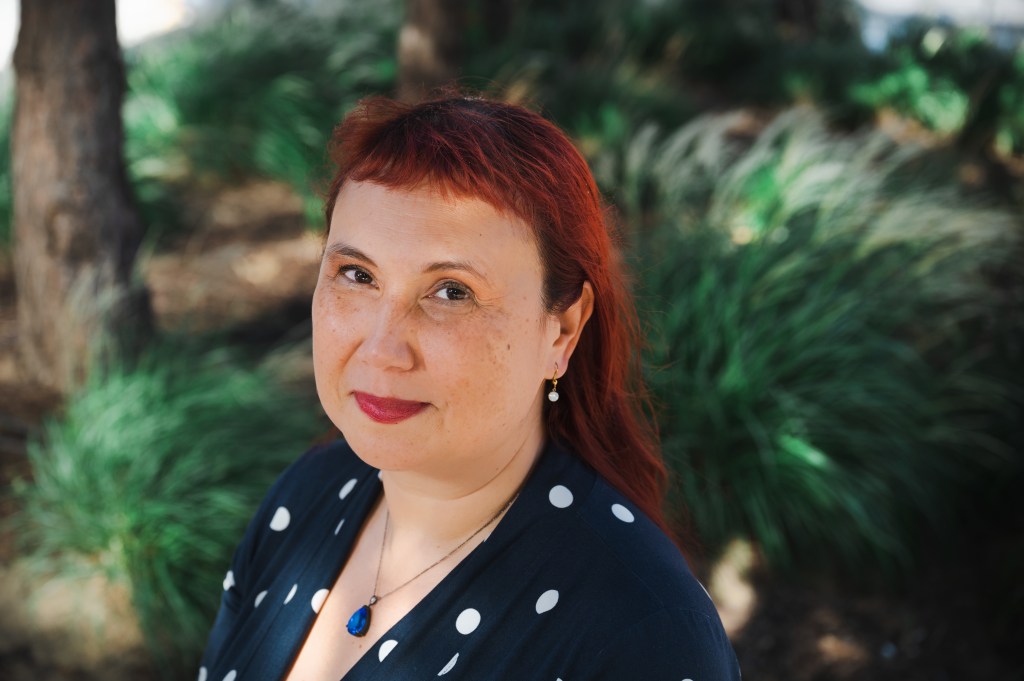
For this week’s interview, we meet L. Kiew, a chinese-malaysian living in London. L Kiew works as a charity sector leader and accountant. Her pamphlet The Unquiet was published by Offord Road Books in 2019. She was a 2019/2020 London Library Emerging Writer. L Kiew’s debut collection More than Weeds is published by Nine Arches Press (2023).
Amplexus
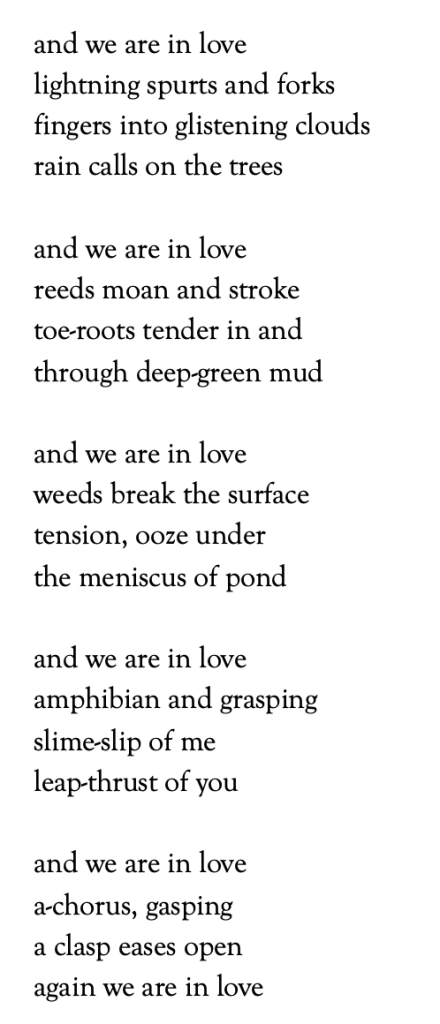
Glyn F. Edwards: By allying language associated with the nature world to language associated with arousal, ‘slime slip’, ‘leap thrust’, ‘reads moan’, ‘a chorus gasping / a clasp’, your linguistic choices are both sexual and amphibian throughout; the central question the poem seems to investigate is whether this is physical ‘love’ with or for the natural world, or perhaps it a sexual encounter so primal as to invite a wider interspecies biophilia. Could you elaborate on core themes in ‘Amplexus’ and in your wider work?
L. Kiew: In ‘Amplexus’ and my wider work, I seek to unsettle the distinctions and boundaries between the human and other sentient lifeforms; I don’t see homo sapiens as separate from the natural world. I also don’t subscribe to any sense of hierarchy of life or that the human is set above or apart from the other inhabitants of our world.
The speakers of the poem could be frogs, or another animals; this ambiguity is for the reader to resolve. I have been asking myself who gets to love, and asking why we hold to the binaries between you and me, human and other, natural and unnatural.
Frogs are particularly interesting to me because their highly permeable skin places them in dynamic interaction with their environments. In thinking about love, I explore the particular state of being “with and for” other lives. And isn’t sex both primal and interpretative? Should we interact and identify more closely with other living beings?
Glyn: ‘Amplexus’ is the Latin verb ‘to embrace’, but it is used almost exclusively as a scientific term to describe amphibian breeding behaviour. TS Eliot believed epigraphs should be “designed to form an integral part of the effect of the poem”, but here you decide against defining the title. How significant do you feel the readers’ understanding of the word in the title is to this poem?
L. Kiew: I don’t believe that it’s the role of the poet to shut down paths of meanings for the reader. I see the title as a suggestion, not a command. I believe that a poem comes into its effect in the act of reading. While on my tongue and in my ear, the world ‘amplexus’ feels beautiful, I want to keep the title open to interpretation.
Glyn: ‘And we are in love’ forms the central refrain in the poem. How significant is the momentum built by this line before it appears in a repositioned form ‘again we are in love’ in the final line?
L. Kiew: As a technique, I find repetition interesting because it both reinforces by restatement and also allows for destabilisation as the number of contexts for the refrain accumulate. I was reflecting on how we build relationships through repeated interactions, rather than through the singular transaction.
Glyn: In ‘Amplexus’, you make several strong decisions about where to break the line, such as in ‘toe-roots tender in and / through deep green mud’ and ‘break the surface / tension, ooze under’. Can you discuss on one or two key poetic decisions made during the editing process?
L. Kiew: I think of line breaks in terms of pauses and pulls. With conjunctions, I hope to pull the reader over the line end and onward; for example, with ‘toe-roots tender in and / through deep green mud’, I’m aiming for the reading experience to echo the physical experience being described. When I break the line between words that often gravitate together, I hope to create a gap for the reader to enter into, a pause which might shift the meaning for the reader.
Discover more from Modron Magazine
Subscribe to get the latest posts sent to your email.

 Modron Magazine