This week’s guest post from Rae Howells talks about the project “Art for the Common” organised to save part of Clyne Common from development. Her love for Clyne Common also inspired her new poetry collection This Common Uncommon. Also, in a note from the editors, please don’t forget that Monday 9th September will see poetry submissions for MODRON issue 5 closing so please submit by then.
I find it hard to read the news about climate change. How often I have felt small and helpless in the face of articles that seem to offer no hope, just dismal predictions and downward trends. From animal species under threat to melting glaciers, footage of terrifying wildfires or catastrophic floods. What can one person do against such huge, complex – often global – problems?
Like most people I am hungry for practical things I can do. There are the usual culprits – reduce flights, take public transport, stop single-use plastic, eat less meat, go solar. I do my best. But an action point that has really stuck with me is this: use whatever skills you have and get involved in something local, something community-based.
The wonderful thing about this one is that it gives tangible, rewarding results. Plus you get to meet people and make new friends.
So when I became aware that a section of Clyne Common at West Cross, a well-loved green space near my home, was under threat of development I thought: this is it. Maybe I could try to make a difference.
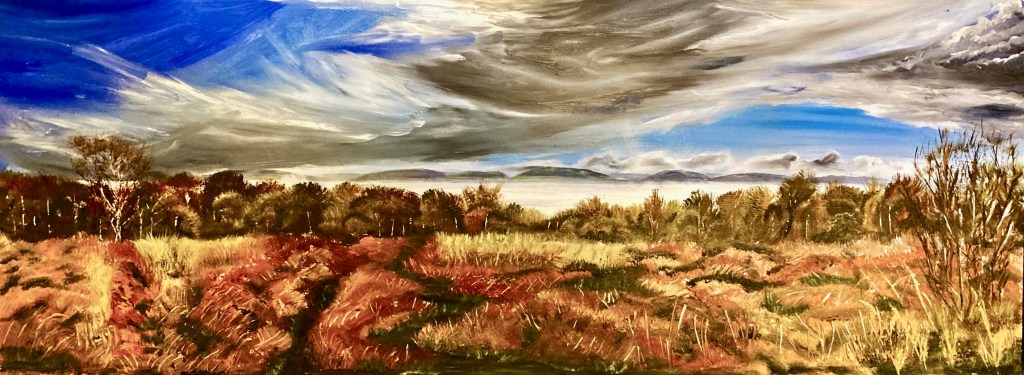
Now, West Cross Common has been neglected for decades. Not even the commoners use it for grazing any more. But beneath the encroaching bracken, gorse and scrub, there are wonders. Its neglect has been the making of a wild ecosystem largely untroubled by human intervention, and therefore teeming with a diversity of plants, alongside insects like dragonflies and hoverflies, bumble bees and gatekeeper butterflies. There are amphibians in the shape of toads and frogs; reptiles including common lizards, slow worms and adders. Birds include red list species like greenfinches and hawfinches. There are globally rare waxcap mushrooms, and devil’s bit scabious, the food plant of the protected marsh fritillary butterfly.
And if you stand back and understand the common in context, it is obvious that as a peat-rich wet heathland, this space nourishes and safeguards hundreds of species across a much wider area, that it is a kind of green battery sustaining life across a suburban and semi-wild landscape that we West Cross residents are privileged to share with nature. West Cross is a dormitory of streets, many built on former farms in the 1930s, the rest a large post-war-constructed council estate. My grandparents moved here in 1954, and now four generations along, their great-granddaughters thrive here. Our family has loved this green and wild space as a place to run free, walk the dog, listen to the drone and chirp and rustle of hedgerows and scrub. The thought of its loss is almost visceral, grievous – beyond what the heart can stand.
So I joined the campaign, and donated my skills, such as they are. I wrote letters, and a few press releases and social media posts. And one day I wrote a poem. I called it ‘A Living Autopsy of Clyne Common’. It was long and I tried to pack everything into it. Too much, honestly. So I chopped it up and the fragments reworked became two, three, six, ten poems. And from there, a book began to take shape, and I thought I’d use my journalism skills to interview local residents about their memories of this common place and write poems about them too. They told me that the common belonged to them – a land that we had all assumed would be safe because it is a common, with all that is tied up in that ancient legacy, lands that are open and kept in store for all people for all time, and which we were shocked to find could be stolen from under our feet.
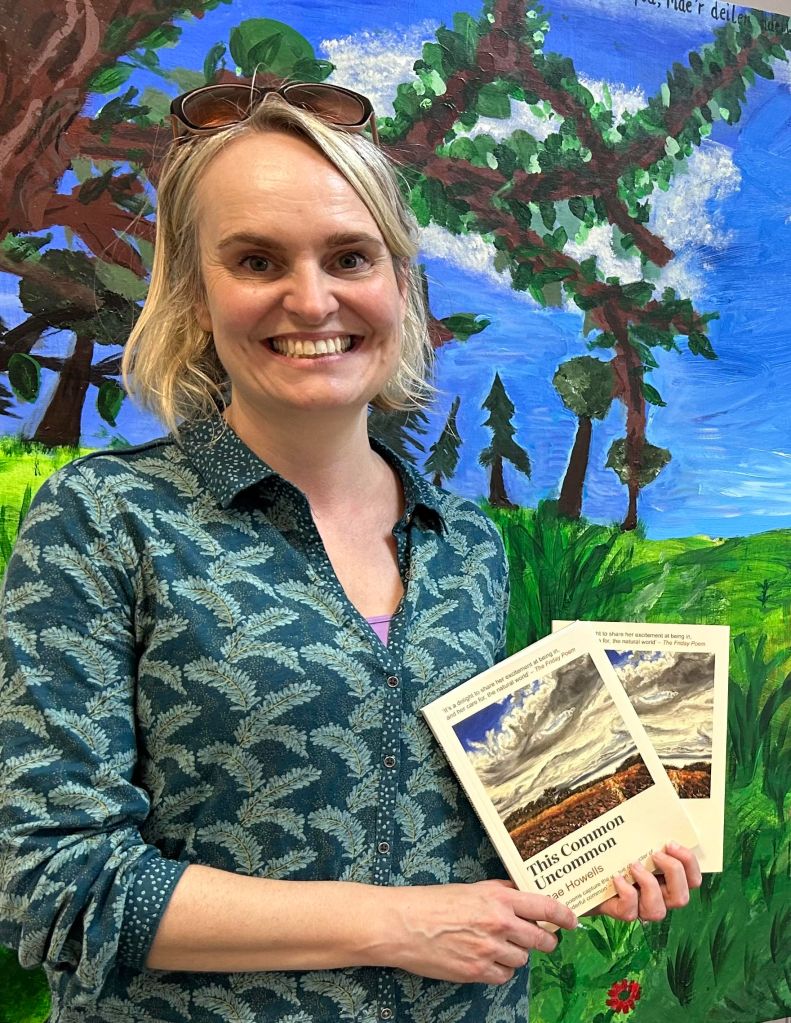
In May this year my book was published, This Common Uncommon. And a funny thing happened. Through my research and later at poetry events, I began to encounter more and more arty people in connection with the common. Dozens of them emerged, mainly amateurs: photographers, watercolourists, oil painters, abstract painters, videographers, textile artists, collage makers, sculptors, poets and writers.
At my daughter’s school, one of her teachers, Mrs Bond, discovered my book and decided to use it as the basis for fieldwork on the common, translating one of the poems into Welsh. For the whole summer term the 90 children in years 5 and 6 worked together to paint a huge 2.4 metre plywood panel inspired by this poem to create a scene of the common, as well as scores of wooden discs showing the wildlife to be found there.
All this got me thinking. Could this abundant artistic talent be celebrated somehow, perhaps with a community event, an exhibition? A few artists nodded their heads when I pondered this aloud, and said encouraging things to me. So I rang the local community hall and found they had a gap in the diary, a Saturday in July. Rashly, I booked it. We had just under a month to get Art for the Common off the ground.
We had no budget beyond my meagre book advance, and no time to apply for funding. We also had no idea how to display the artworks. How could we show the variety of pieces in a big empty hall? My brother-in-law works in construction and suggested heris fencing – a cheap and cheerful mesh fence that we could hire inexpensively and which would be self-supporting, strong, and versatile for attaching artworks. We hired eight panels, plus the rubber feet, to be delivered the day before the exhibition, and the owners of the community hall kindly said we could store them in the car park until the event. A local art group got involved, and offered us use of their easels. With minimal costs and thinking-out-of-the-box display stands, we were all set.

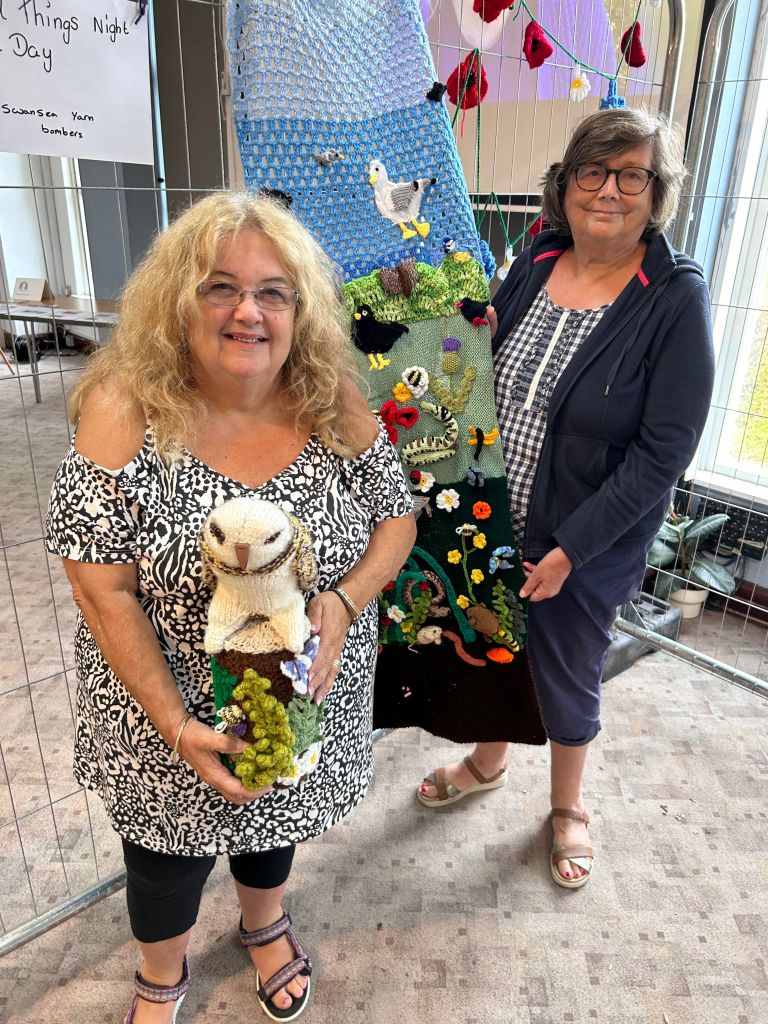
We put out a call to local people, inviting them to submit their artworks. And we begged the school to let us borrow the artworks the children had created. Thankfully they said yes. Too big to fit in a car, the panel would need something bigger so we also arranged to borrow a camper van to transport everything to the venue. Our local yarn bombers got in touch to offer a pair of six-foot-high knitted panels, The Common By Day, and The Common By Night, displaying the common’s diurnal and nocturnal wildlife, with sections knitted by women from all over South Wales.
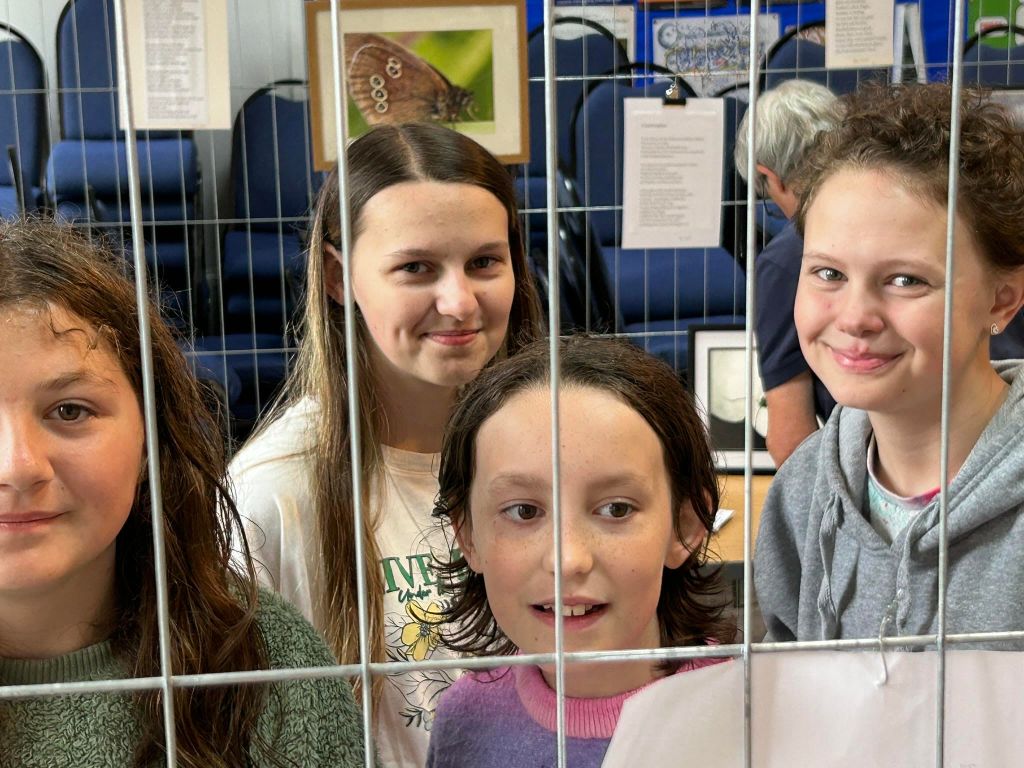
The day before the exhibition we gathered up the artworks. The camper van was too small for the big plywood panel so my husband and I carried it on foot half a mile from the school to the hall. Two people separately stopped and offered to help us – community in action. On the morning of the exhibition a crew of about a dozen of us set up the space, and when it was complete we counted everything up and found that almost 150 people had contributed to Art for the Common in one way or another, inspired by and in honour of our local common. A further 70 or so people turned up on the day to enjoy the art, draw or write something of their own at the art table, or make a crown from the fronds of bracken my daughters and their friends had been out to cut that morning.
After years of slogging on a campaign, with its ups and very many downs, here was something positive. It felt triumphant. Celebratory. A thing that radiated light and creativity and connection, all the good things that art gives and brings. And all of this from the seed of a single poem.
So, can art save the planet?
Last week, I attended the public inquiry into the de-registration of West Cross Common. Our final chance to save it, we hope. Or perhaps the final nail in this land’s coffin. Along with dozens of other residents I took to the stand and spoke in opposition to the plans. And what I spoke about was Art for the Common, the positivity of so many members of our community gathering together to show what they love about this small and scrubby piece of land. Art forces you to inhabit a space, to observe deeply, to listen, to read the braille of light and shadow, trace the lines through the bracken and into the heart and soul of a place. All of those contributors had undertaken this creative process, and were as a result indelibly connected to West Cross Common and invested in its future.
That I was also cross-examined by a London barrister about my poetry book during the inquiry speaks volumes. Art has power.
We won’t know the outcome of the inquiry for many months. But if the common is destroyed beneath a digger’s blade, the art we made will endure, as will the bonds between us. We made Art for the Common.
I feel less desolate than before. The late Welsh poet Nigel Jenkins was a believer that poets had important work to do: “Poetry should be out and about, doing a job in the world, ambushing people, not hiding in classroom cupboards and magazines that nobody reads” he said. I reckon he was on to something.
Rae Howells is a poet, journalist and lavender farmer from Swansea. Her debut collection, The language of bees (Parthian), was shortlisted for Wales Book of the Year 2023. She has previously won the Rialto Nature & Place and Welsh poetry competitions and been featured widely in journals including Magma, The Rialto, Poetry Wales, New Welsh Review, Acumen and Poetry Ireland. A keen environmentalist and a believer of the restorative power of wild places, she is poet in residence at Llanelli Wetland Centre. This Common Uncommon is her second poetry collection.
www.raehowells.co.uk
Discover more from Modron Magazine
Subscribe to get the latest posts sent to your email.

 Modron Magazine