Interview by Glyn F. Edwards
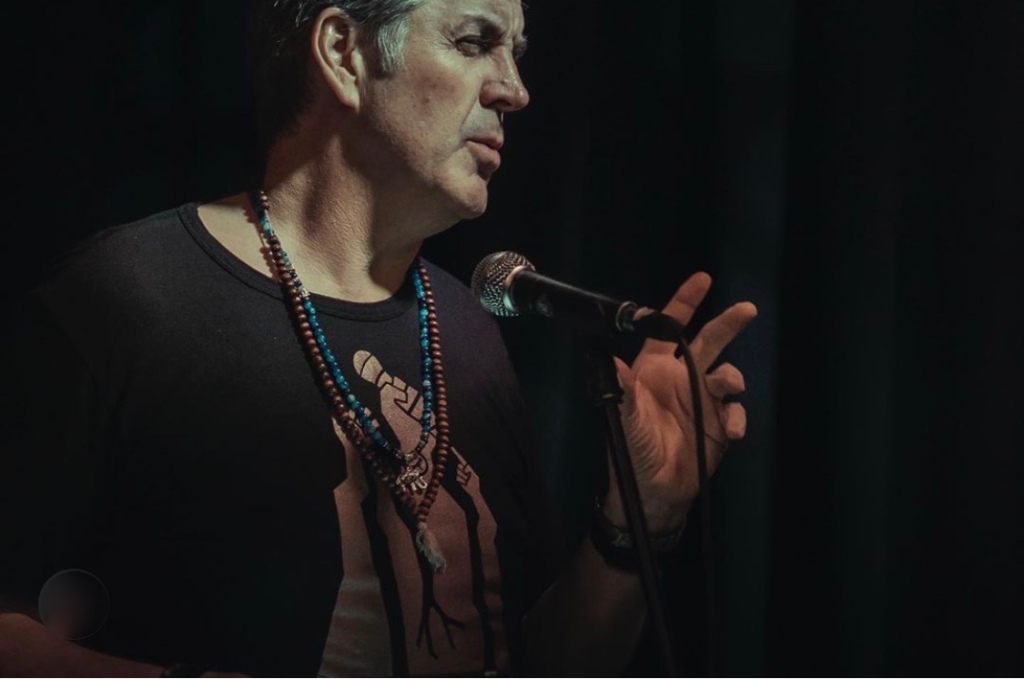
Welcome to a new interview in our series on writing the #MoreThanHuman, a set of interviews with poets and writers on how they approach writing about the environment. The more-than-human is a phrase that seeks to side-step traditional nature-culture dualisms, and draw attention to the unity of all life as a kind of shared commonwealth existing on a fragile planet. It also reminds us humans that there is more to life, that there is more world, than the human; it relocates us in relation to the mystery.
This week’s interviewee Simon Maddrell is published in numerous anthologies and other publications including Acumen, AMBIT, Butcher’s Dog, The Moth, The Rialto, Poetry Wales, Stand and Under the Radar. Simon has four pamphlets: Throatbone (UnCollected Press, 2020); Queerfella (The Rialto, 2020); Isle of Sin (Polari Press, 2023); and The Whole Island (Valley Press, 2023).
Squirrels dig up daffodil bulbs and replace them with walnuts

You can find a Google Doc accessible version of this poem here.
Glyn F. Edwards: ‘Art is flying is flying-in melting icebergs from Greenland’ evokes the image of a chunk of iceberg, cordoned off, dripping into oblivion, tourists open-mouthed in a gallery’s white noise. How far do you believe that raising awareness remains a viable response to the environmental crisis?
Simon Maddrell: Imagination meets reality. Funnily enough that line is inspired by Olafur Eliasson’s Ice Watch, which was staged in front of Tate Modern in 2018 –– an installation of ice blocks taken from the waters of Greenland. In the last few weeks a story has emerged that a new company, Artic Ice, has started shipping ancient glacial ice to cocktail bars in UAE. Maybe they saw Eliasson’s exhibition and thought, ‘what a waste!’. Part of the company’s rationale is the valid point that their trade deficit with Denmark means that the first leg of the journey is carbon-light due to the number of usually empty containers returning to Denmark from Greenland. This is a valid argument for shipping material for recycling from the UK to China (The UK imports twice the goods by value than we export to China). However, the cocktail ice trip to Denmark is only 25% of the nautical distance to UAE, and for me there is something distasteful about drinking centuries old ice in Dubai.
Glyn: How far do you believe that raising awareness remains a viable response to the environmental crisis?
‘Raising awareness’ isn’t just a ‘viable response’ but it is the only option to create meaningful action for environmental change. Our challenge I think is how art can be effective in this activity, especially as great art has the ability to ‘show not tell’ in the way that the best adverts do, and the worst social media ‘debates’ don’t. Speaking of which, the imperative of raising awareness can be demonstrated by the advertising/marketing model of AIDA (Awareness; Interest; Desire; Action) i.e. how to drive people towards action. The first, most important step, is to gain ‘Attention’. Art, potentially, can garner attention and create Interest and Desire –– possibly even bypassing the social media algorithms that drive people to only read what they want to hear or already agree with. Action doesn’t arise from nowhere and art and advertising are both critical in ‘changing perspectives and minds’. It’s not a coincidence that many poets write advertising copy!
Glyn: The title enjambs into the first line while every other line seems to stand independently, which must have allowed you freedom to format and reformat the couplets. Was the poem always organised in this order? Which lines caused you to make difficult decisions?
Simon: Yes, I do love using titles as the first line of the poem — albeit a good friend suggested I cut the ‘because squirrels are evil’. My defence, that I obviously only meant the invasive, red-killing grey ones, didn’t work. I don’t often capture single thoughts lines of poetry and then re-arrange into a poem. For me, single thoughts are usually the start point of a poem’s exploration, but in this case I seemed to have captured a few snippets that connected somehow. Originally the poem wasn’t formatted in couplets and had six more lines, so the biggest challenge was scrapping certain lines like ‘climate change is an abstraction’ and ‘Don’t sit on a unicorn and laugh at your girlfriend.’ It was made easier by organising into couplets finding a relatively close association within the couplets and between them on the journey through the poem. The couplet I had most problem with was ‘an elephant shits out most of the grass & leaves. / places affording views over the sea don’t sink our troubles.’
Glyn: How long has ecology been a primary theme in your poetry? Has eco-poetics paralleled your environmental awareness?
Simon: My main themes have always been my own queerness; the Isle of Man; Nature, ecology & extinction; Queer History. I don’t think yet that there is a primary one but all of these themes or subjects always overlap like in a Venn diagram one way or another. e.g. my latest pamphlet a finger in derek jarman’s mouth from Polari Press is actually all of these themes except the Isle of Man. I’m a ‘late-starter’ poet so my environmental awareness preceded my poetry. I did Peace Studies at Bradford, majoring in environmental, development and radical economics. My dissertation was a study of a community self-help project in semi-arid Kenya. In 2002, I founded an international development charity, which at the time was unique in its approach of supporting rural communities to develop through soil & water conservation. This has been a decades long priority for the world’s Drylands (41% of the land, producing 44% of food crops and over half of the world’s livestock, whilst at the same time home to the greatest bio-diversity, and highest rate of species loss) but has only really gained focus alongside climate change, which only exacerbates a problem that has existed throughout the Anthropocene. My challenge is writing about these matters without ‘preaching’ which is perhaps why I often focus on the philosophy of extinction and specific species threat. I did write a poem though about my work supporting communities to build small-scale sand dams, using cement as a carbon exploration, which was published in Annie Journal. I imagine that my eco-poetics will only become a greater part of my poetry output as time goes on.
Glyn: What do you consider to be a poet’s responsibilities when writing about, or even, giving voice to the more-than-human?
Simon: Anthropomorphism is well-documented as a dangerous approach to use and, being neuro-divergent, I know to my cost how much trouble one can get into assuming that someone or thing thinks like you!
Almost before that, I think, is even considering humans as the ‘apex species’ as far as the planet’s ecology is concerned, and that we should even think it is desirable to measure all other species in comparison to ‘how much like us’ they are. We’d be better served understanding how other species on this planet thrive whilst also supporting both each other and the overall ecology of the planet. Much of this is achieved through a lack of ego of course, and our responsibility is to attempt to shrink ego as much as possible (unless you want to parody it like in my, perhaps unsurprisingly, unpublished poem ‘My Universe’)
My Universe

[You can find a Google Doc accessible version of this poem here.]
Simon: Whilst we need to avoid assuming animals ‘think like us’ I do feel that it is equally damaging to dismiss the conscious decisions of animals as instinct, whilst at the same time claiming that humans possess 100% free-will, rather than also actions driven by internal chemical reactions, like plants finding a partner to climb up. Exploring the wonderment of other species is arguably more powerful than only lamenting humans as the most destructive force on the planet, aided and abetted by an economic system that is designed to destroy itself. Capitalism works on the fallacious assumption of unlimited human and natural resources to feed it. We have convinced ourselves that self-destruction can be avoided through regulation, whilst in reality regulation just slows down the inevitable.
For me, a key part of giving voice (and/or due consideration) to the more-than-human is a total acceptance of our own individual mortality (back to shrinking ego) but more importantly, the ultimate inevitability of human extinction. I’m convinced that if we truly embraced this fact that the way we perceived the world’s ecology and the way we behaved and acted would transform itself. Whatever type of delusion or delusions causes this, the truth is actually out there. I think my only consolation is that the planet will both outlive us and thrive afterwards, whatever damage we do –– unless an asteroid catches it unawares!
Discover more from Modron Magazine
Subscribe to get the latest posts sent to your email.

 Modron Magazine