The past year has seen repeated climate-linked flooding across parts of the UK and Europe, renewed debates over asylum policy in response to environmental displacement, and increasingly visible global negotiations over loss-and-damage responsibilities. What once appeared theoretical, with the movement of peoples shaped by environmental collapse, is becoming an immediate moral and political reality. The ecological crisis is no longer only about landscapes disappearing; it concerns communities relocating, identities being reshaped, and the ethics of welcome being tested. In this light, the theological question raised at the above named conference feels less speculative and more prophetic: stewardship cannot remain a private spirituality when the consequences of environmental degradation are borne unevenly across the world. The land continues to shape culture, but now it also exposes the moral boundaries societies construct around belonging, responsibility, and reconciliation. Here, Richard Scott gives MODRON readers an insight into the discussions of a conference in June 2025. Since then, the urgency of these reflections has only intensified.
What do we lose when we lose our natural world – just ecosystems, or the stories and selves shaped by them? Can ancient theology, steeped in myth and mystery, still speak meaningfully to the most urgent crisis of our age? And if the land has shaped our culture, and memory, how do we now engage with the land appropriately?
These are the types of questions I was posed with on the 10th of June 2025, at a thought-provoking conference held at PJ Hall, Bangor University, hosted by the National Centre of Religious Education for Wales, the Institute for the Study of Welsh Estates, and the Bangor University’s School of History, Law and Social Sciences. The multidisciplinary event, ‘Biblical Landscapes’, explored the rich history of religion and myth, and how this is deeply imbued in Wales. It struck a particular chord with me as an emerging academic in Religious Studies and Theology, especially in relation to Eastern Orthodox theology.
The foundational message woven through the evening was the intrinsic tie between humankind and nature – a symbiotic relationship in which humankind imbues land with meaning, while the land itself shapes co-existing cultures and folklore. As the world faces its greatest ecological crisis, we are facing a profound existential crisis. As we lose our environment and nature, we lose the synergetic relationship that provides us with folklore and divinising myths – stories that shape our identities. We risk a loss of personhood before a greater crisis consumes us.
So, inspired by my research, how does Orthodoxy answer this?
I was struck that the Bible, at first glance, seems to offer an outdated answer to the ecological crisis of climate change. Take the passage in the Gospel Matthew 6:28-34 which exhorts to those reading:
And why do you worry about clothes? See how the flowers of the field grow. They do not labour or spin. Yet I tell you that not even Solomon in all his splendour was dressed like one of these. If that is how God clothes the grass of the field, which is here today and tomorrow is thrown into the fire, will he not much more clothe you – you of little faith? So do not worry, saying, ‘What shall we eat?’ or ‘What shall we drink?’ or ‘What shall we wear?’ […] But seek first his kingdom and his righteousness, and all these things will be given to you as well. Therefore, do not worry about tomorrow, for tomorrow will worry about itself. Each day has enough trouble of its own.
Given that the Office for National Statistics reports 74% of adults experience some form of climate anxiety, is it not ironic that the Bible forwards a message of hope through analogies rooted in the very nature now under threat? Have the hopes of a New Earth been undone by our irresponsibility? As Dr Gareth Evans-Jones, the first speaker and co-organiser of the event, precisely stated:
The old call to ‘tend’ the garden and ‘till the earth’ has a renewed urgency in our time, due to the ecological crisis we are experiencing. Environmental ethics is more than just policy; it’s more than just words in a political party’s manifesto […] it is a spiritual and moral responsibility.
This set the tone for the evening, especially in the Welsh context, where the land has been sacralised with biblical eponymies. Environmental stewardship is no longer just a corporeal duty; it is a spiritual responsibility, as emphasised by Dr Evans-Jones through his own studies of eco-theologians such as Sallie McFague and Thomas Berry.
Professor Angharad Price offered a poignant reflection on how place names and biblical imagery shape memory, identity, and literature in Wales. In O, Tyn y Gorchudd (The Life of Rebecca Jones), she drew on her family history to explore how 20th-century rural life was infused with Christian language and values. Her more recent work, Nelan a Bo, continues this theme through the lens of the Methodist revival. One striking example was the renaming of Rhos Chwilog to Bethel – reflecting both religious identity and the transformative power of revivalist faith. Her insights showed that names are not mere markers of geography, but vessels of belief and belonging. Both novels ask how we remember – or reinterpret – a sacred past in a changing cultural and spiritual landscape.
Bolstering the points made by Professor Price and Dr Evans-Jones, Doctoral Researcher, Mr Alex Ioannou with the Institute for the Study of Welsh Estates, offered an astute historical-existential perspective. The mission of Mr Ioannou, as stated on his website, ‘Reframing Wales’, is to explore the fact that ‘the relationship between public histories of place and environmental change has been the subject of scholarship across disciplines, exploring the links between society’s collective understanding of landscape and our attempts to tackle climate change.’ Given that our personhood is symbiotically tied to the landscape, every individual is facing an existential crisis. The myths, folklore, and religious values inextricably tied to Wales and its awe-striking nature are slowly losing their power to construct the Welsh conscience. Climate change does not merely have external effects – it reshapes our interior landscapes.
Reinforcing this, Dr Martin Crampin (University of Wales Centre for Advanced Welsh and Celtic Studies) took us through Welsh representations of biblical scenes in art and stained-glass windows. Christ was often depicted standing before rolling, lush green hills reminiscent of the Welsh countryside (with Harlech Castle even making an appearance!). Especially popular in the Welsh conscience was the image of Christ as the Good Shepherd, recovering the lost sheep. This art demonstrated how humanity has extrapolated meaning, moral identity, and character from the land itself which is at risk of losing its potency through climate change.
This existential point runs consistently through Orthodox Christian theology, particularly in the system inspired by St Maximus the Confessor, where the Orthodox believe that as we were created in the Divine Image, there are imprints of the divine throughout Creation. Our identity and destiny are intrinsically linked to the world around us. As the modern Russian theologian, Vladimir Lossky, wrote:
Every created thing has its point of contact with the Godhead; and this point of contact is its idea, reason or logos which is at the same time the end towards which it tends. The ideas of individual things are contained within the higher and more general ideas, as are the species within a genus. The whole is contained in the Logos, the second person of the Trinity who is the first principle and the last end of all created things.
As embodiments of the ‘logos’ of Creation, we have a responsibility to offer the world back to the divine in thanksgiving, forging a better future for humanity. To secularise this: it is our duty to act, for every time we do, we leave imprints through newly created myths inspired by those of our ancestors. Myths and folklore, and the identity we gain from them, inspire communion – not just with the divine, but with one another, now and in the future. Losing our natural world means losing the relationships we have with our loved ones and neighbours. Rather than acting as forces of division, local myths inspired by nature become unifying forces – encouraging appreciation, sharing a deeper gratitude for one another. Drawing from St Maximus, nature helps bring about ‘the union of all things in God, in whom there is no division’, through the shared myths it inspires. This was clearly emphasised by two other speakers, poets Sian Northey and Siôn Aled, who led the Llwybr Cadfan Pilgrimage project on behalf of the Diocese of Bangor, as their shared reflections from their journey to Ynys Enlli through haunting yet stunningly beautiful poetry.
An exemplar of this is the below extract from one of Siôn Aled’s poems, Where Paths Meet, written in Boduan:
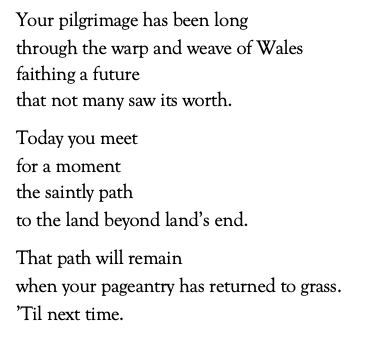
Though bleak, especially in the final stanza, there is hope buried within. Interpreting Aled’s writing, the pilgrimage through the ‘warp and weave of Wales’ is part of ‘faithing a future’ – one that is ultimately better. Why? Because our interaction with nature communes with pre-existent lore and sacredness fostered through our predecessors. It is a kind of natural sanctity that cannot be replicated. Therefore, our future lies in the natural world. The stories, legends, and myths that sacralised Wales still live and shape us, and quite literally live in the land, with Ynys Enlli being rumoured to have 20,000 saints buried in its soil. But those who call Wales home today can add new values and stories into the land for future generations to be inspired by. Biblically, we are assured that nature will be the proxy through which humanity is restored:
On each side of the river stood the tree of life, bearing twelve crops of fruit […] and the leaves of the tree are for the healing of the nations (Revelation 22:2).
The talk itself created new art forms inspired by Wales, demonstrating the power of nature in fostering communion. This was further exemplified by Joe Cooper, Director of Music at Bangor University and St Deiniol’s Cathedral, who shared his liturgical and devotional compositions written for the Cathedral. Inspired by the Welsh landscape, his music underscored the unity of the divine with the natural world, while reinforcing our dependency on Wales’s rich cultural heritage; demonstrated further by his reference to 16th-century poet Dafydd Trefor. This music, he explained, could only have been born from lived interaction with Welsh traditions, rooted in the very soil we stand on. It is a sign that there is still hope in the face of ecological crisis. Decidedly, the ecological analogy of Matthew 6 is not tonally unfit. As shown through this music and theology, we have a responsibility to nature – and therefore to our neighbour. These commitments form the foundation of our shared hope for our natural World.
Having heard these fantastic talks and viewed the exhibition, I was led to introspection – one that began with concern but ended in a hope that was deeply enriching. In combination with my current studies in Eastern Orthodox Theology, this affirmed to me that this is a decade for change – to restore our world and our character as communion-seeking human beings through confronting climate change. Through our shared stewardship of the World, St Maximus said that ‘the human person unites paradise and the inhabited world to make one earth […] gathered together.’
Be we religious or not, these words carry with them a true significance for us all.
Richard Scott is a PhD Researcher in Christian Theology and Mormon Studies at Bangor University, under the supervision of Dr Gareth Evans-Jones. His thesis is a comparative study between the Eastern Orthodox Church and the Church of Jesus Christ of Latter-day Saints, and their views of salvation and deification.
 Modron Magazine