Welcome back to our nonfiction series titled “Plots & Plants”, inspired by intimate connections with place and the natural world. Plots & Plants is a space for nonfiction from writers and environmentalists to talk about places special to them. This series will be an archive and record of places for us to reflect on as time passes, and as we continue to experience environmental emergency and loss. Here, Carly Holmes describes a walk in the woodland at the Teifi Marshes, part of the Wildlife Trust of South and West Wales.
It’s autumn, late afternoon, and a damp, grainy dusk is slipping almost visibly from the sky to cloak me. The trees I walk beneath – oak and beech – loose crinkled leaves, whispered death throes, and the only sound is the dogs as they track scent back and forth. Everything has settled for the coming night.
This path, these woods, are almost as familiar to me as my own garden. The Teifi Marshes nature reserve in Cilgerran is only a couple of miles from my home, its ancient woodland a soft gauze of bluebells in the spring, gaudy with holly berries in the winter. Over the years I’ve brought myself to this place happily, impatiently, angrily, distractedly, and it has never failed to tug me out of my own head and into its realm. There has always been a point somewhere along the path – a heavy rustle in the leaf litter off to my right or the sight of a line of juvenile blackcaps bookended by their parents – where my mind is no longer back there, at my desk or buried in an email I need to compose, but immediately and totally here.
And now, this afternoon, I walk with the dogs trotting ahead and behind me, beneath a gritty, lowering sky, and I could be the only human in the world. Apart from the prod of mobile phone in my coat pocket (I always take it when I’m walking alone in case of trips and twisted ankles) I could be a Victorian version of myself. A Georgian version. The modern world has thinned to nothing.
There is a low, rumbling bellow from behind me. A deep, bull-like bass. I glance back and see the fierce, intricate spears of antlers shifting among the trees just off the path. And then ahead of me, close by, an answering bellow that ends in a throaty cough, a glimpse of ruddy shoulder moving among the foliage. It’s difficult to make out much in the tumbling twilight but I know that I’m caught between two red deer stags, both braced for the rut.
I’m suddenly frightened, my heart knocking at the back of my throat; frightened as much for the dogs as for myself. I call them to me quietly, clip their leads on, and begin to edge slowly away from the stag behind me, towards its rival. I have to pass it to continue back to the car park, to the safety of car and then home. Suddenly I long for the safe, warm, lit space of domesticity.
The dogs pull on their leads, excited by the smell and sound of these huge creatures, and I tug them tight to my side and continue my tentative creep forwards. The stag sounds his challenge again, tipping me into a stumble that almost becomes a fall, and the sudden surge of panic is a feral thing, pushing at my insides, trying to find a way past my efforts to contain it. An urge to run, shout, blindly trample my way through the woods and out. I force myself to stop, embrace stillness, breathe.
And then onwards again. Step by step, until I’m level with the stag and can see his bulk from the corner of my eye. He’s in the tangle of trees beyond the path, and he has no interest in me, doesn’t turn his head to watch me pass. His focus must be on his own self, on the necessary and brutal competition to become champion of the rut. Provided I leave him alone, don’t interfere in the vital acts of his private life, he will in turn leave me alone. The dogs are silent now, moving fluidly to the rhythm of my strides, and we walk on and leave the creatures behind us.
Back at the car, before I turn the ignition and head for home, I sit for a moment with the windows down and listen to the faint bellow, the answering call, of two wild animals locked into their timeless exchange. I ponder how I feel. The dregs of adrenaline and fear are still churning my blood, but I’m exhilarated too. Emotional. I think I’ll hear that sound in the coming nights when I close my eyes in bed, and I’ll remember again how privileged I was to bear witness to it.
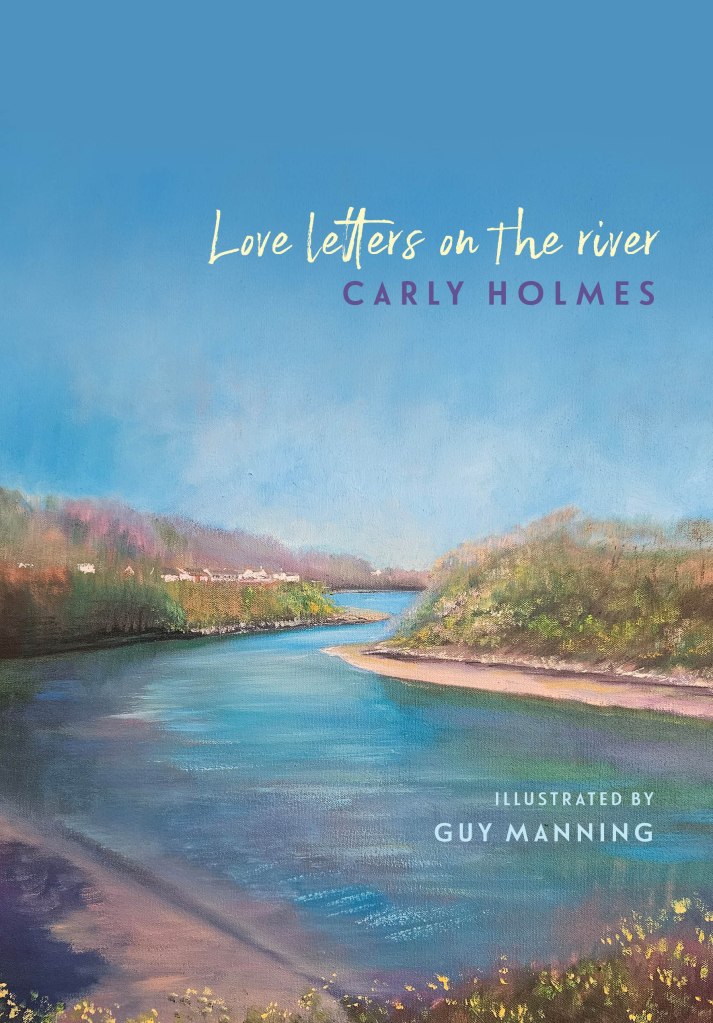
Carly Holmes lives and writes in a small village on the banks of the river Teifi in west Wales. She is the author of the novels The Scrapbook, which was shortlisted for the International Rubery Book Award, and Crow Face, Doll Face. Her short story collection, Figurehead, was published by Tartarus Press in limited-edition hardback and reprinted in paperback by Parthian Books. Love Letters on the River is a collection of very personal nature essays, set around the Teifi valley. It is, in her words, a book that puts the animals she encounters at the very centre of the writing: “Meeting those wild lives on their terms. Not on mine.”
 Modron Magazine