Interview by Glyn F. Edwards
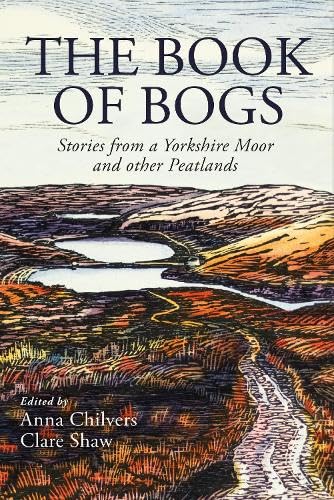
Clare Shaw has four poetry collections with Bloodaxe: their last collection was a Poetry Society Book of the Year. In their writing, teaching and activism, Clare’s work often engages with issues of ecology, wellbeing and social justice. With novelist Anna Chilvers, they are a co-editor of The Book of Bogs (Little Toller, 2025).
Glyn F. Edwards: To what degree was The Book of Bogs a form of community activism in response to the proposal to build England’s largest onshore wind farm on Walshaw Moor?
Clare Shaw: The short answer – The Book of Bogs began as activism, and it became art.
It has its roots in the campaign to save the protected peat of Walshaw Moor from the “Calderdale Energy Park” proposal – according to which sixty-five immense windmills, with accompanying infrastructure (roads, concrete footing, and battery storage units) would be built on these South Pennine blanket bogs.
The area of development would encompass Top Withens – reputed site of Emily Brontë’s Wuthering Heights, and a reflection of the strong literary and artistic culture within this area. Perhaps it was inevitable that there would be a strong artistic response – and in 2024, a large group of artists came together to respond.
To quote the book, our stated aim was “to bridge the distance between those of us who know and care passionately about peatland – and those who haven’t yet been introduced to the rich, life-saving world of the bog”. We agreed on an anthology of writing – creative, scientific, personal – which would “offer an immersion in these magical and threatened landscapes”. We wanted the reader not “just to understand peatland, but to feel it”.
Glyn: The map of peatland in the UK serves as a key to the locations covered by the book’s 40+ contributors. How did the anthology evolve into its final guise as an extensive coverage of British peatland?
Clare: In that year, Anna Chilvers and I began approaching writers who had a particular connection with peatland. Given the national profile of many Hebden Bridge writers – including Amy Liptrot, Horatio Luther, Kim Moore – we were delighted that all of them agreed to write for the book. But from the outset, it was important to us that the anthology was not limited to the particular challenges facing Walshaw Moor. Instead, we wanted it to reflect the variety of peatlands across the UK and beyond. We wanted it to evoke their rich ecology, their fascinating cultures, and the crucial role they play in mitigating climate change and its consequences. Peatlands cover around 3% of the world’s surface, yet hold 30% of its soil carbon. Yet across the world, they face destruction – in the UK, around 80% of our peatlands have been drained or damaged. Appreciating the worth of a single moor like Walshaw, and the urgent need to protect peatland – requires a national, even global, perspective.
But if I’m honest, we were taken aback by the scale and range of the response. Almost every writer we approached agreed to contribute to the anthology – including writers of international renown like Guy Shrubsole, Rob McFarlane, and even Patti Smith! The outcome was an anthology of 43 authors, with a scale, range and dynamism that surpassed that anything we or Little Toller had dared to hope for.
Glyn: The Book of Bogs makes peatland its protagonist. What was the first time you realised the habitat had such a remarkable agency?
Clare: In ‘The Love Story of Walshaw Moor’, I write:
“By 1990, just 4 per cent of lowland raised bogs remained, and swathes of upper peatland – the blanket bog of the moors – had been lost to afforestation; to thin trees planted in crowded, monotonous rows. I knew little of this. I was looking for a girlfriend – Tall friendly college student, loves Kate Bush and rainy nights – and at eighteen, we met, and moved into a Liverpool flat. The dustbin men were on strike and rats climbed like squirrels in the trees. On a clear day, from Everton Brow, we could see the Welsh hills. We didn’t visit. And Burnley didn’t want me anymore, but I cried when I left it. I missed my moors, their wild, though I knew nothing. I didn’t know how they were created, or what they held. I don’t didn’t know the motorway to Liverpool was built on the drained remains of the ancient Chat Moss. I knew that landowners burned the heather, and at dusk the low flames looked like sunset or hell, the air grubby with smoke, but I didn’t know they did it so grouse could eat the new roots and rich men could shoot them; or how flames damaged the peat; how peat was black magic which grew at 1mm a year and yet held more carbon than forests. I didn’t know the world was heating up and the waters were rising, and that my own small world would soon drown”.
I was born to the moors of East Lancashire, and for much of my life I loved the moors and their blanket bogs with an uninformed passion – for the gothic romance of their bleakness, for the sense of freedom they gave me, and the way they reflected my own harsh circumstances and my resilience. But it took a residency on the raised bogs of South Lancashire, where staff and volunteers worked to protect and restore the remaining areas of the devastated Chat Moss, for my understanding of peatland to grow. There’s no coincidence in the fact that I was undergoing some frightening health issues whilst I worked on the mosses, and I found a beautiful reflection not just in their perilous health, but also in the slow process of their recovery:
It’s 2021: I wear a mask for my appointments at the oncology department, Burnley General. Afterwards, I drive to Little Woolden Moss, where the land is soft, and there’s cotton grass clean as snow. There are no hills here. Close by, the motorway sounds like the sea. I am learning what it means to be peat, to hold death gently inside me. I learn there are 37 kinds of Sphagnum moss, and 23 types of dragonfly. I learn that the bogs, these small surviving patches, are being restored. I learn that recovery is slow, there are worse things than falling, mud is gentle. I know myself as bog now, not one thing nor the other, but all. One teaspoon of soil contains more living organisms than there are people in the world: I learn that sometimes you have to kneel in the dirt, to look closely.
It was a new way of seeing. Though I learnt it on the raised bogs of South Lancashire, I took it home to West Yorkshire, and at night, my daughter and I looked at slugs by torchlight, delighted by the slow ballet of their tentacles. The collective noun for slugs is ‘cornucopia’, and once the bogs had taught me how to notice, I saw the world as a place of plenty. I learnt to distinguish between heathers, to see sundew and tormentil, butterwort… I slowed down for fungus and moss, enthusing about their colours, their wild and delicate architectures.
Glyn: Together with Anna Chilvers, the co-editor on the project, you navigate the UK’s peatland through assembling poetry, creative prose, non-fiction and mixed media – the outcome is polyphonic whole, speaking in tongues, insisting to be heard. Which of all of the different voices in the project do you return to most often?
Clare: I wish I could answer this question simply, but I can’t! There are so many ways I return to the book – for Information, for inspiration, for models and templates of working, for my own enjoyment. Some of the short bright poems, like Ian Humphreys’ ‘Tormentil’, Jane Clarke’s ‘Recipe for a Bog’ or Victoria Gatehouse’s ‘All about Peat’, give fast and powerful access to the bog’s wonder … Alys Fowler’s ‘The Peatland has Two Mothers’ has the incredible ability to convey precise scientific information in the most beautiful, lyrical way … Mel Giles’ ‘Moss Fox’ is a master class of how academic disciplines such as history and archaeology meld perfectly with the emotion and humanity of art. I find such personal resonance in Nicola Chester’s ‘Wild moors of the imagination’ which is a perfect exploration of how we are shaped by landscape, and how landscape is in turn shaped by our stories. But if I could only take a single piece to my desert island, I’d have a hard time choosing between Carola Luther’s ‘Descent’ or Michael Malay’s ‘Lystna’, for their scale and ambition, for their experimentation with form, for the way in which they take a contemporary issue and create a new mythology around it, and because every time I read both of these rich, musical pieces, I find something new in them.
Glyn: What’s the current state of progress with the proposed wind farm, and do you have a different vision for Calderdale and moorland habitats in general?
Okay. So here it is in summary. In 2023, a proposal is submitted for a wind farm of 65 turbines, up to 200 metres tall, covering over 9 square miles of SSSI peat moorland. Calderdale Wind Farm Ltd is owned by a subsidiary of Al Gihaz Holdings; a Saudi Arbian company with a fifty year record in supplying infrastructure to oil, gas and more recently, renewable energy developments. The nature and size of this project means that planning permission is sought and granted at a national level by the relevant government minister – in this case, Ed Miliband, the Secretary of State for Energy Security and Net Zero. This process is reserved for Nationally Significant Infrastructure Projects, and leads to much smoother and quicker decision-making on matters of “national interest”. Yet throughout 2024, the proposal sparks major local opposition over its environmental impact. Objections coalesce around the following.
- Destruction of peatland: The Uk’s peatlands are recogniseded by the Nature Minister Mary Creagh identified peatlands as crucial “national rainforests,” storing 3.2 billion tonnes of carbon.
- Damage to legally protected sites of special scientific interest of national ecological importance, such as the nesting areas of red-liste birds like the curlew and merlin.
- Increasing flood risk to the regularly flooded areas of the Calder Valley.
- Damage to the area’s literary heritage and its tourist industry.
Following a period of mandatory non-statutory consultation last year, accompanied by a Preliminary Environmental Information Report, Calderdale Wind Farm downgrades its original proposals. The proposed wind farm now consists of 35 wind turbines of 200 metres height (for reference, Blackpool Tower is 158 metres high). The proposed site will cover 2227 hectares of peatland, largely situated within Brontë Country. The proposal is now in a 9 week period of statutory consultation, in which local communities, statutory consultees and other stakeholders can review the updated proposal and offer feedback. On the basis of this process, and the completion of mandated environmental assessments, a DCO application will be presented later this year. In short, we are now in a window of time in which we can formally register our concerns – and it looks entirely possible that Ed Milliband will grant planning permission to the developers by the end of 2027.
Of course I’m a supporter of the net zero targets. But these moors should not be industrialised so that we can meet our constantly increasing hunger for energy. My vision for the South Pennine Moors to become a National Park. In the 1940s, when National Parks and Areas of Outstanding Natural Beauty (AONBs) were first designated, the South Pennine were proposed alongside the Lake District, Dartmoor and the other National Parks. Yet it was decided at the time that the urban and industrial heritage of the area made it unsuitable for National Park status – a decision which to me, speaks more loudly about the class-bias of the decision makers than the beauty, culture and ecology of the land. We’re better than that now. We know that our upland moors, with their extensive blanket bogs, their nature and culture should receive recognition, protection, investment and, to be honest, love. In the meantime, I want to see recognition of its existing legal protections as South Pennines Site of Special Scientific Interest, a Special Protection Area, and a Special Area of Conservation – along with an aligning of the government green energy strategy with the national and global commitment to peat restoration. Because whether its Walshaw Moor or Papua New Guinea, whether it’s the blanket bogs of the Carneddau or the mangrove swamps of Florida, these are marvellous, vital places, and if we save them, they may well save us.

