Interview by Zoë Brigley
Welcome back to our series on writing the #MoreThanHuman. We offer a set of interviews with poets and writers on how they approach writing about the environment. The more-than-human is a phrase that seeks to side-step traditional nature-culture dualisms and draw attention to the unity of all life as a kind of shared commonwealth existing on a fragile planet. It also reminds us humans that there is more to life, that there is more world, than the human. It relocates us in relation to the mystery.
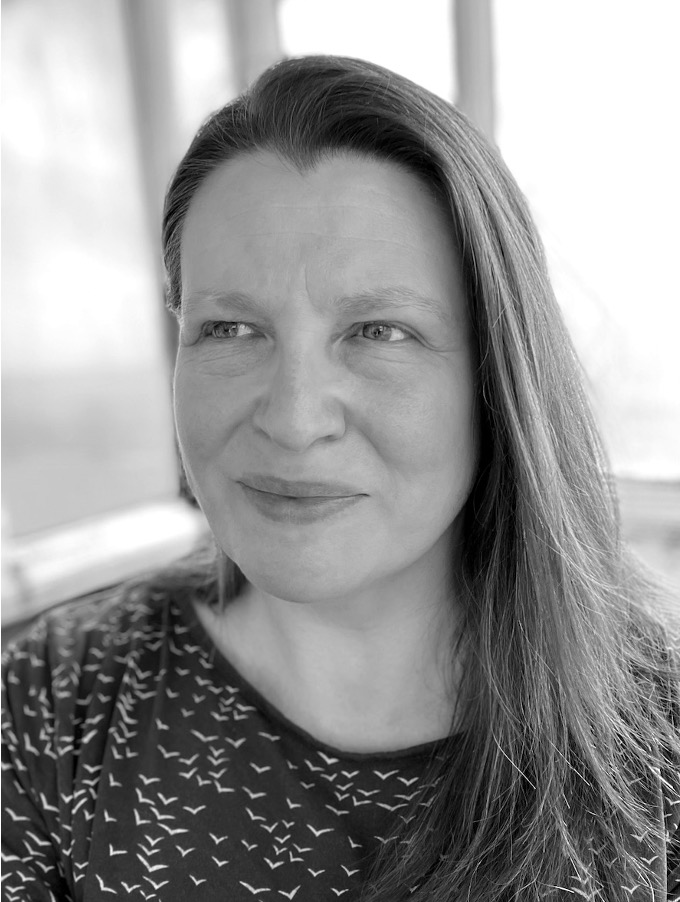
As part of our interview series on the “more than human” perspective in environmental poetry, we meet Em Gray, a neurodivergent poet living in Brighton, UK. She has been highly commended by the Forward Prize, shortlisted for the Creative Future Writers’ Award and has won second prize in the Mslexia Poetry Competition.Slow
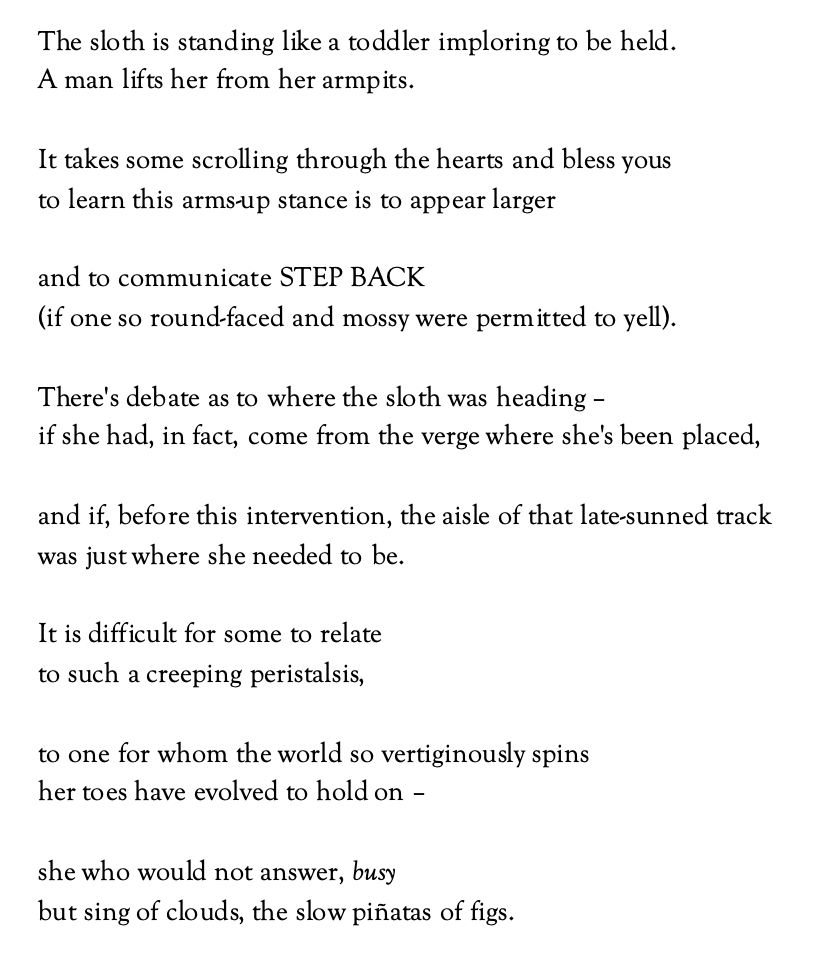
Zoë Brigley: I feel like sloths have become another meme-friendly, cutesy animal online, but there is something so sad about the unfolding of this sloth’s story. Is poetry the antidote to how humans present animals on social media?
Em Gray: Thank you for this interesting question, Zoë. Reading poetry, for me, echoes a sharing between two people. Perhaps we ‘listen’ more keenly in this dynamic – the reader approaching a poem with deeper intentionality of attention than to the randomly scrolled content so often used to zone out.
The baby schema ticking ‘cuteness’ of the sloth sells. I think of the many ways in which animal-related social media content can be biassed, altered or manufactured to monetise our brief attention spans and responses; delicate snouts ‘booped’, AI wolves cuddled, scent glands/ traffickers’ nets/ abattoirs erased – and all interspersed with ads that encourage a shopping mentality in the viewer, blurring the lines between product and animal.
At best, such representations are reductive, whereas poetry, I think, can expand and resonate from the field that exists between poem and reader. Poetry has a capacity to hold (with its slant telling and similes) what’s complex and ultimately unknowable – admit, ‘I can’t speak the truth of another species, but maybe this is what it’s like.’
Fiona Benson’s ‘Mama Cockroach, I Love You’ is a great example, I think, of an antidotal poem, with its unflinching detail of this insect we have damned and othered as ‘pest’, threaded through with the ‘intimate and sweet‘. This sweetness isn’t a buy-me-pet-me cuteness, but describes the efforts of the mother cockroach to sustain her offspring. One question asks, ‘What if your kitchen is fumigated?!‘, challenging notions of the ownership of space and holding a mirror to the human species as persecutor.
Zoë: You also cleverly outline the problem of human interventions designed to ‘help’ animals without understanding their behaviour or needs. It feels like a difficult human problem – the desire to help but realising that the best intentions might also cause harm. I wonder how you see this?
Em Gray: ‘Slow’ was inspired by a clip in which intervention was probably unstaged and well-meant. But it also looks at the issue of acting from our own presumptions, projections and needs.
There are, of course, risks when intervening in animal suffering, such as the disruption of survival behaviours and of an ecosystem’s prey/predator balance. I remember the dilemma faced in 2018 by the BBC crew who dug a snow ramp to help a colony of penguins, but I wonder if the crew’s actions caused more controversy because of the ‘perfect’, discrete expanse of the penguins’ habitat being seen as the nature with a big ‘N’ so separate from ourselves (whereas helping a fox trapped in a football net, for example, might present less of a dilemma).
When we see ourselves as separate (or superior) to nature, instead of being a part of it as human animal, we limit our awareness of, and concern for the suffering of other species, including suffering we have contributed to or directly caused.
Zoë: I like the move at the end of the poem to enter the point of view of the animal, so different to that of humans. How difficult was that to write?
Em Gray: The word ‘busy’ came to mind neatly as a pivot to the last line – this word that can shut down connection in conversation, suggest a sense of rushing/speed, and is often used in a way that posits busyness as a virtue (in ironic contrast to the word ‘sloth’ as one of the seven deadly sins).
I’ve recently been reading about animal vocalisations, and researchers’ conclusions that some of these are simply an expression of joy. I hoped in my mention of singing not to be anthropomorphic, but to suggest, instead, a place of connection between species.
I did grapple with the last line, recognising that trying to voice another species using one’s own language, references and limitations of understanding is an inherently flawed process, a colonialisation of sorts. But I think I chose to embrace this flawedness with the piñatas metaphor (this object so rich with religious/cultural meaning) for its association with celebration and abundance, and for how the fig grows in sloth habitats of south and central America and forms part of the diet for some sloth species.
Zoë: How did your interest in writing about the natural world begin?
Em Gray: I used to think that to qualify to write about nature, one had to be striding Wordsworthily up hills – an image that plays into the romantic notion of Nature as other – unpeopled, the penguins’ perfect snow.
But during the 2020 lockdown (of listening and noticing in a new urban quietness) I watched foxes and birds from my window, and began to write regularly. I wrote about the small natures around me; a house cactus coming into flower, the herring gulls’ nonchalance around the scarer kites on the hospital roof opposite, the spider who lived in my bathroom.
My first published poem, ‘Pluck’, emerged from an online City Lit course taught by wonderful poet and tutor, Sarah Westcott, and was about a local pigeon with no tail feathers. I reflect on how invested I felt in this pigeon’s recovery back to easier flight when all our wings were lockdown-clipped.
Now, due to other difficulties getting out, I experience the world often via screens. This has directed one writing interest towards the prisms through which humans present and perceive animals online, especially when these prisms cause harm.
 Modron Magazine