Interview by Zoë Brigley
Welcome back to our series on writing the #MoreThanHuman. We offer a set of interviews with poets and writers on how they approach writing about the environment. The more-than-human is a phrase that seeks to side-step traditional nature-culture dualisms and draw attention to the unity of all life as a kind of shared commonwealth existing on a fragile planet. It also reminds us humans that there is more to life, that there is more world, than the human. It relocates us in relation to the mystery.
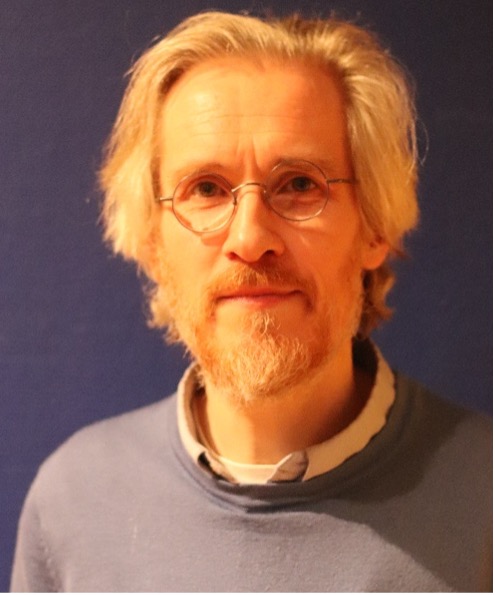
Here, we meet Matthew Griffiths, an Oxford-based editor and educator, author of the collection Natural Economy (Red Squirrel, 2016), the critical book The New Poetics of Climate Change (Bloomsbury, 2017), and the novel The Weather on Versimmon (Big Finish, 2012). He was longlisted for the National Poetry Competition 2025.
Last Year’s Weather
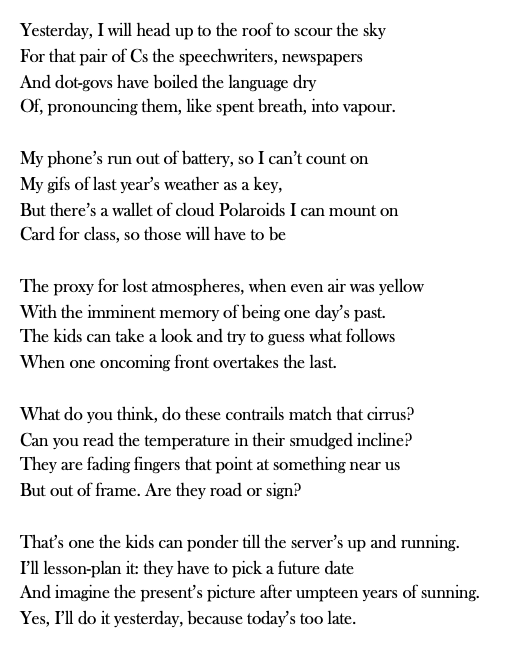
Zoë Brigley: It is remarkable these days how few poems we receive that rhyme. Here, I must say I think the rhymes works well. They are subtle! But I don’t want to put words in your mouth. Would you tell us about how the poem ended up in this form and how that links to a sense of inevitability in the poem perhaps?
Matthew Griffiths: I think the poem started rather than ended up in this form, to be honest – certainly, the first draft of the opening lines is aspiring to regularity, or quasi-regularity. I feel comfortable working in structure, even though I’m interested, critically, in more experimental poetics, and would like to be more experimental myself.
Reading the poem now, seven or eight years after I drafted it, I agree there is that sense of inevitability you mention. But I also notice the ABAB rhymes are weaving together ideas in tension with one another – talking of “yesterday” in the future tense, the reversion from digital to print photography, even the generational dynamic between speaker and kids. The rhymes also knot together sounds when the syntax is running over line endings, building up both momentum and tension in the earlier part of the poem.
In practical terms, I was composing this in one of those spells when I was (as now) trying to write every day, and rhyme and form helped give support and direction to the idea, which was in this case prompted by the news (when, in the first Trump term, references to climate change were being removed from official US websites). Fitting writing into my day also meant I was doing this on the bus coming home from work – when I was living in London, with the bus coming along Piccadilly and the top of Green Park, then past Hyde Park. Shorter, more regular lines were easier to manage in a reporter’s notebook, and more legible!
Zoë: That is a great opening to the poem: “Yesterday, I will head up to the roof”. I mean already we are put in an uncomfortable space where logic is not quite working. Does that relate at all to your feelings about ecological emergency?
Matthew: Thanks; and yes, it does. My reading of that has changed since I wrote the poem, though. Just as I’d like to be more experimental, I’d also like to be more hopeful – or at least, less pessimistic – in what I write on climate change. The first draft began “Today I will head to the roof”, but I changed that to “Yesterday” to create if not a sense of inevitability then a tension. If you start believing something is inevitable, you run the risk of making it inevitable. So as I read it now, I see ambivalence rather than fatalism. Clearly the situation hasn’t got any better in recent years – if anything worse. However, my attitude has changed, in that there is still scope to resist the discourse of inevitability, and try to imagine alternatives, ways out of this temporal paradox.
Zoë: The kids in the poem are an important presence and they give the poem urgency. I have the feeling that the problems are not just about the speaker but that they are responsible for future generations which increases the tension?
Matthew: The speaker’s tone is nervy, isn’t it? I’m not sure I’d properly picked that up until you pointed it out. I see from my edits that I toyed with putting the fourth stanza into quotation marks, as though it was directly addressed to the kids. But without that punctuation the speaker may be asking themselves these questions as well, uncertain whether there is any value in this as a classroom exercise.
As it happens, I have since been teaching climate literature – albeit to college rather than school students – which I hadn’t done at the time, and one of the things they have taught me is the value of hope, or the need for hope, to enable action. I’m not sure the poem quite offers that, but it doesn’t rule it out – the speaker’s doubt leaves room for hope. I’ve written elsewhere that the literature of climate change needs itself to be amenable to changing interpretations as the climate changes, and perhaps this is one of those instances where I do manage to live up to my own criticism!
Zoë: Is there anything else you want to tell us about this poem?
Matthew: I’m struck by how my own childhood forms part of the poem, the photos stuck on card to go on the wall at primary school. Is that world – so recent in my memory but so distant to today’s children, or anyone I’ve taught – the object of wistful reflection as an adult? Or has the world actually passed a tipping point in that time? Will we revert to life like that when the days of ready energy run out (which has affected phone battery and server here), or is that itself small-c conservatism, a yearning for the simplicities of forty-odd years ago? The poem can’t reconcile the two, so “Last Year’s Weather” as a phrase and a title is both specific and nostalgic, as well as opening into something altogether more uncertain – the world, and the future.

