Interview by Zoë Brigley
Welcome back to our series on writing the #MoreThanHuman. We offer a set of interviews with poets and writers on how they approach writing about the environment. The more-than-human is a phrase that seeks to side-step traditional nature-culture dualisms and draw attention to the unity of all life as a kind of shared commonwealth existing on a fragile planet. It also reminds us humans that there is more to life, that there is more world, than the human. It relocates us in relation to the mystery.
Here, we meet Ilse Pedler who lives in Cumbria and works part time as a veterinary surgeon. Her first collection Auscultation was published in 2021 by Seren. She is the poet in residence at Sidmouth Folk festival and is one of the editors of Bending the Arc a magazine of Thrutopian writing.
How We Hid The Truth
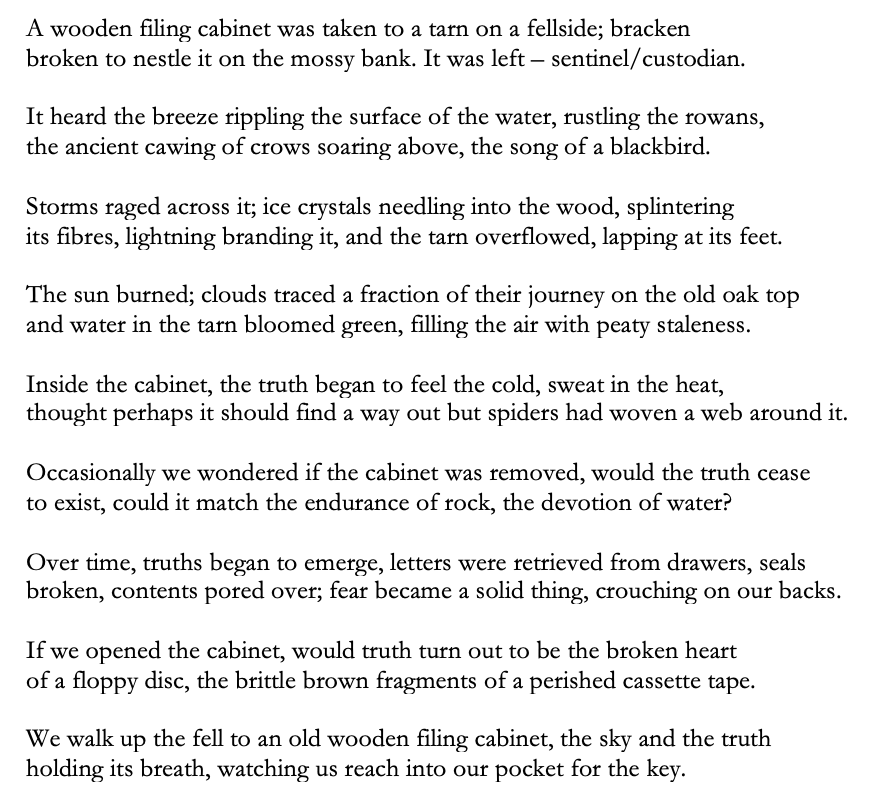
Zoë Brigley: There is something weighty about this poem… Perhaps it’s the sense of inevitability as time passes, and the filing cabinet – once dumped and forgotten about – comes back to tell us some truth about our own carelessness. I wonder whether a real filing cabinet inspired this poem?
Ilse Pedler: Ha, interesting, not a specific one consciously, but now thinking about it, in the office at work there were a series of huge old metal filing cabinets that contained everything to do with the practice, all the admin and accounts and HR information etc. The practice manager used to hide chocolate biscuits in there for particularly stressful days too!
There were also a series of smaller wooden filing cabinets that contained the client records on cards, this was pre-computer, and when you opened those it was like going into a secret world of animals and people’s lives. Longstanding clients had thick bundles of dog-eared cards held together with an elastic band and you could see all the different vets’ handwriting and sometimes little drawings they’d done. I think I must have subconsciously channelled all of that. I definitely wanted the filing cabinet to be wooden rather than metal to reflect the natural environment.
Zoë: I’m thinking now as well that there’s the feeling of a parable here or a folktale. I almost feel sorry for the filing cabinet. It comes to life for me, and the ‘old oak top’ reminds me too that it once was a tree in a former life. There is a real sense of loss, that reminds me of ecological stories like Oscar Wilde’s tale of ‘The Happy Prince’. Do you think there are any particular writers or stories that influenced the telling of this story?
Ilse: I definitely wanted the poem to have a folk tale mythical quality about it and many folk tales have that surreal element where time and/or events become impossibly expanded or contracted, as well as that sense of inanimate objects being perfectly capable of becoming animate.
Zoë: You have recently set up a Thrutopian poetry group. Could you tell us something about Thrutopias? I’m also wondering if this poem is Thrutopian in that it is calling on us to act.
Ilse: Yes, it’s very exciting, Alice Willitts, Hilary Watson and I did Manda Scott’s Thrutopia Masterclass in 2024 as we wanted to find new ways of writing about the environment that weren’t as bleak and dystopian as some current eco-poetry. That’s not to say that there isn’t a place for that too but we felt people were becoming disengaged with the climate crisis and often feeling helpless and depressed. Thrutopian writing imagines ways through to a world we could live in and be glad to leave to future generations. It tells stories about tangible change and walks us along the challenging path from here and now to a hopeful, liveable tomorrow. It accepts unpredictability and upheaval as foundational to the times that we’re living in, but doesn’t dwell in that fear. We have written poems about retrofitting cities, the campaign for installing swift bricks in all new houses and the joy of coming together as communities. We have joined forces with Katherine Stansfield a poet and fiction writer and Laura Baggaley a YA fiction writer to produce a Substack magazine called Bending The Arc, which showcases thrutopian writing. We release two issues a year and our third edition is due out on Earth Day, it contains poetry, fiction, interviews and articles about Thrutopia including everyday actions, so small things that we can all do to make a difference. This edition also includes a piece from Rupert Read, the person who actually coined the phrase thrutopia.
Alice, Hilary and I have also just had a pamphlet of thrutopian poems published by Dialect Press called We’ll Meet You There. We believe strongly that we need to get the narratives out there and give people some hope and show a way forward in this fractured world we’re living in at the moment.
I guess ‘How We Hid The Truth’ isn’t strictly thrutopian as it ends leaving us with the question of what is going to happen next, rather than actually opening the filing cabinet and showing us ways of nurturing the truth and bringing it back to health. I guess a sequel is needed!
Zoë: Is there anything else you want to tell us about this poem?
Ilse: I am very fortunate to be a member of a group of women poets called the 57 Collective started by the amazing Alice Willitts, and this poem began in one of our monthly meetings chaired by Elvire Roberts who has one of the most interesting and enquiring minds I know. She was thinking about secrets in poetry and how she enjoys poems that keep something hidden that may be revealed or hinted at as the poem ends, or maybe doesn’t. Elvire set us a series of questions based on Wallace Steven’s ‘Thirteen Ways of Looking at a Blackbird’ and so the poem really started there and through successive drafts became contracted and more concerned with illustrating climate change through the use of an inanimate object. (I did manage to keep a blackbird in there though.) At the end I wanted to leave the reader with a sense of, this is what we know about the effects we are having on the planet, we have the key, whether we use it or not is up to us.
I think the answer for me has been to open my filing cabinet, recognise the truth for what it is and to try and find ways of moving on from what we know into a more thrutopian way of thinking and positive action.

