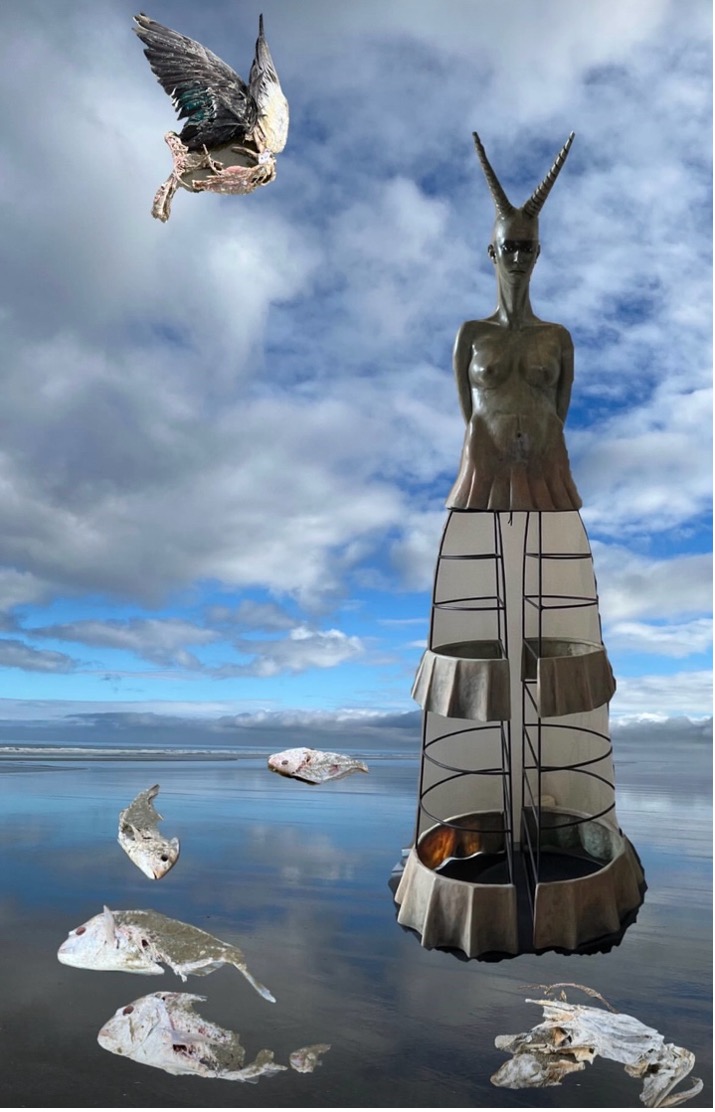
Interview by Zoë Brigley
Welcome back to our series on writing the #MoreThanHuman. We offer a set of interviews with poets and writers on how they approach writing about the environment. The more-than-human is a phrase that seeks to side-step traditional nature-culture dualisms and draw attention to the unity of all life as a kind of shared commonwealth existing on a fragile planet. It also reminds us humans that there is more to life, that there is more world, than the human. It relocates us in relation to the mystery.
Here, we meet Gabriela Denise Frank, a transdisciplinary artist, editor, educator, and the author of How to Not Become the Breaking. Her writing and visual art appear in BOMB Magazine, Chicago Review, Camas Magazine, EcoTheo Review, The Rumpus, and elsewhere. Off the page, she seeks to expand the definition and experience of literary art by placing literary art in the path of everyday life.
How to Live on a Damaged Planet
To save what’s left, you have to love the world as it is, not as it was.
—CA Conrad
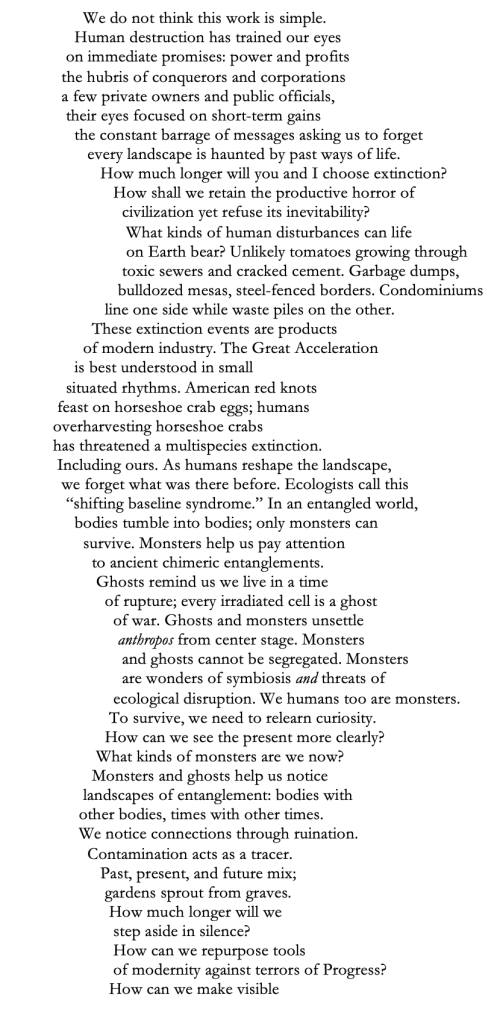
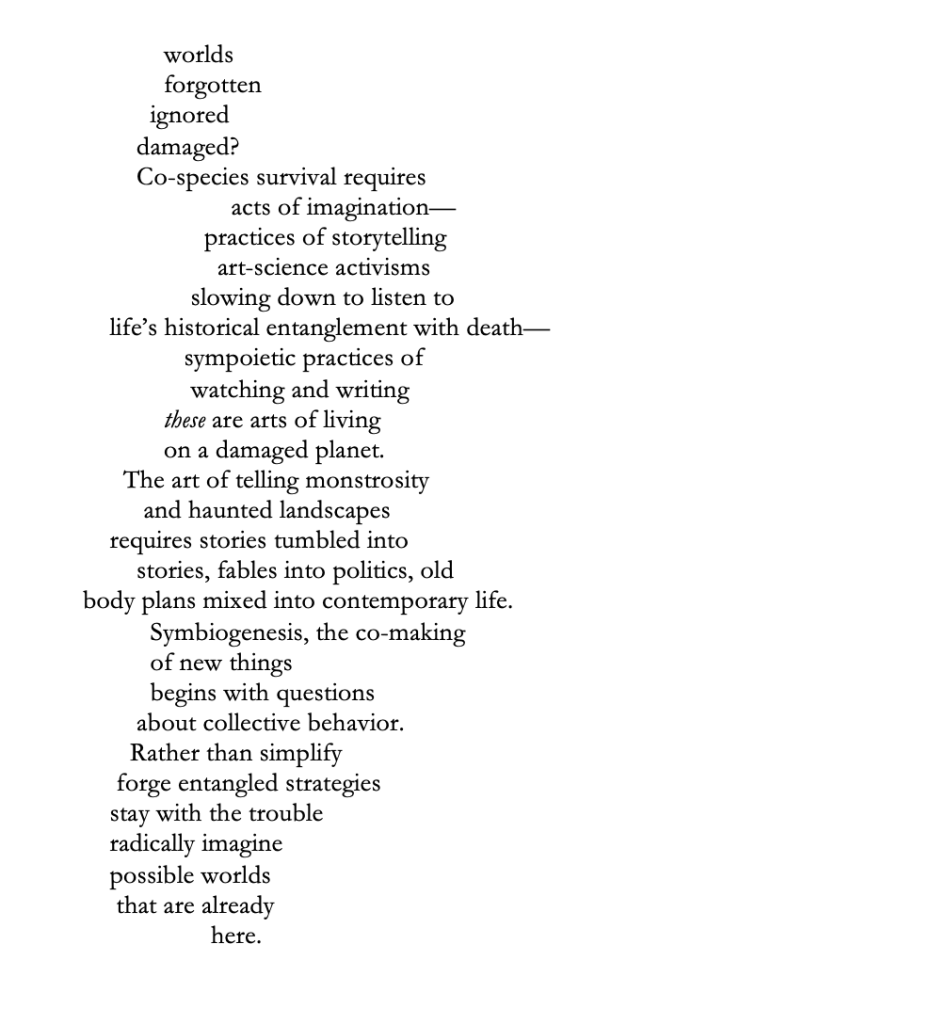
Author’s note: This cento is stitched together with lines from the two introductions to Arts of Living on a Damaged Planet, edited by Anna Tsing, Heather Swanson, Elaine Gan, and Nils Bubandt.
Click here to listen to an audio recording of this piece.
Zoë Brigley: Tell us about your use of the cento form, especially for readers who may not have encountered it. You quote from the book Arts of Living on a Damaged Planet. What inspired that idea?
Gabriela Denise Frank: When I’m feeling stuck or I need to find my way back to the music of language, I turn to the cento. The cento, which translates to “one hundred” in Italian (pronounced chen-toe), began as an honorific form of 100 lines, composed from the corpus of a poet’s work. The name is also associated with a seventeenth century Latin word for a patchwork garment, so you can think of the cento as a collage of words rather than textiles or images.
With centos, the pressure of composing from scratch is lifted. My rational, progress-driven mind goes on break and my subconscious takes over. One line snags my attention, which leads to another and another, and soon, a voice outside my own—and, often, a narrative spine—emerges. It feels magical because what I’m finding was in the text all along, and yet…it’s not what the writer intended. Is it the subconscious or the collective unconscious that we’re tapping into with flow states like this? Who knows?!
Everything hangs together, just barely, in the cento. It’s a delicate palimpsest of lines on lines that have no earthly business in conversation. They are assembled first in the mind of the writer, then the reader, although the meaning for each might be different. This flexible, generative form yields surprising revelations because our brains are made for pattern identification, even when there is no intended pattern.
As a spooky science fan, I loved Arts of Living on a Damaged Planet. It’s a thought-provoking collection of short works whose printing flips over halfway through. You can start on either side—Ghosts or Monsters—either way, when you get to the middle, you’re forced to turn the book over and reorient yourself to enter the conversation from the opposite direction.
The physical act of reading Arts of Living is a reminder not to get too comfortable in one’s thinking. The way the subjects and themes overlap is cento-like: everything is connected, patterns emerge, yet the essays were written by different authors coming at the state of the planet from distinct perspectives. I got to wondering how the symbiotic relationship of monsters and ghosts meshed together, so I united the two bookended introductions. As a conjoined text, the questions they raised felt as compelling as the loose instructions for how to move forward.
Zoë: That is a powerful epigraph from CA Conrad. What influence do you Conrad has on your writing?
Gabriela: This quote woke me up! There’s heavy critique of the right’s fascination with and nostalgia for the past, embodied in sentiments like make America great again, but liberals and progressives aren’t immune to the desire to resurrect the past. I’ll speak for myself: I realized that I had been clinging to the past when I wished aloud for “normalcy” to return. This line from CAConrad spotlighted a privileged passivity in that yearning, however well-intentioned, for the restoration of a “normal” past—which is to say, for a seemingly easier past to supplant the disastrous present.
It’s tempting to want what’s remembered as a more positive, simple time in our country: the illusion of an arc of history bending in one direction—namely, justice. This suggests a neat path and an end, but the future is always in progress and each arc is part of a complex, branching timeline. Those “normal” times weren’t just and equitable for everyone, particularly Black Americans, Indigenous peoples, and people of the global majority—or for our immigrant brothers and sisters, the LGBTQ+ community, and women. I’m not saying we should ignore the past, but we can’t keep our gaze turned back toward what seemed less bad when there’s serious—and joyful—work to be done in this moment. CAConrad’s poems operate in the space of present action.
Their writing reminds me to focus my energy on what’s present and what’s possible. Nothing is inevitable and we are not alone, no matter what the tech oligarchs’ push marketing insists. As social creatures, we find joy working in community—this is where we need to look. That said, our work does entail documenting the past, since current regimes are eagerly erasing the progress we’ve made.
By this, I mean everything from Rachel Carson’s foundational reporting (just as environmental protections are being stripped away) to public exhibits being taken down because they describe our country’s Black history and the role that chattel slavery played in the founding and ongoing prosperity of this colonial nation. Our docupoetics can help to preserve history; as long as we remember, we can build on that. I see CAConrad’s writing, which confronts war and harm but also contains love for the planet and care for community, as part of those docupoetics.
Their work points to the fact that every political and humanitarian crisis is also an environmental crisis. We see this in the genocide of the Palestinian people in Gaza and in wars in Ukraine, Sudan, and, now, Iran. To feel dispirited by these events is understandable, but we can’t stay there, otherwise things will not change. We have to face the present—together. And maybe we add a dash of glitter to lift our spirits in tough times. Conrad’s poems, which take the form of rituals, also speak to this.
Powerful people and companies hope that the rest of us will feel powerless and give up, give in. We have to work with what we have and do what we can as a global community to make things better. How can we work with what’s abundant, even if what’s abundant is “undesirable”? What change can we radically imagine—and realize—through collaboration? How can we become each other’s joy again?
That’s what CAConrad’s work teaches me. I first learned of their poems and (Soma)tic rituals from Joyelle McSweeney’s book, The Necropastoral: Poetry, Media, Occults. One of my favorites is the ritual called “Security Cameras and Flowers Dreaming the Elevation Allegiance,” in which the speaker messes with a security guard who is surveilling them on camera as they lick and suckle flowers and shout, “I’M A POLLINATOR, I’M A POLLINATOR!!” The security guard can’t handle it; he goes apeshit. It’s glorious.
Zoë: Adaptation seems to be an important theme in this poem like the ‘tomatoes growing through / toxic sewers and cracked cement’. I am wondering if adapting means becoming monstrous and thinking about what it means to be a monster. Is monstrosity something to with being polluted but surviving anyway?
Gabriela: I think it’s fruitful to poke at the binary of “pure” and “ruined” that monsters raise. Even if we don’t adhere to them personally, we’re surrounded by spiritual and secular notions of purity that are linked to goodness, worth, and aspirational perfection. Of course, nothing is pure—everything changes and everything is entangled.
Take the gut biome, whose flora outnumbers the cells we call “ours.” What is a “pure” human, then? Are we not “polluted” or “contaminated” by those and countless other organisms that comprise the body? Our entangled embodiment, the interworking processes of those entities and ours, is far from pure in the sense of sterile or “clean”—yet isn’t their infiltration part of what makes us human? And alive? Are we not chimeric already, then?
The purity mindset insists that something monstrous is aberrant and defective because it doesn’t obey or conform. It can’t be predicted or controlled—like the flower-licking speaker in “Security Cameras and Flowers Dreaming the Elevation Allegiance.” In a culture that uplifts individuality, purity, and control, the “ruined” holds little or no value. Once purity is “spent,” the “contaminated” thing is a lost cause—it’s been infiltrated by the Other. It can’t be redeemed, so we should toss what’s ruined and move on. We see those who don’t care about ruining Mother Earth eying other planets that they hope to colonize—and ruin and abandon.
Then there’s the monstrous feminine illustrated by creatures like Medusa or Grendel’s mother. The monstrous must be slain before her unruly monstrosity spreads. In a patriarchal ableist culture built on systemic racism, what isn’t pure is marketed as something to be feared, prosecuted, and killed. Monstrosity is branded as a fallen state—a physical punishment for a transgression—“evidence” of divine judgment. The monstrous is a life barely worth living because it’s full of “deserved” suffering. This is why the façade of purity must be upheld, otherwise one becomes “revealed” as impure, as monstrous, as Other.
Yet those tomatoes are amazing. Adaptation means understanding cycles, systems, evolution, and entanglement. They adapted to grow in unforgiving conditions, just as our biology will be tasked with adapting to an unpredictable and increasingly hostile climate and an industrially polluted, damaged world. There are real challenges in surviving those conditions and the only way to do it is collectively—not just with humans but with all species and planetary systems. To quote the disability activist Alice Wong, “When something can’t be fixed, then the question is, what can we build instead?” To which CAConrad urges us to work with what we have in the state it exists. No hopium, no magical thinking, no purity—just imagination, collaboration, creative adaptation.
How will we evolve—not just our bodies and processes but our thinking? What does make survival worth it? (Answer: each other.) Enter: mutation. Is this a “pollution” of the “original” human form? Or imaginative adaptation? What does mutation then make possible? It’s kind of jokey, but I think of Kevin Costner’s character who sports gills in the movie Waterworld. It’s off-putting because gills are supposed to be on aquatic creatures—animals that are “beneath” humans, in some people’s estimation—but, if that’s the kind of adaptation survival calls for, the genome will make it happen. How will we define monstrosity then?
Zoë: The shape of the poem is very arresting. Could you tell us about that?
Gabriela: Because bodies of many kinds figure in Arts of Living, I wanted to embody, not merely celebrate or distill, the poem onto the page. It didn’t feel right when the lines were left-justified. From the start, they wanted to break free of the hard margin.
I played with shaping the lines into an organic, undulating curvilinear form—in my mind, an S curve of a spinal column—something alive or once alive. Maybe both. When the poem moves into mutation, adaptation, and disruption, the smooth curve becomes noisy and glitchy. Here, the reader is invited to consider what co-species survival might look like. A different kind of symmetry. Vital, but not domesticated. Body plans tumbling into each other. Unruly.
I took inspiration for the disruption from CAConrad’s “shard” poems, which are organic yet assymetrical. They work kind of like Rohrshach blots or clouds: the shapes you find in them reflect what’s in your imagination.
Zoë: Is there anything else you want to tell us about this poem?
Gabriela: When I went to record the audio, I worked with a performance coach. She had the text ahead of time, but she asked me to read the piece aloud before she gave me feedback. After the initial read-through, her face bloomed with Aha! She admitted that, when she read it on the page, her heart dropped. She thought, Oh no, another depressing poem about climate change, species loss, and the things we can’t fix.
Hearing me read it, she realized that it’s actually a journey that ends in optimism. There are things we can do, and we can do them together. It was a good reminder that poems translate differently when ingested by the eye or the skin if, we’re reading by touch, or the ear when they’re communicated in sound and breath—inspiration.

