
Thinking in the Heat Wave About Clothes, Coins, Yearning, Flying Foxes and What I Cannot Escape
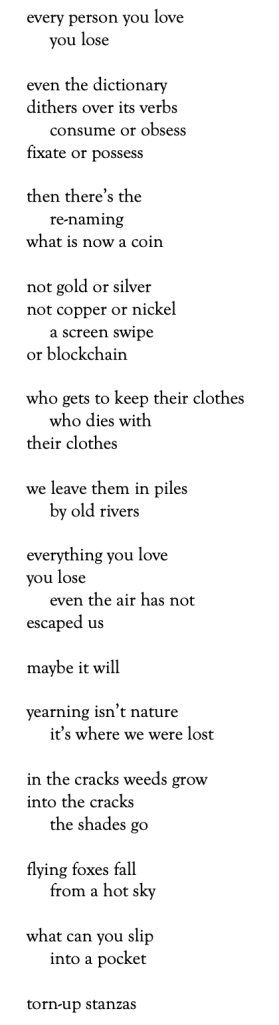
COMMENTARY
I cannot ignore non-human beings and objects. They surround us and support us, yet we have degraded, exploited and destroyed so much, and seem too often to mis-understand their unique roles in local and global phenomena and networks, and their nonhuman particularity.
As humans, we produce so many non-human objects, often corrupting the original nonhuman sources, without considering the consequences. For instance, metals have been refined and turned into currency for commerce and ultimately, greed, and, also due to further greed, are being replaced by a series of non-human entities, of human origin but capable of replicating and replacing human exchange. Our clothes were made from plant and animal fibres, and now more often from petroleum-based or other synthetic materials. What offers cover and shelter is discarded too readily to pollute both lands and one of our oldest sources, water. Weeds are only plants no-one wants. What might be a destructive plant to one person can be another’s food, medicine or fibre. Weeds have their place and will find it, even among the cracks and detritus of the world.
Human-induced climate change has generated severe heatwaves worldwide. In Australia in January 2024, thousands of dead flying foxes were reported to have fallen from the sky or to have died in their roosts in southeast Queensland, the largest number on record (at least 45,500), as well as in sizable numbers in Victoria and South Australia. Heat-related die-offs also occur with other wildlife, but such events are usually more difficult to validate. Because flying foxes live in colonies, it is easier to study the effects of extreme heat on this species.
The form of the poem, its narrow fall, is like something dropping from the sky. The brief indented stanzas are as if they are torn by human touch, directly or indirectly.
You will find a Google word doc accessible version of this feature here.
With thanks to the Poetry School.

Jill Jones was born in Sydney and now lives in Adelaide. Her latest book is Acrobat Music: New and Selected Poems. Her books have won or been shortlisted for a number of major literary awards. Her work is widely published in Australia, Canada, Ireland, NZ, Singapore, Sweden, UK and USA. Instagram: @jill_jones__ Facebook: Jill Jones.
 Modron Magazine