
Zoochosis
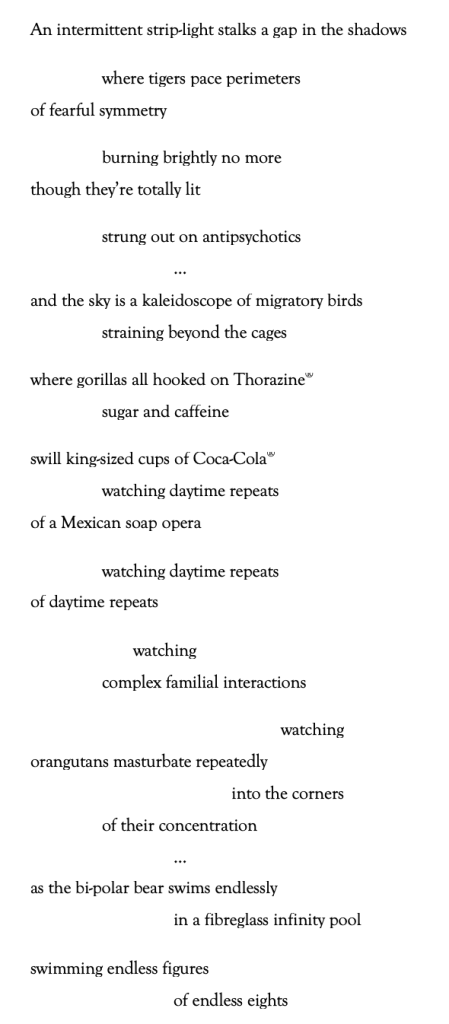
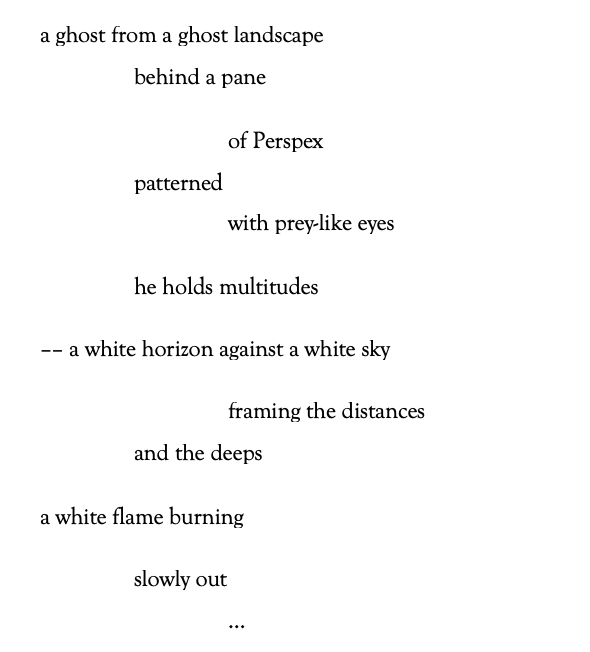
Note: In 1992, Bill Travers MBE, Co-Founder of Born Free, first coined the term ‘zoochosis’ to describe obsessive, repetitive behaviour in zoo animals. He said: “In every zoo I visited when compiling the Zoochotic Report, I witnessed some sort of abnormal behaviour.”
COMMENTARY
What is your approach to writing the more-than-human in this poem?
Using the awe of the more-than-human in Blake’s ‘The Tyger’ as a starting point to highlight how zoos ultimately diminish both sides of the human / non-human equation.
What principles motivate your approach to writing the more-than-human?
I believe that all animals deserve to live their lives free from suffering and exploitation, which includes preserving natural habitats for the wellbeing of all.
How does your physical location affect your writing of the more-than-human?
Living in Aotearoa New Zealand, I write as an English immigrant and acknowledge Māori and Moriori as the traditional custodians of this territory. Human influence on the human and non-human is still raw here. In terms of the latter, birds are popular symbols of the problem. Before humans introduced predation, birds evolved with no or poor flight. The only native land mammal is the long-tailed bat (pekapeka-tou-roa), which, in 2021, was voted Bird of the Year. A spokesperson stated: “A vote for bats is also a vote for predator control, habitat restoration, and climate action to protect our bats and their feathered neighbours!” An estimated 63% of total land area has been converted for human use; more than half for farming (which is responsible for 50% of greenhouse gas emissions). ‘100% Pure New Zealand’ is a brand. This is a land of the sublime in the Romantic sense. It is also a land of polluted waterways, high rates of child poverty, and has one of the highest youth suicide rates in the OECD. Upon moving here (an opportunity I am ever grateful for), I found different birds singing different songs in different trees. I saw global issues at a local level through a new lens – and that has irrefutably informed my writing of the human and non-human (can they be separated?).
You will find a Google word doc accessible version of this feature here.
With thanks to the Poetry School.

Originally from Kent, Dave Simmons now lives on the Kapiti Coast in Aotearoa New Zealand with his wife and their two cats and two Kaimanawa horses. He writes poetry in moments grabbed between his job as an editor and hours spent in paddocks come rain or shine. Dave counts a range of poets as significant influences, including Ted Hughes, Robert Creeley, John Glenday and Alice Oswald. He is currently working on his first collection.
 Modron Magazine