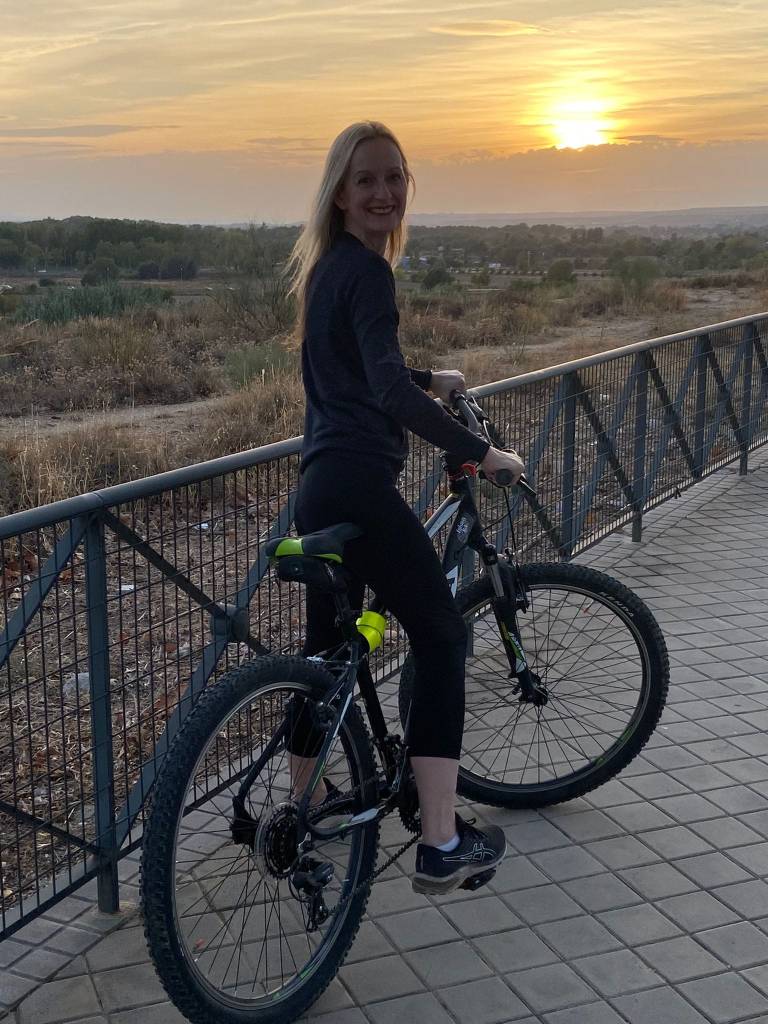
Welcome back to our nonfiction series titled “Plots & Plants”, inspired by intimate connections with place and the natural world. Plots & Plants is a space for nonfiction from writers and environmentalists to talk about places special to them. This series will be an archive and record of places for us to reflect on as time passes, and as we continue to experience environmental emergency and loss. Here, Lisa Kelly talks about an experience of the town of Aranjuez in Spain.
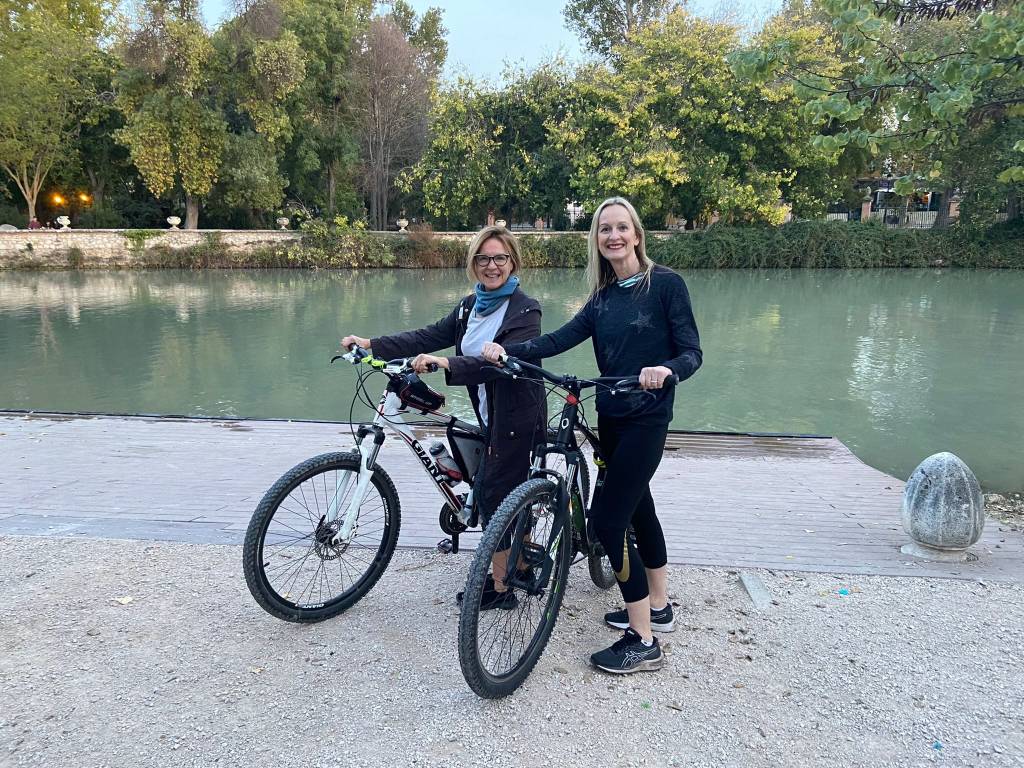
A late autumn morning and I’m with Belen in Aranjuez, a town south of Madrid on the river Tagus, where for centuries the kings and queens of Spain spent the spring months. She’s parked the car at Peurta del Legamarejo and is reaching for plastic bags from the glove compartment. I shift my knees. The surrounding land belongs to a cooperative of local farmers that provide fruit and vegetables to the residents, but we are not here for tomatoes and onions, we are here for conkers.
Horse chestnut trees line one of the paths that radiate through the fields and Belen will fill as many bags as she can for her partner Angel’s dogs. He owns two German Shepherds, Ika and Tek and they are not well-trained. Belen wears bruises and scratches as symbols of their uncontrollable love. She is five-feet tall and when they bound at her to greet her, or want to play, they put their paws on her shoulders to lick her face and sometimes knock her over. Gathering conkers is part of the solution. In the coming winter months, when she doesn’t want to walk far with the dogs, she can exhaust them by standing wrapped up in layers and throw conkers for them to fetch. They don’t eat the conkers, which are poisonous to dogs. In fact, they don’t fetch them; they chase them. I ask Belen why she doesn’t throw toys. She has in the past but often Ika and Tek will run after the plastic chews or balls but not retrieve them and as well as being expensive and wasteful, it means a lot of plastic chews and balls litter the land. With conkers, it is a different story.
Like the dogs, I feel the need to run and am wearing trainers. I offer to help with the conker harvest, but Belen knows I want to jog rather than stoop. She points me in the direction of the river. I do and don’t know the area. It is over three decades since I was living here, travelling around the different regions in a touring show with Aranjuez and its central position as our base. The landscape has the familiarity of a dream – hazy with the impression of rich golds and huge pale blue skies like a Velázquez painting.
Everyone I knew from that time is missing – except Belen. She is a landmark that I can reach. But now I am running away from her, not chasing conkers but a connection with a time and place I have lost. Running also from the intimacy and intensity of being with a friend with communication barriers. Belen’s English is far better than my Spanish, but my single-sided deafness means listening and deciphering what is being said can be mentally exhausting and frustrating. I am not fluent in British Sign Language (BSL), but I am at a level where speaking and signing at the same time comes naturally. Although BSL is not a universal language, some signs are iconic where the visual and meaning concur, such as smoking, walking, aeroplane, crying. It helps when talking to Belen.
Thinking about signs is a way of communicating with the non-verbal. As I run, I watch for what the trees are telling me. Broken sticks all over the ground and under the tree or vertical cracks in the trunk are a sign of damage or poor health, while bark flaking off the tree is a sign it is not getting enough nutrients. But some signs are more abstract and whimsical, less rooted in reality and more attuned to omens and dreams. How many birds are in that flock? What does the number seven signify? Why are they flying close to a storm cloud in a northerly direction? Watching how a cloud forms the shape of an elephant to slowly change into a blue whale that will shower the earth through its blowhole reminds me of the plasticity of nature. I look out for mushrooms at this time of year – how the fruiting bodies of the mycorrhizal network below the ground are announcing the existence of the communication network, the Wood Wide Web, which shows how connection is not just about being seen or heard. Beefsteak fungi are found on chestnuts and mature oaks; it is a parasitic bracket fungus, and its red meaty appearance is easy to spot, and it is a good substitute for the real thing. I wonder what the dogs would do if they were thrown a beefsteak fungus instead of conkers.
I have been running for 20 minutes in a straight line and know I must turn back soon to meet Belen but am nearly at the tree-lined riverbank. I cannot see the water for the vegetation, but remember its distinct shade of green, almost jade. I am not certain if it is from algae or a mineral in the soil, and if the colour will match the colour in my memory. On this long avenue, I have passed only one dog walker and their black collie and a man on a scooter, perhaps a farmer checking on whatever he will sell on Sunday when Belen will come again to buy the local produce of which she is fiercely proud.
It is not the season, but Belen has already reminded me that the strawberries are the best in the world and of the route of the Tren de la Fresa or the Strawberry Train. It offers excursions from Madrid to Aranjuez in early summer with strawberries served in straw baskets by attendants dressed in nineteenth century period costumes complete with richly embroidered long skirts, bustles, and hats. An opportunity to play make-believe and live in the past. When I was last in Aranjuez, my parents were alive, and Belen’s mother was alive, and her father recognised her. I was invited to a family lunch in her sister’s garden where he enjoyed the spread – gazpacho, boquerones, patatas bravas and green salad. Under the canopy to protect us from the searing heat, which is not a memory of thirty years ago, he was given a flyswat to bat away persistent wasps. We all need to expend energy in translating our desires – whether it’s in chasing conkers, shooing wasps or running after memories.
I am sweating in my shorts and t-shirt but am at the river where the air feels cooler – probably not by many degrees but just looking at the water slows my heartbeat. It is a shade of green I can only see while staring – impossible to recall as soon as I turn my back. The water communicates with me only in the present tense. I cannot stay long because Belen’s bags must surely be overflowing with conkers, but I want to retrieve something. I have run this far to fetch. I look around on the bank and there are cinders and ashes, evidence of campers or picnickers.
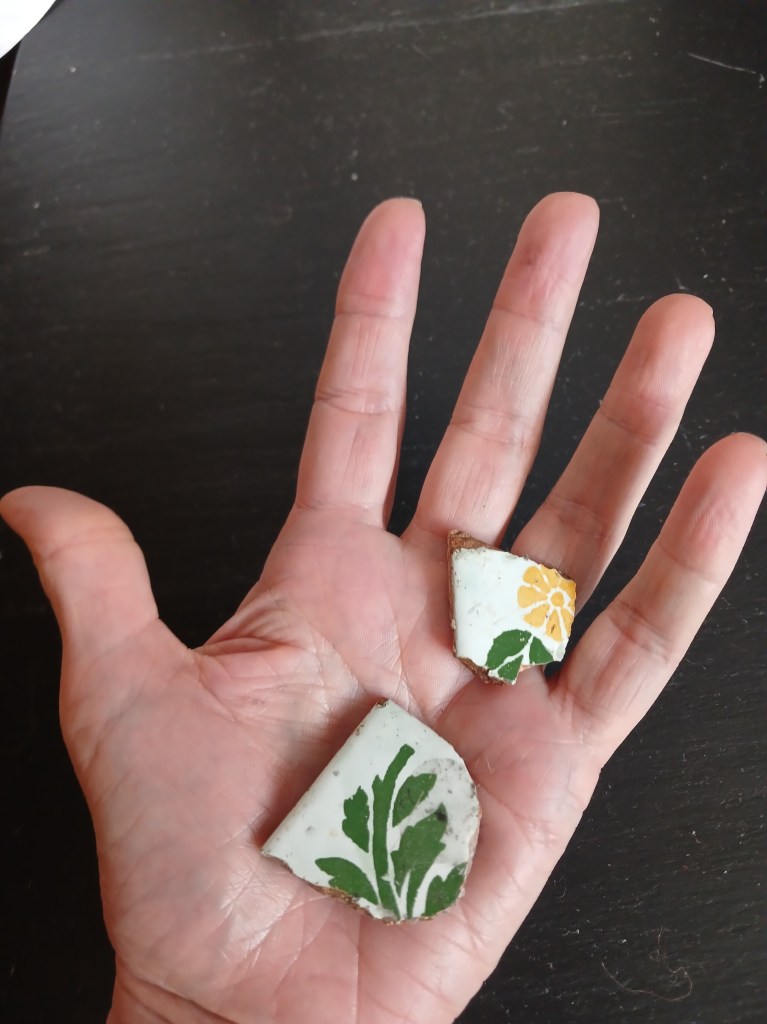
Further along are broken pieces of ceramics. I pick up a couple of pieces with a yellow and green flower design. From their thickness, and a straight edge to one of the fragments, I guess they are from a tile. My pockets are shallow, but room enough for these relics. The pattern is simple, the leaves and flowers too abstract or naïve to identify a species, but a floral pattern in tiles has a symbolic significance. Stylised flowers and leaves symbolise fertility, growth, the beauty of nature and abundance. It is time to run back with a pocketful of fragments, broken symbols and memories chased after like dogs chase after conkers.
Lisa Kelly’s The House of the Interpreter (Carcanet) was a PBS Summer 2023 Recommendation. Shortlisted for the 2024 Forward Prize for Best Single Poem – Written, she was a 2025 judge. She is an AHRC-funded PhD researcher at the University of Birmingham, exploring the climate crisis through British Sign Language.
 Modron Magazine