Community articles seek to build solidarity using art and culture to tackle ecological crisis, as well as providing models for new community projects. Here Eve Ruet describes the use of writing and drawing workshops to draw attention to and process our feelings about endangered species.
Biodiversity is declining at an alarming rate, yet only a few endangered species – such as polar bears, penguins and pandas – capture the headlines, while most extinctions happen out of sight. According to the International Union for Conservation of Nature’s ‘Red List of Threatened Species’, 41% of amphibians are threatened with extinction, as are 37% of sharks and rays, and 36% of reef-building corals, for example.
This project uses the power of poetry and art to increase public awareness of, and engender greater empathy for, less visible endangered animals. Working in collaboration with the Natural History collections of the National Museum Cardiff (led by Jennifer Gallichan), a team of Cardiff University researchers (led by Dr Christina Thatcher and Dr Lisa El Refaie) ran three creative writing and drawing workshops for adults in Cardiff in February and March 2024.
In the workshops, the participants, many of whom had little or no training in or experience in creative writing or drawing, were guided through a series of carefully structured activities. These involved responding to the specimens of endangered animals selected by the Museum’s team, including a white-clawed crayfish, pink sea fan, noble pen shell, scaly-foot gastropod, and hawksbill turtle. Participants were invited to observe, describe, and draw these animals from different angles. They were also asked to imagine what it would be like to be one of these creatures and, through writing, try to capture what it might be like to experience the world through their eyes and ears. Their shapes, colours, and sizes of these animals inspired participants to write poems and prose like the following piece on the rainbow leaf beetle.

These creative activities also sparked fascinating discussions infused by the knowledge of the curators. Did you know that the tree pangolin is being hunted for the medicinal properties associated with its scales? Or that the scaly-foot gastropod is made of iron? Questions about the definition of ‘endangered’ animals, why humans tend to be more interested in vertebrates than invertebrates, and our responsibilities towards the natural world were discussed with passion.
One activity focused on the power of metaphors. First, participants made a list of some of the objects they could see around them. After choosing three of the objects in their list, they wrote the name of one of the endangered animals and the word ‘is’, followed by the three objects. This resulted in many different and surprising metaphors, such as ‘the water vole is a water bottle’ and ‘the pink sea fan coral is a stack of pastel[-coloured] chairs’. Participants used these metaphors to inspire creative writing and to explore ways of representing these ideas visually, as can be seen in the example below. This participant discovered a startling link between water voles and water bottles through their creative work: They are both ‘full of life’ but they are often treated as worthless by many humans.
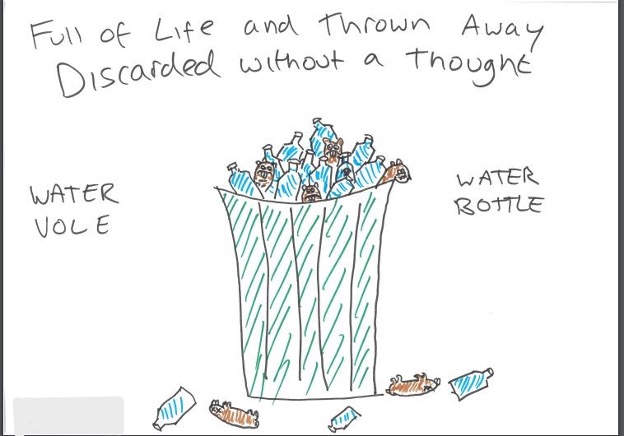
A few weeks after the workshops, we conducted interviews with some participants to find out more about the workshop’s impact on their feelings about endangered animals, and their attitudes towards nature more generally. One of the participants described how the workshop had ‘enhanced their knowledge and understanding’ of endangered animals, adding that: ‘if you follow climate change, which is now [a] massive topic and issue, it’s just something you can’t avoid.’ Another participant shared that they had started litter-picking since the workshop.
We are now working on enlarging the scope of our project. The next step will be to create a workshop toolkit with detailed instructions and guidance, for any individuals or organisations who would like to use creative writing and drawing to develop greater understanding of, and empathy with, endangered animals and to trigger positive action for the planet.
If you are interested in learning more or discussing anything related to this project, please contact Dr Christina Thatcher at the following email address: thatcherc@cardiff.ac.uk
Eve Ruet is a PhD student in Sociology at Cardiff University working on Wales, Welsh identity and photography.
Christina Thatcher is a poet and academic, whose work focuses on creative writing as a therapeutic or wellbeing intervention in a wide range of community settings.
Elisabeth (Lisa) El Refaie has spent much of her academic career studying the communicative potential of metaphor across different modes and media.
 Modron Magazine