Out of the Forest Killzone and into the Corn Crop Ambush

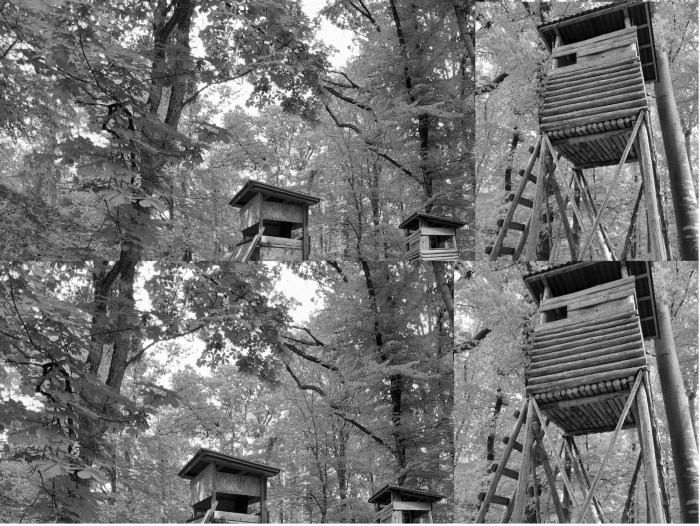
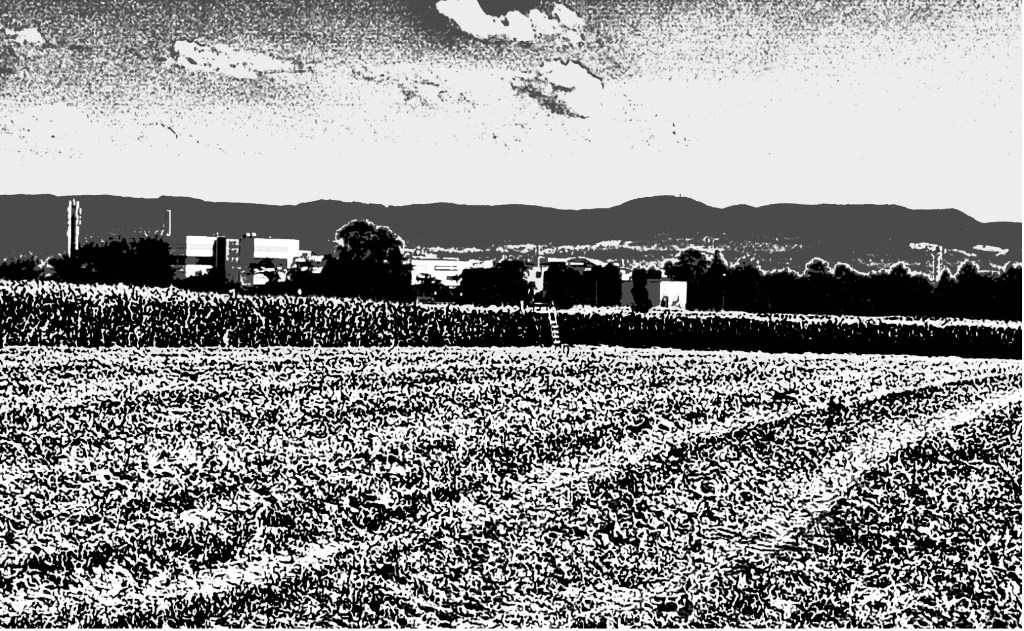
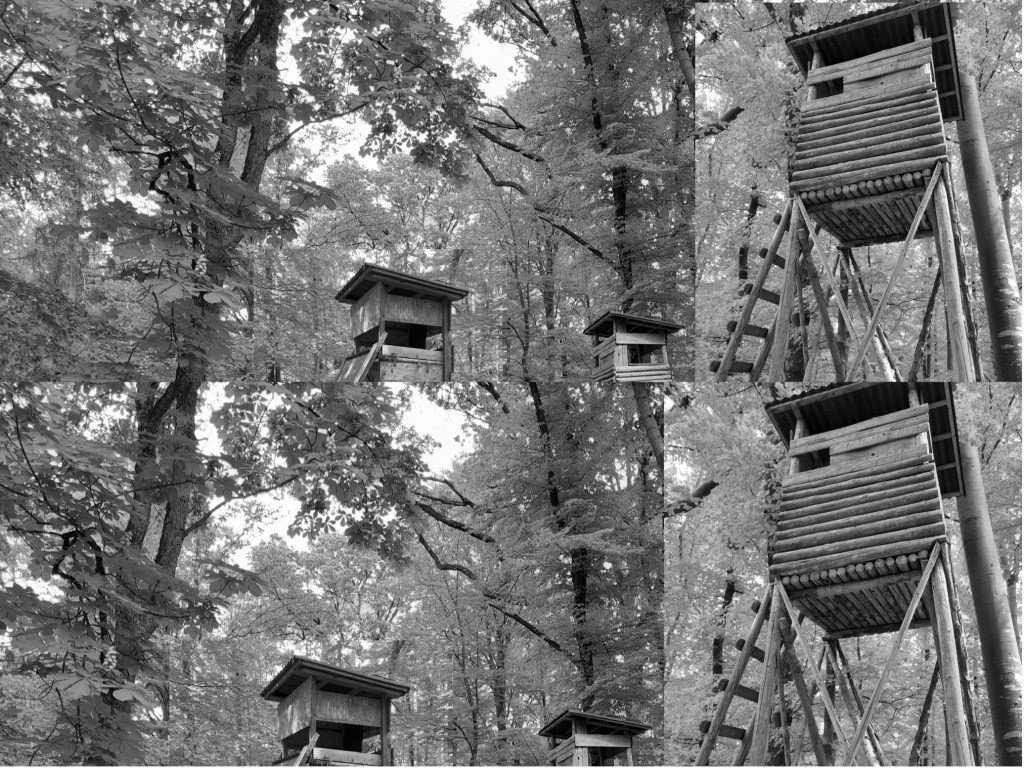
This sequence was written summer 2023 when we were living in Tübingen. I walked the paths north to and through the forest of the Schönbuch most days, and to enter the forest I passed this field which at that time was under crop with corn. As the corn started to fruit it was demarcated by an electric fence which was quickly augmented with a shooting tower. I had wondered why a substantial indent was left in the crop pattern, and then realised it has been set up as an “ambush” area to entice foraging wild pigs, who once drawn in would be in sight of the tower.
There are many such towers along the edges of the forest all over the region, and also set on paths inside the forest itself. Given the number of people who walk these paths, especially the ones leading up and around the forest areas, it is astonishing that there aren’t shooting accidents even more frequent than there are. And of course, the shooting of pigs and deer is no accident, and carefully planned as a military operation.
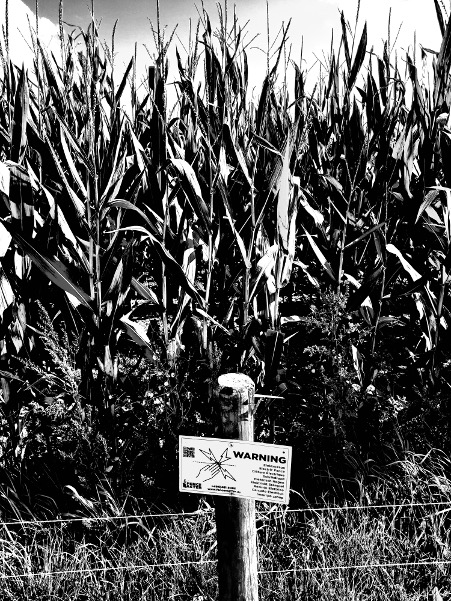
The language of recreational hunting is mixed with the classic faux-capitalist deployments of “tradition”, and “management” of pigs and deer, whilst simultaneously ensuring the availability of animals for this recreational pursuit. I find it an offensive, abusive, and exploitative “past time”, that needs calling out for what it is. Many people are exposed to its physicality and language of slaughter without really taking much notice beyond, maybe, following the warning signs to be wary of shooters.
The forest, with those towers — shooting platforms/hides for surveillance — “becomes” a prison camp for animals, and the panopticon is reformatted so the abused animals, following their natural trails, are “guided” into the killzones. The garb of the hunters fits with the attempted de- and re-languaging of the forest itself so it is reformulated into the “tooth and claw”/blooding scenario of a “natural mode”. With their sophisticated “sports” weapons, care of the arms industry and the fetishisation of death, and their morphing of the solitary (hunter) with the group (club), these hunters play out deadly fantasies dressed up as “ecology” — desecrating, killing, exploiting the forests.
As part of my “life-long” Graphology work, this poem-photo-essay-cycle is a tracing out of observation and immersion in an attempt to find a poetic language of non-violent resistance. Writing about these things isn’t enough — other forms of intervention have to take place, but the poem (cycle) can be part of this process of disruption.
To draw attention beyond the obvious is something figurative language can do. People walk past these “arrangements” and “configurations” — some registering disgust, others just wary of the electric fence for themselves and their pets, others taking no notice at all, its reality having been absorbed into the familiarity of conducting their own lives. The “off”/low-fi approach to the photographs is very much part of the ambience of “camouflage”… of not seeing fine detail to replicate the denial and avoidance, and also to encourage the viewer to look more deeply into the forest of words. The proliferating towers are like cubby houses of childhood dragged into adult life to gain control over the fantastical, to render all life subservient to the “sporting” compulsion. It is disturbing on so many levels.





Find an accessible Google doc version of these poems here.
John Kinsella‘s recent publications include the three volumes of his Australian collected poems: The Ascension of Sheep (UWAP, 2022), Harsh Hakea (UWAP, 2023) and Spirals (UWAP, 2024). Other poetry books include Drowning in Wheat: selected poems (Picador, 2016), The Pastoraclasm (Salt, 2023) and Graphologies (Arc, 2023). A frequent collaborator with other poets, writers, artist, musicians, and activists, he lives on Ballardong Noongar land at “Jam Tree Gully” in the Western Australian wheatbelt. A recent collaboration with Kwame Dawes is UnHistory (Peepal Tree, 2022). He is a committed environmental and rights activist.
 Modron Magazine