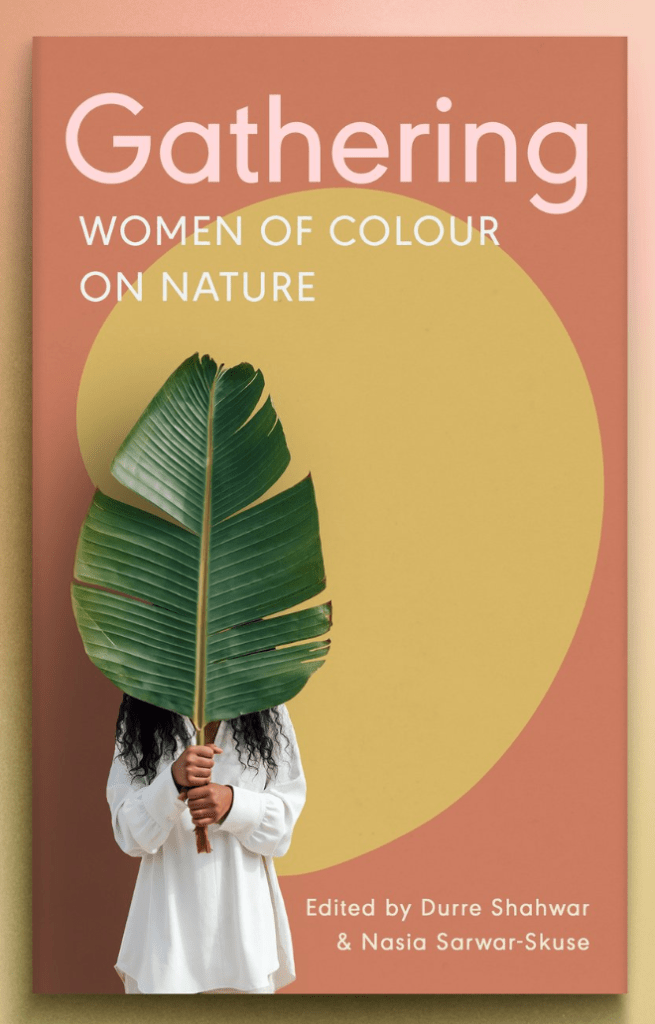
Gathering is a much needed and anticipated environmental anthology edited by two of Wales’ most exciting new writers, Durre Shahwar and Nasia Sarwar-Skuse. I have been looking forward to reading this collection, and the result does not disappoint. I would go as far as to say that this is a necessary and important reader for anyone interested in environmental movements and combatting ecological crisis. The essays (and some poems too) include a fascinating variety of outlooks and approaches, and it combats the tendency in publishing to promote white voices writing about the environment over writers of the global majority. This is a rich and inspiring anthology full of wisdom.
I want to talk in detail about the essays and poems, because every contribution is enriching and illuminating. Louisa Adjoa Parker’s ‘A British-Ghanaian in the West Country’ begins by challenging the “somewhat romanticized view of rural Britain” which “has long been presented as a space which is inhabited by – and exists purely for – people who are white”. Adjoa pushes back against the idea that “African, Asian, and other global majority heritage people are purely urban dwellers”, describing in detail her happy memories of the natural world in Devon and Dorset, as well as microaggressions, abuse, and racist jokes from white friends. Later in the collection, Khairani Barokka’s long poem ‘an ecostory’ uses an anecdote to show how much weight white voices carry in academic environments, compared to people of the global majority:

Thinking about another aspect of whiteness and nature, Taylor Edmonds opens by describing how stepping into a Cornwall pub feels riskier for her than for her white, Gloucestershire partner who “knows their language”. Edmonds describes joy and fear on entering natural spaces as well as memories and questions in tracing her grandmother’s Scottish roots to places that may in future be underwater due to rising sea levels. [We are proud at MODRON that Edmond’s poem ‘My Magnolia Tree’ inspired by this journey was published in MODRON Issue 1.]
Equally inspiring and fascinating is biologist Jasmine Isa Qureshi’s account, ‘Nature is Queer’, which offers a great introduction to queer ecology, turning away from ‘heteronormative binary bias and anthropocentrism’. The commentary is convincing in arguing that roles assigned to us are not based in nature or biology but are socially constructed. It is also moving to read how nature “helps us to understand our own queerness”, given that it “defies the ‘facts’ of gender and identity that have been forced upon us as humans”.
Considering food production, Maya Chowdhry’s ‘In Relationship with Sugar’ is not just an essay but a whole sensual experience with instructions and a QR code that takes you to an audio track. The point of the essay is about the production of sugar and its connection to transatlantic slavery and capitalism, and this daring, innovative text forces us to think about where our food has come from today and historically.
Sharan Dhaliwal’s essay on ‘The Nature of White Sustainability’ was particularly fascinating, looking carefully at Western culture’s consumption and commercialization of indigenous ideas and practices. Dhaliwal refers to “power systems created on the back of colonialism and imperialism”, pointing out that “racism is deep rooted in environmentalism”. Dhaliwal highlights the gentle consumption practiced by indigenous communities and how that is coopted by capitalism, e.g. turmeric in “fancy packaging” is now a desirable health commodity. Altogether, Dhaliwal offers a passionate and inspiring case for pushing back against capitalist notions of what sustainability should be.
Some of the essays explore religion and spirituality. Alycia Pirmohamed’s ‘The Stones of Scotland / (a)version’, recounts how, during the COVID-19 pandemic lockdown and Ramadan, she felt a need to be close to Islam and to nature. Contemplating the Scottish landscape, she considers what belonging means to a family whose “ancestors were forced by the wind and arrived elsewhere”. Sofia Rehman’s ‘From God We Come and To God We Return’ was truly enlightening in its analysis of the Qu’ran’s teachings about nature. Rehman demands “an ethics of care and reconnection to nature”, spiritual in form. This doesn’t necessarily mean being Muslim, but it does mean turning back to spiritual principles that value and cherish the natural world. Adéọlá Dewis turns to the Yoruba belief system, which teaches “that we are nature”, adding “As above, so below. What is outside is also inside”, before recounting rich and enduring memories of growing up in nature in Trinidad.
Negotiating the harsh environment of academia and the frustrated desire for a career in paleontology, Katherine Cleaver documents how study and work can throw up intimidating barriers separating neurodiverse people from a career devoted to nature. Cleaver goes on, however, to become an archaeologist, stating “I no longer simply walk in nature; I exist in it.”
Nature as a comfort in difficult times is a strong theme in the collection. Nadia Javed, a self-described “Muslim punk” replaces the high of “being on stage and having an audience in the palm of your hand” with experiences of nature and a slower kind of living. Javed, however, rejects the idea of nature as “healing”; she is not broken, but “just trying to survive in a capitalist world”. Writing in the context of illness, Durre Shahwar wisely asks “who gets to define what nature is and what it does for us – who gets to access it for healing, who gets to write or create art about it?”. Shahwar turns to Sufi poems and music and their emphasis on the peace found in simple experiences of nature rather than the extremes represented by Friendreich’s Romantic painting of a mountain climber, Wanderer Above the Sea of Fog.
Survival is key for Susmita Bhattacharya who describes her interactions with nature during treatment for breast cancer. Bhattacharya finds solace on Dartmoor and begins writing poetry – some very moving poems included here – as a way of making sense of her treatment. Similarly, Tina Pasotra overcomes a difficult depression by visiting and swimming in the sea. Far more moving and complex than the commercialisation of “wild swimming”, Pasotra’s reflections ponder a family journey from the Punjab to Luton and through a daring choice by Pasotra’s mother – to Wales.
Some essays explore specific aspects of nature. Hanan Issa’s eloquent hymn to trees, ‘The Sacred Arbor’, moves from the crying tree of Islamic history to the Qur’anic Tree of Immortality/Everlasting Life to the Mayan Yaxche tree, to Yggdrasil, and the “Cau Goddeu” (Battle of the Trees) in the Book of Taliesin. Kandace Siobhan Walker offers an experimental essay – actually a set of mini essays drawing on everything from Braiding Sweetgrass to Spirited Away – in which trees also feature:
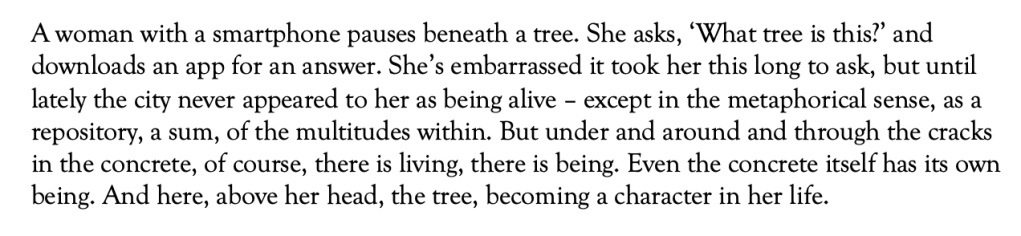
Walker’s pantheist miniature story could be an allegory for all of us, as in this time of crisis and in the context of technology developing inevitably quickly, we begin to realize how deeply connected we are to nature, as like us, the world is alive; how we realize that we ourselves are nature and the separation falls away.
I could write much more about each one of these essays as every contribution is a gem full of insights, wisdom, and new perspectives on environmentalism. I cannot praise Shahwar and Sarwar-Skuse enough for the group of writers they have brought together here. Gathering is a deeply rich collection which I will be reading and rereading as a comfort in the face of ecological crisis and as an inspiration in working towards mitigating it.
Zoë Brigley is a founding editor of MODRON. zoebrigley.com
 Modron Magazine