Interview by Glyn Edwards
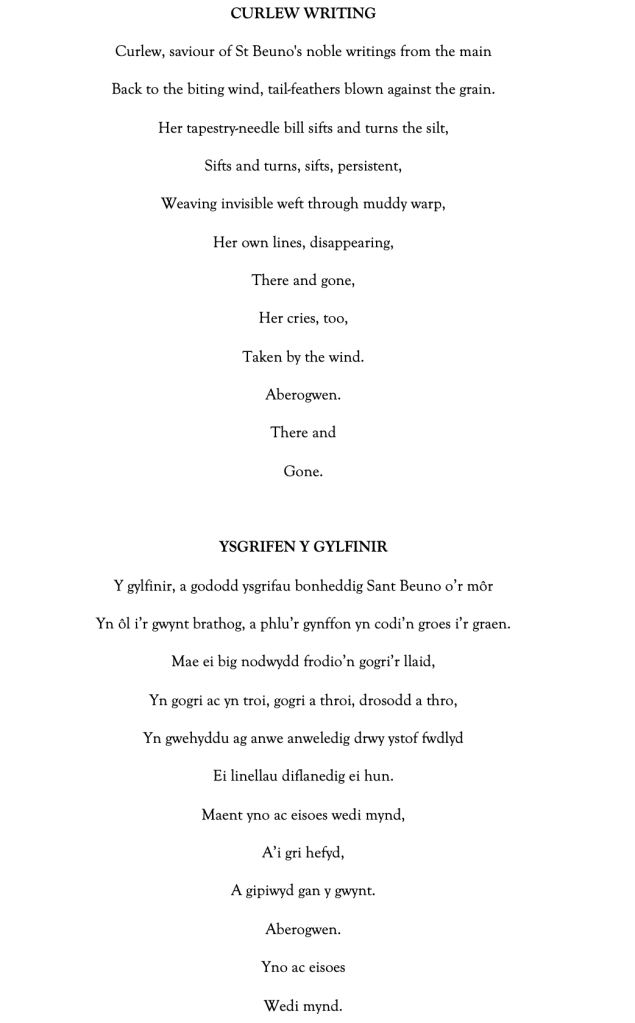
Glyn Edwards: In the first line, the curlew is ascribed the epithet ‘saviour of St Beuno’s noble writing’. Can you elaborate on the nature of this myth? Does mythology feature as a central theme in your writing?
Wendy Dossett: The poem draws on the Welsh folktale about a curlew rescuing St Beuno’s book of sermons when it fell into the sea during a miraculous crossing the saint made from the Llŷn Peninsula to Ynys Môn (Anglesey). St Beuno is actually best known for being the uncle of Gwenffrewi (St Winefride), celebrated at her holy well in Holywell, North Wales. The story goes that Beuno raised Gwenffrewi from the dead after her brutal decapitation by a thwarted suitor. The myth is fascinating for the ways it shapes expectations around gender. It can be read in multiple ways of course, but one way is that it upholds ideas of women’s sexual purity and male power and agency. I read the curlew myth as another type of myth altogether, one that figures the natural world as subservient to a religious meta-narrative. There are many examples of such tropes – the animals in devotion in the nativity of Jesus, the story of cattle-trampled corn miraculously standing up again for the young Guru Nanak. The Beuno curlew story is not about gender at all. However, I’ve introduced that lens into the poem because his life raises gender questions for me. Gwenffrewi does not lack agency. She heroically resists her rapist at the cost of her life. But ultimately the story is one of male power. She is both killed, and then miraculously raised, by men. Beuno is an agentic male, with the power of religion on his side. His power is associated with words and writing. I wanted to give voice to the silent, obedient curlew in that story, and try to imagine her daily life as also articulating, speaking, writing, weaving, creating.
Glyn: The poem’s title exploits a dexterous gerund, so the semantics of ‘writing’ function neatly as both verb and noun. To what degree is this ‘writing’ about a curlew, and to what extent is the bird itself ‘writing’?
Wendy: That’s a wonderful way of putting it! Yes, it’s both. And I’m also asking questions about what writing is. The poem figures the curlew as both a writer and as a weaver. Tapestry needles are curved like the curlew’s bill, and I imagine her weaving something precious, just below the level of human consciousness. That image comes from spending time watching curlews on the mud-flats at Aberogwen, near Bangor. They’re feeding of course, but I was struck by their industry and an impression of their creativity. It’s perilous to anthropomorphise wild creatures as it’s trying to make them conform to a human blueprint. But watching with the Beuno story in my mind, I felt awe that the curlew was prepared to set all her own work aside to save the writings of this apparently saintly, greatly celebrated, but clumsy human man. The vanishing of her work in the mud is contrasted with the permanence of his written words. I’m hinting at the indelibility of male-assigned work and the invisibility of female-assigned work. His articulate ‘words’ are contrasted with her inarticulate ‘cries’. Yet, she’s what stands between his work and destruction. Not only does she save his writings, she communicates, tenaciously, in her own language, weaving her own disappearing story in the mud. The poem is an attempt to convey something of her tenacity and creativity, but also her fragility. ‘There and gone’ is the story of so many species at this time
Glyn: Migratory birds make perfect metaphors for the transitory aspect of seasons, but here the curlew’s presence seems to work appositely with the myth. Both are ageless, both are ephemeral. Do curlews as a species hold particular significance to you?
Wendy: There is something about what they look and sound like that captures my imagination. I also love that they come back to us here in North Wales in early autumn, when the swifts and swallows are gone, the nights are drawing in, and it can sometimes feel like there’s not much to hope for. We’re already experiencing the multiple joys of late spring when the swifts come. How wonderful to feel the joy of the return of the curlews when we most need joy. My heart just sings when I hear their bubbling cry. However, the idea that our generation is potentially overseeing their decline and journey towards possible extinction if nothing changes, is a source of sadness. In 2024, the Slender-billed Curlew was declared ‘Probably Extinct’, and the Common Curlew remains on the Birds of Conservation Concern Red List. The charity Curlew Action does much important awareness-raising and conservation work, and our own North Wales Wildlife Trust that cares for the Llyn Celanedd Reserve at Aberogwen is a crucial support to the curlews who overwinter in that beautiful spot.
Glyn: ‘Curlew Writing’ was kindly translated into ‘Ysgrifen y gylfinir’ by the poet and academic Eurig Salisbury. As the translator ‘sift(ed) and turn(ed)’ English into Cymraeg, did he encounter any aspects of the poem that struggled to ‘be taken by the wind’ during the process?
Wendy: Oh, nicely put! As you can imagine, I was absolutely thrilled that Eurig was willing to do this translation. Readers will know he’s a renowned poet, a hugely celebrated expert in the poetic art of cynghanedd, and one of Wales’s senior literary figures. It also turns out that most of the available English language material on St Beuno (writings attributed to Beuno, historical records and myth sources) have been translated and put into the public domain by Eurig himself as part of the Seintiau Project. I couldn’t have wished for a more perfect translator for this poem. As a new, inexperienced and untrained poet, I’m deeply honoured. I was so delighted that he was able to maintain the shape of the poem on the page. The shape is meant to signal disappearance. The curlew’s ‘writing’ disappears in the mud, below consciousness (contrasted with human’s indelible writing), and the curlew species itself is disappearing. After he translated the poem, Eurig did let me know that gylfinir (curlew) is a masculine noun in Welsh. I figure the curlew as female in the poem. Of course, not all curlews are female. I’m figuring her as female because I want the poem to reflect on human gender relations. As a Welsh beginner, sadly I can’t hear how awkward my female-figuring sounds. But not being able to properly hear someone’s language, despite yearning to, is part of what the poem hopefully conveys. Afterall, none of us hears the curlew’s language. It’s strangely pleasing to me that there is a translation problem, because that resonates with the principal message of the poem; namely, an invitation to listen to the quieter and more difficult to understand voices, despite the barriers to hearing.
Wendy Dossett is a former academic and a new poet. Her work has appeared in Performing Recovery and online with Northern Gravy. She has four poems in the new Northern Gravy Anthology, edited by Ralph Dartford, published by Valley Press, 2025. Her themes include grief, desire, trauma and nature. She performs occasionally on the North Wales open mic circuit.
Eurig Salisbury is a Welsh poet, novelist, and lecturer in Creative Writing at Aberystwyth University, known for his published poetry and prose, international literary work, and roles as Welsh Children’s Poet Laureate (2011–13) and Aberystwyth’s first Town Bard.

