Interview by Zoë Brigley
Welcome back to our series on writing the #MoreThanHuman. We offer a set of interviews with poets and writers on how they approach writing about the environment. The more-than-human is a phrase that seeks to side-step traditional nature-culture dualisms and draw attention to the unity of all life as a kind of shared commonwealth existing on a fragile planet. It also reminds us humans that there is more to life, that there is more world, than the human. It relocates us in relation to the mystery.
Here, we meet meet Lauren, a writer published in various print and online publications including Magma, The New Welsh Review, The London Magazine and Poetry Wales. She won the Live Canon international poetry competition, 2025. She is the Co-Editor and co-founder of Black Iris Poetry. Her pamphlet, Tiny Glories is out in May with Green Bottle Press and her micro-chap, Lavender Hill it out in June with The Braag.
A History of My Father as the Arctic
Zoë Brigley: Maybe we could begin with you telling us more about the story of Pytheas and how you came across it?
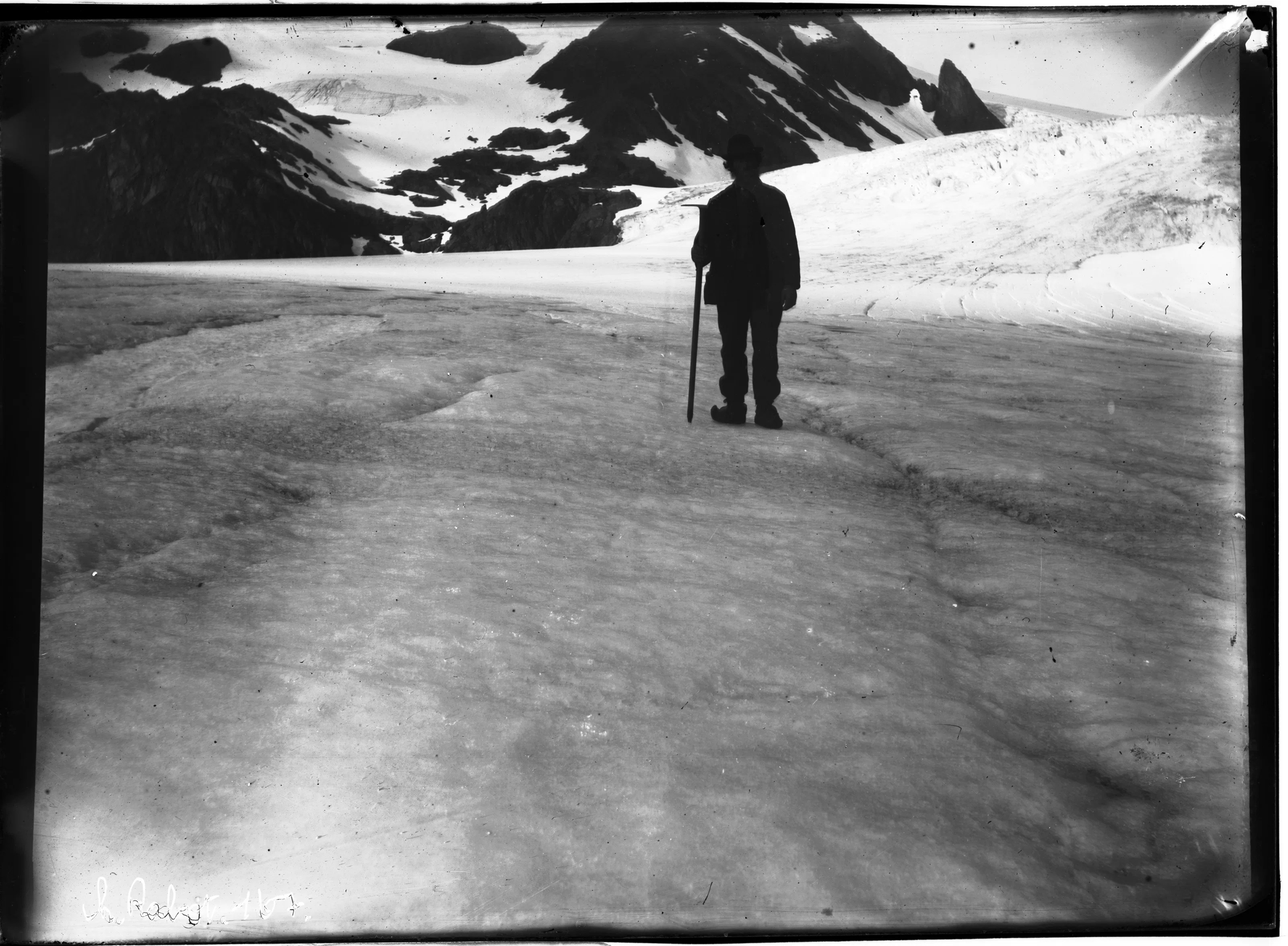
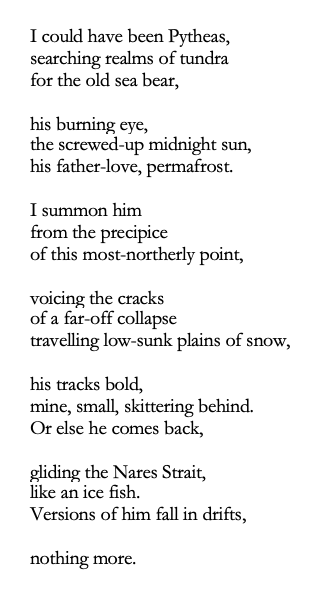
Lauren Thomas: I wanted to include a character from a far-flung time because this is a poem that tries to travel a great distance. Pytheas was a Greek navigator who lived more than 2000 years ago. He was reportedly one of the first people to travel to the Artic and write about what he saw. I was interested in his story because his was a lonely discovery; he had to return to ancient Greece and explain that he had seen this land of snow and ice, and no one really believed him. His experience must have felt very isolating, which fitted with the voice in this poem who is also in an alien landscape, trying to find a means of explaining it. I also wanted to reference mythology and storytelling, as this poem comes from a sequence that thinks about the stories we may tell ourselves, in terms of our own understanding of the world and our relationships within it.
Zoë: It’s an interesting comparison here to have the child and the father compared to the Human and the Arctic, and there is an implication too that there is a potential loss in store for the child and for human beings. That’s a moving way of signalling how serious the loss is, and I wonder if writing is a way for you to come to terms with loss?
Lauren: I think in times of great loss, which we are seeing globally, it seems impossible not to write it, but that can be a difficult thing to do when things are on such large scale and magnitude and manifesting in so many different ways; any attempt can feel trivial or glib. This poem looks at a small personal loss, relatively speaking, perhaps the change in a relationship between a parent and child over time, or the loss of an idea of something, which is in fact mythical and constructed through memory. Those sorts of losses are of course, profound for the individual. By setting the poem in the Arctic, an ecologically fragile landscape, which is at threat and receding, there’s an attempt to reference the scale and impact of loss that so many are facing on a global level, the last line, probably sums up the poem’s failure to do so.
Zoë: There always has to be a balance when writing about nature in terms of representing it as its own thing, irreducible to what humans might project onto it, and then the overlap and synchronicities of our experience with the natural world. I guess what I am wondering about is how we balance writing about us humans (a part of nature) and nature more generally?
Lauren: I agree. I think when I am writing using the natural world as a setting, I try to reflect the autonomy it has in the wild. If connection happens, I want it to happen organically and not in a contrived way. I heard Linda Gregerson describe eco-poetics as a framework that exists in a realm where poems discover in the process of their making their own ecologically centred meditation or conversation.
A good example of how I came to understand this concept came after a visit to the Wetlands in Newport. Spring was barely evident except for the white blooms of hawthorn against the sky and the call of a Curlew came in off the salt-marshes, as a group of us were walking to the shoreline. There was something prehistoric about it that connected very deeply inside of me and it helped me appreciate how we can use eco-poetry to explore the temporal nature of humanity, which the Curlew’s call encapsulated.
I enjoyed the connection from past to present in it and when I wrote about it, I was intending to use it as a metaphor for the brevity of individual human existence, but what I realised during the writing of it, was that the call represented the natural world’s existence absolutely on its own terms, without submission to human order. In the same way in this poem, the setting of the Arctic landscape is ambivalent to the process of the personal loss happening within it and yet the connection comes through both subjects being landscapes of extinction. So, I think from my perspective, the balance comes naturally.
 Modron Magazine