Interview by Zoë Brigley
Welcome back to our series on writing the #MoreThanHuman. We offer a set of interviews with poets and writers on how they approach writing about the environment. The more-than-human is a phrase that seeks to side-step traditional nature-culture dualisms and draw attention to the unity of all life as a kind of shared commonwealth existing on a fragile planet. It also reminds us humans that there is more to life, that there is more world, than the human. It relocates us in relation to the mystery.
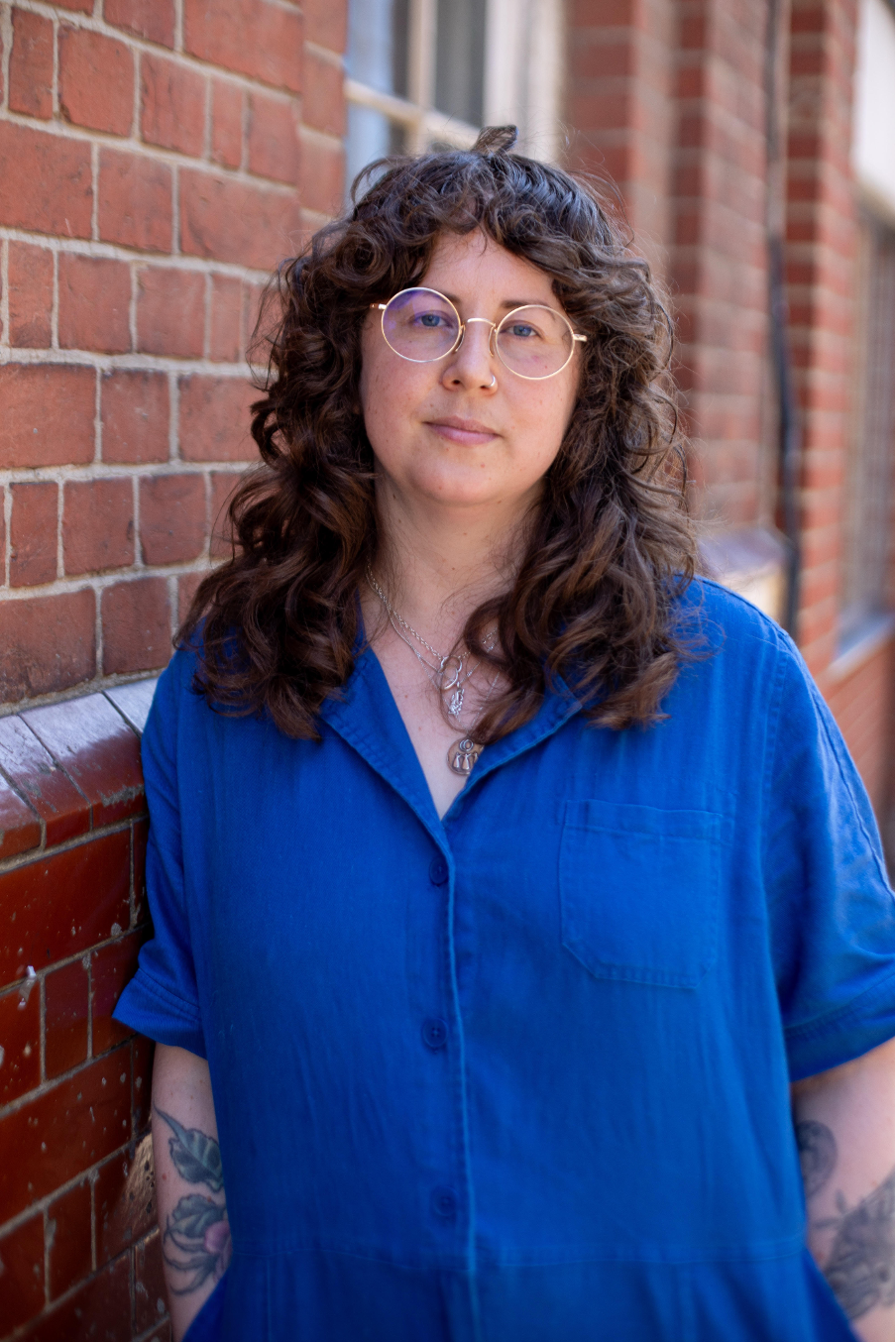
Here, we meet Gray Harper, a queer, disabled poet living in Brighton. Their work has appeared in Ache, Ambit, Magma, Poetry Wales, The Emma Press Anthology of Love, The North, The Poetry Review, The Rialto and The Scores, among others. She won the Bridport Prize for poetry 2013.
here the trees lit up with absence
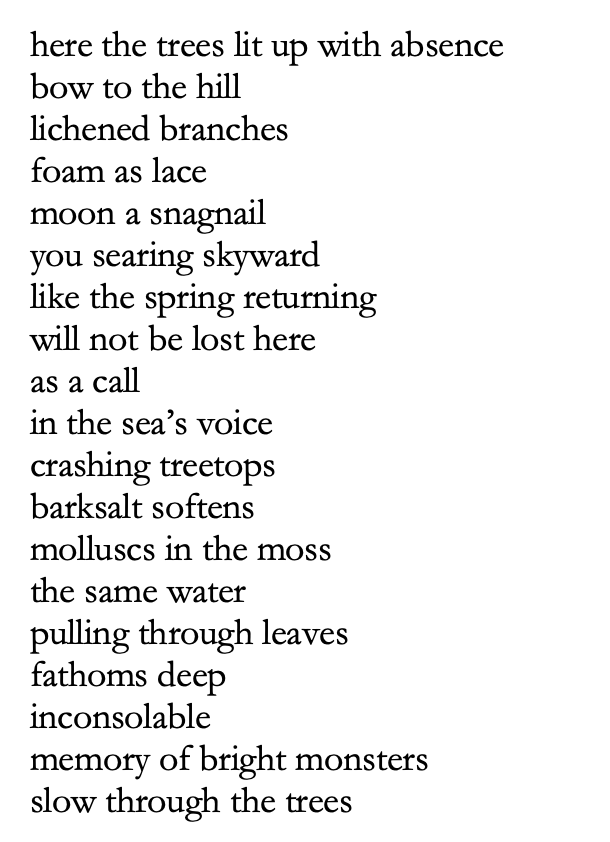
Zoë Brigley: I love the strangeness of the imagery here, as I am often thinking about the impulse to domesticate nature, to humanize it and make it like us and more familiar. I like that nature is allowed to be strange here and I wonder if you could talk to that?
Gray Harper: I think a lot about the fact that all of life contains the monstrous and unnerving, that there are places within ourselves that are as unknown and often scary to us as the deepest parts of the ocean – that we are living in a place we are still learning to understand, as more of it disappears. I think meeting the strange or (to us) monstrous and preserving its otherness connects us to our kinship and solidarity with nature, as a move away from the idea of humans having an inherited dominion over the natural world. The urge to familiarise or domesticate nature often echoes our attempts to domesticate or control ourselves, comes from an assumption that we are above or separate from nature – something else entirely – which I want to resist.
Zoë: There’s also a sense of time passing, of history and the evolution of life. The ‘memory of bright monsters’ put me in mind of that I think. The world is so marvellous when you think about the miracle of existing. Is wonder part of what we need to register as poets focussed on nature?
Gray: I was thinking about the movement of life over the whole history of the planet – forests that used to be oceans, water sources that are drying up – and the strangeness or apparent lostness of living things and their ancestors or descendants, showing up in different places and different ways across the whole of time. I like the idea of the natural world holding physical memory in this way, the layering of epochs within the landscape, and wanted to play with the idea of this as a type of haunting.
My health has made me feel more apart from nature since the start of the pandemic. As a newly disabled city-dweller I find it harder to access places outside the built environment, and I know other chronically ill and disabled poets too who share this experience. In this separation from the land- and seascapes I love, it has become very clear to me that wonder is a vital part of my life, as well as beauty, colour, a sense of the immensity of time and of what is alive outside myself – and that parts of me do really stop feeling in a common aliveness with the world when I can’t locate myself inside its miraculous-ness. The moments I feel, and remember feeling, most alive are when I am experiencing wonder at the world and feeling part of it.
I am always reading poetry of wonder at the world, and I love Lorca on the memory of trees – “Trees! Will your tough roots know/ my heart in the soil?”
I think wonder is vital for nature poets because we need hope in order to keep going and preserve what we can. One of my favourite poems about the ecological crisis is Franny Choi’s Wildlife, and its conjuring of dead creatures back up from the earth – “each drop of oil renouncing its war draft and returning to its oldest names: muscle, stamen, tooth; shell”.
Zoë: The sounds in this poem are very resonant and deepen the sense of place. How do you go about recording the sensory experience of landscape? Is it observed, remembered or imagined, or all three?
Gray: This poem was all three – I wrote the first draft while out on a walk, and I think the sounds and atmosphere of the landscape blended with how I was feeling while I was there. I then edited the poem later, bringing out more of the elements I found interesting and using memory and more of an imaginative lens, as well as reading the poem aloud for sound. I like the way the sound moves through the lines in waves when read aloud, the same way the memory of the ocean crashes through the treetops, but I think this happened organically. I rarely intend assonances of sound and meaning in my poetry in this way, but I love that it happens sometimes. For me the main way to bring this about seems to just be becoming very present while in a place and paying sensory attention.
Zoë: Are there particular traditions (mythic, local, scientific, spiritual) that feed into your sense of the more-than-human?
Gray: As a chronically ill writer I have long underworld periods every year, so I am always drawn to the myth of Persephone and Demeter, and its story of the seasons’ constant movement through death and barrenness or rest, back through renewal, life and beauty. I keep Rossetti’s Proserpine on the wall where I tend to lie down, as a reminder of that connection, that living is experiencing change, that nature also has a yearly season of rest and that in resting I am part of that cycle not apart from it.
Lately I’ve been reading indigenous writers on traditional ways of knowing place and of being in reciprocal relationship with the land, writers like Leanne Betamasoke Simpson and Robin Wall Kimmerer. I’m reading Welsh, Scottish and Irish myths and folk stories too, I like the persistence of the archetypes of older women and solitary women, people often written out of modern stories.

