Reservation Pantoum
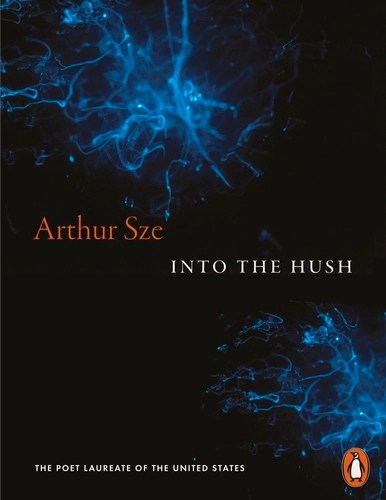
To celebrate the publication in the UK of Into the Hush (Penguin, 2026), we interview the US Poet Laureate, Arthur Sze.
MODRON: You are the US Poet Laureate at the moment. How do you approach moments of ethical and political urgency without tipping into being didactic or over-explaining things? How does that work?
Arthur Sze: I’ll be honest, because I think if one is preaching in a poem, a reader senses that immediately. And in the poems in my new book, Into the Hush, I felt it was risky to write a poem in the voice of a jaguar or a piece of eraser. I thought, I have to try it and see what I can do with it, because the idea is that we’re not alone on this planet, that the way the leaves flutter, aspen leaves shake on a branch – you know, if each word is a leaf, then syntactically maybe the motion of them… maybe there are sentences, maybe the tree is communicating.
That might sound a little new-agey, but actually, if you subscribe to the idea that all things are alive, connect, then the jaguar, even a piece of eraser, they have their own forms of being. So it’s using the imagination to give a possible voice.
Again, that’s risky, but it was worth attempting, because it was presenting an alternative to human-centered vision. I wasn’t trying to be preachy about it. I was trying to experiment with different ways of articulating forms of existence, of living existence on the planet, with a sense of urgency.
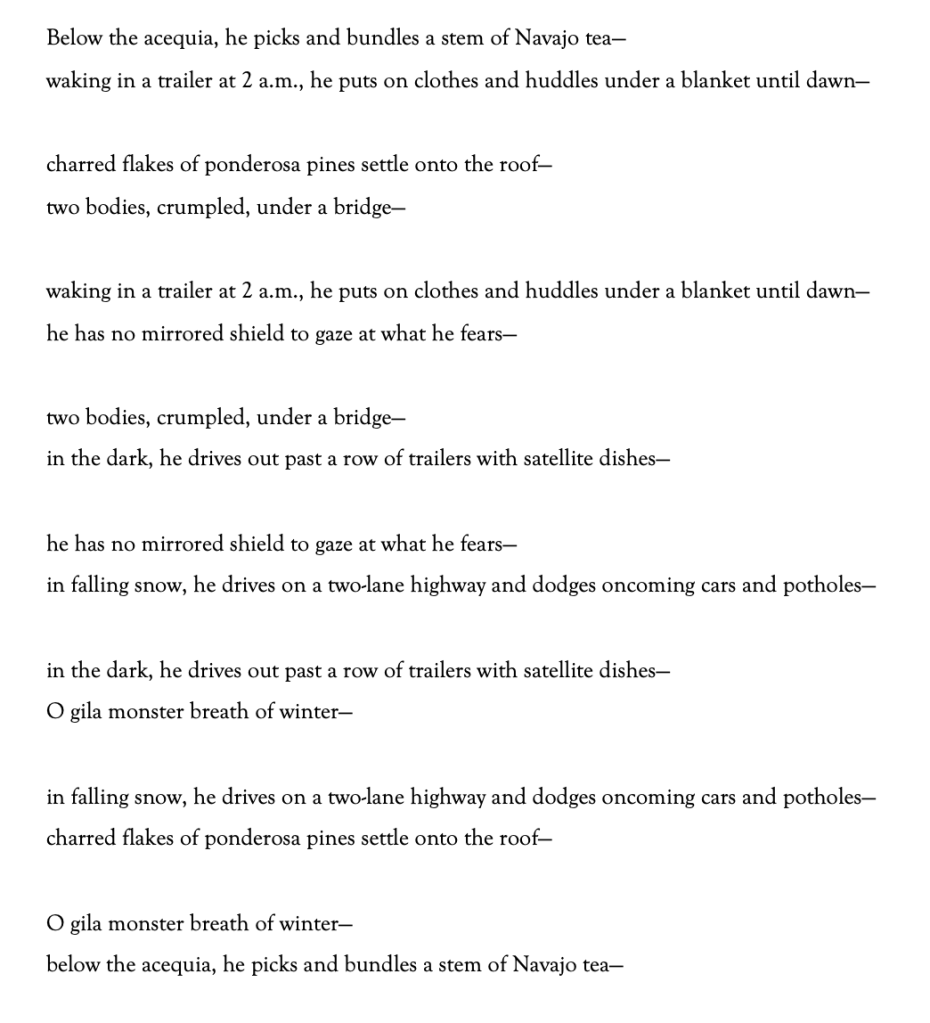
I also want to extend it too in terms of the forms. There’s an ekphrastic poem inspired by an architect’s practice of drawing watercolor. There’s a pantoum – my first two pantoums. Haiku is an Asian form. I’m not trying to call attention to the forms per se. I’m trying to say these forms present a way of thinking or a way of conveying experience that are worth considering and experiencing.
So they’re not so much for display as ways of articulating, ways of thinking out difficulties or issues. Like the pantoum, the way the phrases, the lines, have to repeat – to me there’s a sense of musicality. Then I introduced a pause, which was my innovation, inside of each line to change the location and the rhythm.
It’s like working inside of these different frameworks to, again, show that there isn’t one particular path. I wanted to celebrate many ways of pursuing the paths of poetry rather than one particular path.
MODRON: In your striking poem, ‘Before Completion’, you begin with someone looking through a telescope, and then someone puts a baby into a dumpster.
Arthur: Yes.
MODRON: The baby is rescued, and then there’s a question: “Is this the o, the little earth?” It is so rich – not judging anything, but just simply putting it forward for us to see. There’s an emotional richness, a feeling of shared humanity, or more than that, the shared feeling of being alive. You also move through different locations nimbly. In poems in Into the Hush, we have a Senegalese fisherman and then someone somewhere else making dumplings. We’d just love to hear you say more about that broad vision.
Arthur: In one sequence called ‘The Ginkgo Light,’ I have this fragment of a phrase, “succession and simultaneity.” To me that’s structurally two tensions in my work. I want to have a sense of multiplicity and simultaneity. I feel like that’s truer to the world we live in.
Wordsworth is a great lyrical narrative poet, and you can follow that thread, but our world is so much more simultaneous. It’s more like quantum physics, the idea of entanglement, where something happens here and it’s connected to something far away. You can’t quite see what the relationship is; there’s a kind of mystery and surprise, and I like that we don’t know, that we can’t know, and also that it’s simultaneous.
Einstein said entanglement is spooky action at a distance, which is a wonderful phrase – that things far away are intimately connected, and we can’t unravel exactly how they’re connected. There is this fundamental premise that things are connected below the surface in ways we can’t always see or anticipate. That’s one of my central obsessions. I want to have the worlds in collision without privileging one over the other, but also to show that the worlds, in tension with each other, also enrich each other.
I’m coming back to linguistics, but thinking of how English is enriched over time from Greek and Latin and French, and how many people know “avocado” comes from Aztec? Or “ketchup” comes from southern China, Malaysia to London – it’s like the trade route – and then to America, and now it’s tomato-based. In southern China it was a fish-based sauce. It’s like there are these incredible histories to words that we take for granted.
But there’s this richness of worlds in interaction with each other. They don’t always have to be thought of as in conflict with each other. I mean, sometimes they are, but they can also be enriching each other.
So one of the things I’m interested in is exploring that kind of multiplicity of the world and not really knowing or prioritizing one over the other, because if things are intimately connected, a very insignificant thing might be very profound. Of course, as poets, we know that we love that, right? Something you stumble into that looks innocuous is oftentimes the really powerful moment in a poem. When you try and write big, it boomerangs or something, or just is too unwieldy. If you write with a little surprising sliver or detail, it can really resonate and take your breath away.
MODRON: We were thinking about Into the Hush and forms used. A few of the poems have this refrain where they start with the word “when,” and it’s repeated and repeated, and it’s never quite resolved. The simplicity of that “when” continuing and continuing felt like the spirit of your poems: not quite completed, not quite worked out, but still going after the end of the poem almost.
Arthur: Yeah, absolutely. Well, in the last ten years, I started to write poems in monostichs, in one-line stanzas. That poem ‘Anvil’ that you’re referring to with “when” at the beginning of lines works because I wanted poems rich in imagery, but if I have one image after the other after the other, I can overload a reader. What I like to do, or recently have done, is have a line that’s almost like a microcosm, a tiny world. Instead of going on to the next image too quickly, I want a sense of silence or space where the reader can float it, absorb it, or live with it for an instant or microsecond before the next line comes. So there’s a kind of dance between sound and silence happening.
I want, obviously, the musical repetition, but the last line here is “the anvil on which to hammer your days.” For me, I’m trying to say (not in a didactic way) that all of these moments – when this happens, when that happens – they’re all floating, right? They’re traces that are floating with the winds. It’s like everything, all these intervals, are material for poetry that can be fashioned on the anvil. Here’s the anvil: your days. You can create poems. You can live through this.
The lines end with a dash. That can be risky if it’s done too often, but in my recent poems I often don’t have that period. In the early poems I could say, Okay, here, I’m done. There it is, period – I’ve said it.
Now I feel, No, I’m not in that space emotionally. I don’t feel like I have that sense of definition, that I get to the end and it’s floating. The dash is appropriate, where it just trails off again into silence, or to let the reader then have that space to step in or step forward and fill in through their experience.
MODRON: I was going to ask you about the dash at the end of the line, which is interesting formally, and, like you say, felt like a sort of rupture between that and the next line, right?
Arthur: Yeah, yeah. There’s a sense of incompletion, like it’s just hanging there.
MODRON: Into the Hush is coming out in the UK. You have had a long career, but to end our chat, I wanted also to take you right back. Did you know you were going to be a poet as a child? Or do you think that there were qualities that you had, or experiences that you had, that meant that you were going to be a poet?
Arthur: I came to poetry rather late. Most of my friends would say they were writing in elementary school, junior high school, high school. I had the experience in junior high school, in public school in Garden City on Long Island, of being very intimidated by poetry. We were cringing when we were reading Coleridge’s ‘Rime of the Ancient Mariner’” The teacher was like, Okay, now you’re going to write an essay on the meaning of the albatross. But it was all a setup. Even though we were supposed to be free to interpret, there was one particular slant she was looking for.
I never thought I would be a poet. I mean, my parents were immigrants from China. My father got his PhD in chemical engineering, so growing up as an Asian American in my family it was like, are you going to be a scientist or an engineer?
So in high school I had no idea what I wanted to do. I was good at math and science, and I applied to MIT and got there. When I looked at the math equations and stuff, I just rebelled against it. It’s like, I can do this, but do I really want to do it? Suddenly, I started to write. I just felt, this is what I really want to do. I was so excited and I was writing really bad poems [laughs] but still I was really excited about what could I do with language in my imagination.
In high school there was a class in my very last semester that was contemporary American poetry, so there were some seeds sown along the way. I remember reading Sylvia Plath, Gary Snyder, Robert Creeley, Galway Kinnell. I read contemporary poetry for the first time. I never thought I would start writing poetry, but that was a revelation to me, to think of living poets, rather than reading Coleridge or Wordsworth or Li Bai a thousand years ago, to suddenly be thinking of writing poems with a contemporary voice.
Arthur Sze is an American poet, translator and the 25th U.S. Poet Laureate, renowned for his meditative, imaginative verse. His twelfth collection, Into the Hush, has been published by Penguin in the UK, offering profound reflections on nature, silence and the modern world. He has won major awards including the National Book Award.
 Modron Magazine