Interview by Zoë Brigley
Welcome back to our series on writing the #MoreThanHuman. We offer a set of interviews with poets and writers on how they approach writing about the environment. The more-than-human is a phrase that seeks to side-step traditional nature-culture dualisms and draw attention to the unity of all life as a kind of shared commonwealth existing on a fragile planet. It also reminds us humans that there is more to life, that there is more world, than the human. It relocates us in relation to the mystery.
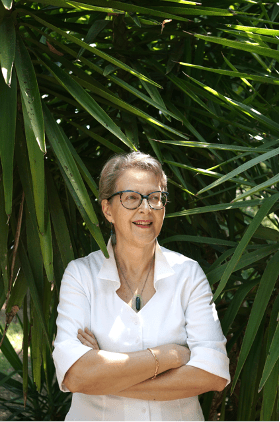
Here, we meet Anne Eyries who grew up in Scotland, worked in Paris and lives in Arles. She is a member of the French Online Stanza Group and has been published in various journals including Amsterdam Quarterly, Consilience, Dream Catcher, Dust, Humana Obscura, Ivo Review, London Grip and Paperboats.
A Brief History of Moss
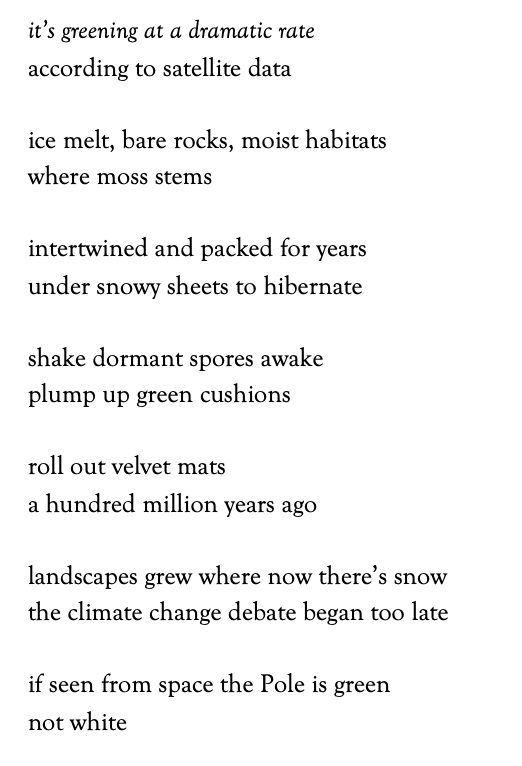
Zoë Brigley: I love the way that the moss becomes ominous here, because of what it signals about our warming planet. What role do you think poetry can have in signalling the vulnerability of our world in the face of ecological emergency?
Anne Eyries: I think poetry is possibly the best way forward to reach the masses and raise awareness without hostility. Look at poems by the National Poets. In “What the Clyde said, after COP26” by Kathleen Jamie, former Scots Makar, the river carries memories, questions and a warning. That poem sparked a group of nature writers to launch Paperboats with a Zine collection where each issue is themed to address an aspect of the ecological crisis. Take “Plum Tree Among the Skyscrapers” by Simon Armitage, current Poet Laureate, who says he has “made the environment a cornerstone” of his work. His poem too reminds the reader what our world was like, contrasting with what it has become.
Poetry competitions on ecological themes also provide – provoke – opportunities to think, write, read about our threatened world. The Rialto Nature and Place Competition 2025 attracted over 3,500 poems from 1,600 poets; whether wide-scale or at local level, poetry is raising awareness, spreading the word.
Zoë: When you write about the more-than-human world, what tends to come first — observation, emotion, or language?
Anne Eyries: To be honest, the story comes first. I began writing with short stories and non-fiction, then flash, and although I now focus almost exclusively on poetry, I realise that I still want to tell a story. Often I’ll see, or experience, or hear, or read something and I’ll find myself saying ‘there must be a poem in there’. If, collectively, this can be called observation, this is what will set me researching, and it’s the drilling down into the subject that will settle my emotion, so that when I start to write the poem itself, I’m thinking about the story and that’s what will drive and determine the language, the words and sound, alliteration, assonance, rhyme, rhythm.
Your question has pushed me to analyse my process and I think I’ve made it appear quite clinical, whereas in reality it’s more organic than organised. I might know what I want to write about, and have done the homework, but there’s always a large part of poetic mystery as to what story will unfold.
Zoë: How do you think about the responsibility of representing the natural world in poetry?
Anne Eyries: It raises challenges of accuracy, terminology and creating pertinent images – fresh, novel images rather than clichés. There’s a fine line between introducing readers to correct or scientific terms that can be understood by the context and using words that create obstacles to sense or flow.
I was on a poetry course where I shared a poem about a peregrine laying eggs, and I’d used the term brood patch which raised a whole debate about correct terminology versus layman’s language. (In the breeding season hormones trigger a bare area on the bird’s chest – the brood patch – to help keep eggs and chicks warm.) Perhaps there’s a moral to this as I kept brood patch and the poem has been accepted with it.
It’s likely that the poet writing about the natural world hopes that readers will empathise with the subject or message, and I think the poet has a responsibility to leave enough room for readers to develop their own emotions and questions about the poem; the poem should not only resonate with readers but also prompt reflection – that’s what will make the story meaningful and memorable.
For the poem – and poet – to be credible, it’s important to respect the subject’s inherent nature and to avoid overt or mawkish anthropomorphism. The two poems I mentioned by the National Poets are perfect examples of how to get everything right.
Zoë: The sparse couplet form works well for this poem with the bald facts outlined in nuggets of consequence. How do you decide on what form to choose for a poem?
Anne Eyries: If I want to write about something specific – like moss or peregrines – I can get carried away with the research and my first drafts tend to be far too long and over-burdened with findings, so I sometimes try to impose the constraint of a formal structure to keep things under control and focus on the precision of language. This poem started out as a very wordy sonnet, tightly bound by five end-rhymes, so when I shared it on a poetry course, the advice was to make it more implicit, more elliptical, get rid of the excessive rhyming, take out the punctuation and that couplets would give it room to breathe – in other words, back to the drawing board. Every poem, whether shared for feedback or not, is a learning experience and experimenting with form is essential. At any stage, simply trying couplets or tercets can show what and where words and lines work or don’t and can propel the poem through a sticky patch.
Zoë: Is there anything else you want to tell us about this poem?
Anne Eyries: I’m passionate about the Golden Age of polar exploration, interested in everything with a polar link, and spent three weeks in Antarctica. It’s no secret that I write what I call polar poems and this one stemmed from a poet friend sending me an article from the Guardian by Damian Carrington, Environment Editor. I was familiar with the basics but intrigued to know more about the life-cycle of moss and ended up with pages of pretty dense information to sift through. I was hooked by the idea of rhyming ‘dramatic rate’ with ‘climate change debate’; the rhyme is now toned down but the message still stands strong. Thank you for this opportunity to share it.
 Modron Magazine